
4 Things That Identify a Great Community

Tomorrow starts Cohort #12 of an amazing program created in Michigan called Shifting Gears that helps people through job transitions.  My involvement in the last year has been a blessing in many ways, not the least of which being the amazing team that I get to work with since starting as the lead facilitator of the program in June.

A cornerstone of the program is creating a community that supports the hard work of making a career transition.  Dr. Diana Wong, who is the creator of the program, added this unique aspect because she understands hard work and achievement.  She also is a master at creating community around herself as a normal habit, and how she does that is probably worth a couple more blog entries.

A great community, like a great team, has some unique characteristics that make it a special place.  Here are four that stand out as I think of Shifting Gears.  Great communities are:

  • Welcoming –  One habit in Shifting Gears is asking people to stand up and say their name when they speak.  When a guest speaker comes in that habit becomes a way to welcome every time someone speaks because they know the name of the person who is speaking.  We also put speakers before lunch so they can stay and share a meal/conversation with the participants.  As a facilitator, whenever someone stops in to share the space with us (ie. a guest) I stop whatever I am doing to make a proper introduction.  Taking time to get to know each other, knowing the names of new people, and greeting with a smile are welcoming steps.  Great communities do this out of habit.
  • Supportive – The formal time together might be meetings, learning events, or even organized gatherings.  Great communities go beyond that by asking How can I support you as you prepare for this networking event? or I noticed you are not yourself today – What is happening in your life right now?. Support is ultimately an action, but it starts with a question and the presence to work through a meaningful answer.
  • Require involvement/ownership – There is a charge of $500 to join Shifting Gears, and for someone who is without a job this is a sacrifice to spend this money.  It would be very easy (and happens often) to come into the room the first day with a customer centric approach that asks What can this program do for me? – after all that is what I paid for.  Joining a community is not about What can I get out of this?. We reframe that question to What is the work I need to be doing for/in this community? .  A great example is networking.  A program circulates want adds or connects job seeker to job boards.  Shifting Gears has a big focus on networking, connecting people to networking events, encouraging the sharing of networking events within the community, and asking people to own the work of networking.
  • Forgiving – Communities have high standards and challenging goals, and sometimes people fail to meet the standards.  Great communities circle around people when they have a setback, and help them work through it.

The four points above can be used by a leader to measure the progress of the team towards becoming a great community.

I look forward to walking with the 39 individuals that will show up tomorrow as we create a community within the new Cohort #12.

What is your learning BRAND?

There are two questions I love to ask people to get a sense for how they learn.

1. Where do you get your learning?

2. What is your favorite TED video?

These two questions help me understand their brand as a learner.  It helps me see how the trends in information flow and the tools that have emerged to create communities around topics have been absorbed into their lives.  For example, if I hear the standard – I am a reader, then I know they prepared for the interview, but question if they are prepared to help my business hit our 2020 goals.   If I hear the talk about a website I have never heard of, discuss what they learned on LinkedIn last week, or try to convince me to drop Business Week in favor of Inc or Wired, then I know I have someone that is hungry and resourceful.

So why TED? Over the past 12 months I have been blessed to be part of a program called Shifting Gears in Michigan, and it has exposed me to individuals in transition that have 15-20+ years of work experience.  When I ask the question, who watches TED videos, <25% of hands go up.  TED is free, it is thought provoking, and it is mostly normal people sharing amazing passion/knowledge for a topic.   It is also not new, and if you are not familiar with it or not plugged into it I will venture a guess that you are not a real active, self-driven learner.  It makes me smile to think of the Shifting Gears participants who begin to own their learning.  Your learning Brand is not about age, it is about attitude and energy.

Elliott Masie, a learning futurist, is having his annual conference this fall and will be talking about how learners want things customized just for them.  He is right (by the way – the answer is called Google or LinkedIn Groups and it is not in the future).  The good news for small businesses is that if you have Google and spend time with your people talking about what they need to learn or what they have learned and used at their job (fyi – development plan) – then customized learning can be mostly free.

Ask the questions.  Listen well to the answers.  For job seekers, work to make your answers compelling and authentic.  Help me get excited about your learning Brand.

What Staking A Web Claim Says About You

So what domain names do you own?

This was my response to someone who told me they were creative and skilled at seeing a problem and generating new ideas.

Answer: Silence, with kind of an uncomfortable look.

I have a hard time believing someone is a creative/problem solver/idea person if they have not staked a claim on the web.

Maybe every resume or LinkedIn profile should have a space for the domains we own.  It says something.

You can’t be a farmer without a farm – right?

Just something to think about.

The Hidden(and not so hidden) Impact Of A Question

A recent WSJ article highlighted the impact on the brain of being able to talk about ourselves.  Talking about ourselves (which we spend 40% of our conversations doing) triggers the same sensation of pleasure in the brain as food or money.  It is a great article – here is the link.

Talent management is about having great conversations.  Sure the processes (interview/selection, onboarding, performance, succession planning, one on ones, etc) are important, but the impact of being present in that time and having both parties open to sharing, questioning, and listening makes the biggest impact.  I like this article because it provides some science behind what we know – it is healthy for us if someone is there to listen.

So what to do with this?  Here are two ways to enable more listening as a leader and one as a follower:

For the leader:

  1. Make the one on one the responsibility of the your team member.  Their agenda (with imput from you) to cover what they need to and what they want to.  (Here is a link to a template and calendar for this)  There should be a time limit – but let them talk, and you listen.
  2. Make a habit to get groups of employees together monthly to celebrate something (birthdays, employment anniversaries, etc.) and listen.

For the Follower:

  1. When your leader comes around or asks “Are their any questions?”, be ready to ask.  Here are two to keep around:  What is one thing that has been keeping you up at night lately?  What have you learned lately?

In the book Bowling Alone by Robert Putnam he makes the case that if someone is a smoker and a loner it will have a greater impact on their life expectancy if they kept smoking and found some friends.  It is healthy to be listened to, and we need to remember to return the favor.

Do You Know How to Start and End a Conversation?

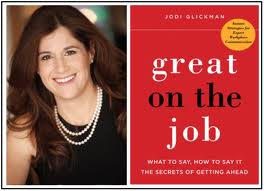
I am in the process of reading/reviewing Jodi Glickman’s book Great On The Job – What To Say, How To Say It – The Secrets of Getting Ahead.  As I go through it I will share some thoughts that make me go Hmmmm . . .  This posting is based on one of those moments.

I watch the eyes, because they always tell the truth. 

Have you ever experienced the glazed, lifeless stare that happens within 10 seconds of starting a conversation with someone?  It is most often the result of them being in the middle of something and me being too urgent to simply ask “Is this a good time?”

Jodi Glickman shares her secrets to opening and closing a conversation under a section she refers to as The Basics.  How to avoid the lifeless stare is addressed up front.  It made me chuckle when she talked about the feedback she received initially from two trusted friends that this section was too basic.  I loved it!  When I talk to people about talent management I stress the partnership between a leader and a follower, and the transparency that has to exist for the relationship to work.  Being specific about What I need is critical, and recognizing that this is not the right time to talk is equally as critical.  In the era of open office doors/no doors at all and cell phones that make everyone accessible 24/7, it is important to be able to say not the right time.

One of the unique pieces of her approach was the ending.  In it she shares two steps:

  1. Thank you
  2. Forward momentum


I love the concept of forward momentum.  Think of it – we have talked and here is where I am going next.  Imagine if every interaction led to some sort of forward momentum?  In talent management: forward momentum = ownership = engagement = great followership

An exercise: What percent of your conversations today lead to forward momentum?


Companies are Like People, Our Culture Defines the Relationship – Tips for doing it well

Companies are like people.  There is actually a study of how organizations act and change, which is where the terms organizational development and industrial/organizational psychology come from.

As individuals we build relationships/trust by working/living along side people and showing them consistent behavior so they know what to expect – what we value.  So how does that apply to organizations?

Culture is built through a relentless demonstration of what organizations value. While perfection is the goal, it is not realistic.  At some point we will have to say we are sorry.  This lens can be used to examine when organizations first meet new people – during onboarding.

Here is a miss / don’t miss list based on years of experiencing it and building it as a leader:

Don’t Miss

  • Clean desk / supplies
  • Someone to greet you and say “we were expecting you”
  • Frequent communication with your leader for 3 months
  • Teammates taking you to lunch or inviting you into the circle/social events
  • Paycheck / benefits
  • All the tools that connect us to others – email, phone, computer, mailbox, list of who to call
  • Plan to direct learning for first three months

Miss Sometimes

  • Nameplate on desk
  • Meeting boss’ boss (because of business) day 1 or week 1
  • Formal orientation in week one (not enough people)
  • 100% achievement of everything on the onboarding plan
  • Email Day 1 welcoming new teammate
  • Quick check-in at the end of every day to see how things are going

I am not a hypocracy chaser, and it is important that a line be drawn in the sand saying that “If we do not do these things how can we expect anyone to buy into our values as an organization?”  As Collins said in Good To Great:

The point is not what core values you have, but that you have core values at all, that you know what they are, that you build them explicitly into the organization, and that you preserve them over time. (p. 195)

Living it is more powerful than speaking it, and speaking it is the first step in living it.  It why I put Build Trust at the base of the trUPerformance model.  Working relentlessly at living what we say makes it easier for people to forgive us when we (as organizations) slip up.

After all, organizations are like people.

What is on your Don’t Miss list?

Assessments for Individuals – How they stack up

This is a series of extra discussions around an upcoming trU Tips related to using assessments in your business.  It will come out next week.  If you are interested in receiving this special trU Tips, please sign up for the mailing list here. 

All assessments are not created equal.  Here is a document I published that summarizes my opinion of nine assessment tools that I have used or taken in my career.  Most of the big ones are covered, and I have excluded 360 tools because that is a whole different topic.  The right tool for your depends on what you want to accomplish,  your budget, and several other factors. 

Here is a summary of some of my recommendations.

Leadership Transitions?  The tool I use in my practice is the Birkman Method.  It’s unique approach for measuring differentiating between usual behaviors and needs is unique, and the stress behaviors that it identifies when needs are not met.  It is a very powerful tool for transitions and also can easily be used for performance issues and career coaching.  It is the best that I have found, but probably more important is the process involved in assessing risks and priorities.  I have recently been introduced to an onboarding assessment that looks more at organizational factors vs personal style that is very powerful.  More to come on this. . .

Team Development? I use Birkman, and as a result it is the tool that I would use with clients.  The tool that I really like in this area is the Kolbe because of how it summarizes energy for a team and presents it back.  There are many drawbacks to using the Kolbe that I highlight in my matrix, but it creates a great conversation within a team.

Fun Team Development/Team Building?  I have used StrengthsFinder with over 400 people and over a dozen teams.  It is inexpensive and can offer insight into a variety of career or job related questions.  For the money, I would recommend it or DiSC® because of the cost and ease of access to experts if there was a desire to use it across an organization.

Any opinions?  I would welcome them and sharing of tools that I might have overlooked.  trU Tips 18 will be out tomorrow focused on this issue.  Sign up here if you would like to hear more.

Choices. (career and talent management)

Choices. 

It is the word that sums up the goal for our own career development and what every person (young or old) works for.  It is also the goal of helping people find success in their role (called talent management) and in our organizations.  When I sit down with clients or friends to talk through development of leaders or managing a change initiative (especially when jobs are going to change) – my mind and questions wander back to the lens I always use to analyze their talent management habits or change plans:  How effectively is their plan creating a conversation?

Ultimately for people to buy into and successfully help your organization get to a different place, there are four questions they(we) need to bring to the conversation.  This is what makes talent management / change management personal.trUYou: our model for developing self-awareness

  1. What do I know about me?  (here is a link to my model for this – trUYou™)
  2. How do my talents, skills, experience and needs match my role and the roles I am looking at?
  3. Can I work for the person leading this group?  How do I feel about the list of tasks I am being asked to ship?
  4. Am I willing to help them be successful, regardless of my answer to question 3?

This Friday I am doing a key note address for a Junior Achievement Job Shadow Day.  I use 3 different size bikes (that students will ride) and cash to drive home a point – you have choices to make.  It is not always an easy journey, but it has some great rewards.  Here are videos I posted of one of my presentations.  Part 1    Part 2    Part 3

Funny thing – if I were to stand up in front of a bunch of seasoned professionals, I would give the same speech.  It is one of those messages that needs to be learned/relearned throughout our professional lives.

Choices are good.

Onboarding Equation . . and 4 Ways to Influence it

I am reading a book called Emotional Equations by Chip Conley.  As a recovering engineer, I am still attracted to simple ways to understand a complex event – and for anyone who has spent time in a science class, that is what an equation represents.

So here is an equation:  Disappointment = Expectations – Reality

The fundamental event of hiring and effectively onboarding a new person is captured in this equation.  It is no wonder that 40% of leaders from outside organizations fail within 18 months (Watkins – The First 90 Days).  We all have stories of experiencing or observing the moment when the This is not what I signed up for panic hits.

A key part of managing talent coming into your organization or transitioning into a new role is managing this equation.  Here are two ways to better manage this equation for new people:

  1. Name it in orientation:  EVERYONE will feel this at some point, so openly talk about it and have a few people share when it happened for them AND how they worked through it.  (great reason to have a panel discussion of newer employees at some point)
  2. Make connections for them Day 1 so they do not feel alone:  Assign someone in the department or another department as a mentor and guide (someone who can empathize with this person).  It takes 6-12 months to become comfortable/productive in a new role, so this person should stick around (especially if the leader is not good at this).

For a person transitioning into a new role:

  1. Create a plan for success:  On day 1, use a development plan template to talk about why they got the role (their talents/successes), what success looks like, and what they need to be successful.  This provides the individual with a target, some encouragement, and a framework for revisiting the how is it going question and make adjustments as necessary.
  2. Assign a friend/mentor:  For individual contributors or managers give them a mentor (or the leader should do weekly one on ones for 6 months).  For an executive get them a coach.  The ROI for a coach is in avoiding the cost of a bad transition (team turnover, mismanaged budget, etc.).  It will pay for itself, and there is plenty of research to back that up.

Talent management is about great conversations.  Talking about this equation is a great conversation for a person in transition.

What do you do?

I was reviewing one of my daughter’s assignments, and in it she was asked what 3 careers would she be interested in and what people do in these jobs.  Here is her description of one:

I would like a career as a nurse because my Mom is one.  The duties are being on time for work and willing to do anything.

When people look at our jobs, it is good to hear what others think is important to do it well.  This is through the eyes of a 9 year old, but confirmed as accurate by the experts. 🙂

I have found that it is surprisingly difficult for people to identify the 5 most important things they do at their job.  I once made the mistake of setting aside only 30 minutes for an exercise with a group.  We needed 2+ hours.  My experience has shown me that when we ask this question, the response is either a high level summary similar to what my daughter provided above, or a detailed list of 20+ items along with an eye roll that sends the message I am too busy! 

This is why I incorporated this check-in for every talent management template I have published.  The performance conversation questionnaire, the one on one sheet, and the development plan.  In a world where resources are scarce, positions stay open for weeks/months, job absorption is very common, and people are afraid to say no . . . it is important to always be comparing perceptions.

Gallup’s #1 question for engagement – I know what is expected of me at work.  Be relentless in sharing/talking about this.  It will make a difference for leaders, followers, and teams. 

Some of the answers might also make you smile.