Rule #1: Sleep

A friend who has never read a business book recommended Rework by the founders of 37signals.  It has made my top shelf and there is one message that helped preserve my sanity during the start-up of my business.  When you are tired, sleep.

Seems simple, but in our drive to complete everything and show any customer in the world that comes in contact with us what an amazing performer we are, the bar gets raised to a point that most of them cannot even see or appreciate.  For me, I was so focused on getting it all done that I forgot I was skilled at my craft and that many of these tasks took a third of the time if I was rested.  So since then I have just gone to bed, and here are a few outcomes for those who need data:

  • 0 missed deliverables
  • 0 feedback from clients indicating I was unprepared
  • 0 feedback from anyone that I appear more rested

The benefit was that it also allowed me to hone in on my new rule that when the house shuts down and my spouse goes to bed, I put everything down and go to bed.  A simple rule, but it has made all the difference.  Nobody else will care that you slept, except the people that have to live with you.  Doesn’t that matter?  It should . . .

Holidays is about being present and putting things down that can be handled later.  It should not take a book or a blog to tell us go to sleep, but sometimes these messages need to be spelled out and we need to be in a place to hear them.

My message for you:  Thanks for listening and sharing your stories with me.  I will not bother you until Jan 7, so stay present with the people that matter in your life.

Have a great holiday.
You don’t need more data

An email came from the Gallup organization yesterday inviting me to buy a full ranking of my Strengthsfinder results for the bargain price of $89.  It promised my 34 talent themes ranked from strongest to weakest.  For those of you that have never taken it, when you buy Strengthsfinder 2.0 or Now, Discover Your Strengths from Gallup you get a code that will allow you to take an assessment that gives you your top 5 talents.  It is a great assessment.

Great move by Gallup, because the popularity of this assessment has resulted in tens of millions of people taking it.  If 1% get excited about this offer it will be very profitable.

I have personally helped over 500 people understand their Strengthsfinder results, and in every group there is always one person who wants more data – all 34 talent themes ranked.

My standard response has been – “What would you do with more data?”  The answers I hear includes statements like Then I will really know or words like certain, exact, and total clarity.

My response – Talent themes start the conversation.  The rest of the conversation is about understanding them, self-observing to see them at work, building on them, refining your understanding of them, and then repeating this process endlessly.  It is not a neat and clean project that ends with a deliverable.  In the end, someone tells you something like You are wise or You do a great job adapting to different situations.  In that is the inherent belief that You get yourself.

Self-awareness is a journey.  It is more about the work than the data.  Would you respond to an ad that claimed Receive total consciousness on your death bed for $74.99? (this is for Caddy Shack fans)

Feel free to buy more data, but you don’t need more data.  Do the work.

My Top 4 Learning Tools

A thought was shared from Greg Hartle (@greghartle) last week about his impressions of people he meets that are in career transitions.

Many people are perfectly prepared for a world that no longer exists.

One area people struggle with is learning.  We wait for events, programs, our leader to direct us, a performance review, time away from our job to learn, or ___________(fill in the blank).  In a corporate class, experience shows me that 70% of people come to class without a clear objective.  In a personal study I have done, 100% of people who went to Google and typed in a “How do you . . . . ” search question had a clear learning objective.  Email me if you would like the full results of my study. 🙂

My favorite places to learn:

  • LinkedIn – I believe Greg’s perspective can be substantiated based on how someone leverages LinkedIn.  This tool is as much about setting up learning communities as it is about building a professional network.  Joining groups and asking/answering questions on a weekly basis.  This should be a cornerstone of your learning strategy.
  • Inc – I still get a paper copy.  It makes me old school, but the information I get from people trying things out is so valuable for me as an entrepreneur and an advisor to growing companies.  For a close friend it is Wired magazine.  I added that for 2013.  More to come . . .
  • TED – At the end of the day every TEDx video is still an event.  Given that, I am still shocked by how many people I work with that have never heard of this.
  • YouTube – 48 hours of new video is uploaded to YouTube every minute.  (see graphic) I once had a friend with a health issue that needed to start giving himself monthly shots.  He is a bit impatient, so after trying to find someone to help he went on YouTube, found instructions, and did it.  I do not recommend this course of action for everyone – but he is clearly not the person Greg was talking about.

As I watch my teenagers interact with the Internet I realize the line between living and learning is non-existent for them.   The mantra that separates boomers from a millennial is a simple shift from I will outwork you to I will out-learn you.  The hardest worker is not the automatic winner anymore.

What are your favorite places to learn?

Good advice for new or old grads – Effective Immediately Post 1

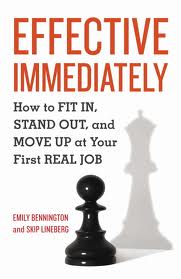
I am in the process of reading/reviewing a book by Emily Bennington and Skip Lineberg called Effective Immediately – How to FIT IN, STAND OUT, and MOVE UP at Your First REAL JOB.  As I go through it I will share some thoughts that make me go Hmmmm . . .  This posting is based on one of those moments.

As I started through this book I found myself grinning at some of the helpful hints.  Not because they were funny (other than the statement – If someone farts, ignore it), but they were the kind of things that are simple, obvious, and too often lost in the shuffle of starting something new.

Advice I liked:

Under the heading Have Patience – a quote from Sir William Osler (a pioneer of modern medicine): The best preparation for tomorrow is to do today’s work superbly well. A great reminder not to get caught in the who is looking and what is the next project.  Just focus on what is in front of you.

Professional etiquette:  Listen more than you talk – Obvious, but how often do nerves translate to communication misses such as talking too much.  Remember that when someone talks about themselves it stimulates the brain in the same way as when someone is eating or receives money.  Get others talking about themselves and listen.

Professional etiquette:  Always clean up after yourself. This one makes me smile, because my first job was in a steel mill where nobody every cleaned up after lunch and expected the janitor to do it for them.  Then I worked for a company that had a cultural norm around this, and every place I have been since I still wipe down the counter in the coffee counter when I leave.  I watch for this habit.

Reality check: Traditional HR departments are either gone or spread thin.  Most new people do not really know the function of the HR department, so they will not miss them.  But this statement is true, and even more true for smaller organizations.  The book goes on to give a list of Macro and Micro items that could be used by anyone to do their own onboarding plan.  For example:  Macro item:  What are the key responsibilities of your job? and Micro item:  Who is your supervisor or boss you report to directly, and who do they report to?

So far I like it.  As with all business books I believe they need to be read with a partner or small groups.  This book is written in short sections that fits that model very well, and is a great reference tool because each short chapter equals a skill.

More to come . . . .


1 on 1’s – Do you ask this question?

Shortly after publishing my last trU Tips on doing effective One-on-Ones (read it here), I received a note from a leader I respect.  I have never worked with him, but every time we talk he asks me questions that make me think.  He is also very willing to try new things.  He is a very valuable part of my network.

Let me call this trU Tips 22.1. In addition to the two questions I recommend once you mastered the basic One-on-one conversation, a third question to ask is – What should I keep doing the same?

Remember the goal of a One-on-One is to build trust and focus by creating space for your people to talk about what they are getting done, where they need help, and get a sense for how they are performing vs the standards you have set for them.  The advanced questions are about getting feedback for you that will help you continuously refine your own effectiveness as a leader.  Think of these three questions:

  • What do I need to do more of?
  • What should I keep doing the same? (the new question)
  • What do I need to do less of?

If you ask these questions and log in the answers over a 3-6 month period, I guarantee it will give you the same results as a professionally administered 360 feedback tool.  In financial terms, the choice is listen for free or spend five figures having someone else listen for you.

I love my network – they make me better.  I am listening.

Make Good Decisions Dad

As I was preparing for a board meeting my 9 year old daughter asked me what I was doing.  She had just told me about her first student council meeting, so I told her about my meeting and that we were going to be approving a budget for the year.  She thought for a second and said in a very matter of fact tone, “Make good decisions Dad.”

Sometimes we forget the basics, and if we are listening there are reminders all around us about what those are.  We just need to stop, listen, understand, and reset our perspective.

Here was my reset based on the wisdom that she shared with me:

  • Goal of a leader:  Make sure the best decisions get made more than not.
  • Development goal #1 of a leader:  Continue to learn and grow so the definition of best for yourself and your team is always being redefined in a positive direction.
  • Development goal #2 for a leader:  Challenge your team to embrace the same goal.

Maybe a good goal today is lead with the eyes and heart of a 9 year old.


4 Performance Words – What Seth said, and What I think

Seth Godin recently blogged about performance, and outlined four kinds:  Bad, Good, Remarkable, and Personal.  Here is the whole post.

In a world where we too often treat performance with labels like Right person/Right seat or A player / B player / C player – it is good to just use words that we all know.

Leading performance is about not walking by the work without letting people know what you see.  It is about getting their view of the work and what they see in others.  It about celebrating things being done, asking a few questions to plant seeds that might lead to a different view of the work, and challenging people to a different level of involvement and ownership.  Try these:

  • Where did you see passion in someone else’s work this week?  How can we celebrate that?
  • How did you personalize your work this week and who benefited from it?
  • What work do you have in front of you that has a chance to be remark-able in how you do it?  What will make it worthy of that label?

Of course you ask these questions, listen, and always revisit them.

Personally, I would drop Bad and Good in favor of Absent and Solid.

I like reading Seth – his thoughts are generally remark-able.


Rule 2 – Individual (not leader) owns the agenda

(This is the second blog in a series outlining the key rules for making one on ones work.  Here is a link to the first:  Rule 1 – Be in the same room together)

I stood in front of a group of human resource professionals and asked them Whats the #1 reason leaders would resist a regular one on one schedule? Their answer – Time.  It is a reality that another commitment, especially one that takes preparation, is going to be an issue.  This is one of the key reasons that Rule #2 exists.  While this time together requires presence from the leader, it requires only minimal preparation because the agenda is 100% driven by the individual.  Here are two reasons why.

First, the number one need for people at work is knowing what is expected of them. Gallup created a twelve question survey they could use to assess employee engagement at work.  They called it the Q12, and the very first and most important question was I know what is expected of me at work. Each day, new problems or opportunities arise in a business, and with each comes an event that could change the nature of the work that someone has to do. The key to a one on one is doing the five R’s around work duties:  refine, revise, reorder, reinforce, or remove.  Since it is a fundamental need for every person to have some level of focus in their work, they will have the strongest desire to own any activity that helps them achieve that.  The one on one is that activity.

Secondly, it addresses one of the top issues with any leader, the ability to effectively delegate work. The #2 best-selling Harvard Business Review article of all time is Management Time:  Who’s Got the Monkey? Leaders have long struggled with taking on too much work from their people.  The inherent question from the leader in the one on one conversation is –What do you need from me? There are four basic needs a leader has to be ready to address.  The need for . . .

  • A listening year
  • Encouragement to overcome a frustration
  • Coaching to see/define other options for getting through a barrier
  • Help prioritizing/re-framing an overbooked to do list

Notice your work is not on the list.  There will likely be some commitments for a leader after a one on one, but most should revolve around working with other leaders to deal with competing organizational priorities.  There is a natural need for leaders to take on the work of their people (for that perspective read the article).  The one on one all about helping the individual achieve a state of 3 Mores/1 less:  MORE focused, MORE autonomous, MORE  successful, and LESS stressed.  In that state, everybody wins, especially the leader.

More to come on one on ones.  If you are interested, here is a sample template for getting started.

Rule 1 – Be in the same room together

According to a study done by the Kaiser Family Foundation, children 8-18 spend 7.5 hours per day using entertainment media, 4 minutes playing outside, and 3.5 minutes per day in meaningful conversation with their parents. Hmmm . . . .

I toured a company called Menlo Innovations in Ann Arbor last month and was shocked to find a technology company that did not use email to communicate.  All project management was done with post-its on the wall and communication happened face to face.  When someone needed to address the group they called out the name of the team, everyone stopped their work, and communication happened.  The business has experienced solid growth and the they have enabled several product launches that prove their methods are effective.  By the way, this is also a place where all coding is done in pairs – two people sitting next to each other and working together.  You cannot work alone on anything.

In a world where everything seems to be going faster, maintaining the right pace in how we interact is still important.

Great leadership starts with purposeful facetime with people.

Step 1 – Be physically present with the people you lead.

Yes, that is impossible for people leading virtual teams.  So to you I ask – What would that presence look like for you?  How close can you come to ‘physical’ presence?

After 20 years working on corporate teams, being married, and being a parent I am passionate about enabling one single thing – great conversations. When I created this template, I thought of a meaningful 30 minutes together between a leader and follower.  If we spend 30 minutes, one on one, every two weeks with each of our people, that works out to  a guaranteed 15 minutes of purposeful conversation per week with each person, or 3 minutes a day.

Hmmm . . . still only 3 minutes a day.  Too much . . . Really?

Watch yourself this week – How is the quality conversation time looking for you?

Everyone needs a Target. Everyone!

Great leaders paint their own destiny

Great leaders live/lead through ambiguity

All of these statement are true, and yet in the details of all of these statements is work.  Inherent in this work is the simple question of What is the work?

One of the core beliefs I have is that everyone needs a target. The details will vary based on the individual, their drive, experiences, self-confidence, etc.   That data that supports this is Gallup’s Q12 and the most critical question to measure employee engagement – I know what’s expected of me at work. There is no exception in the research saying This does not apply to executives.

Yesterday I saw some great training that a start-up organization had put together to help their new leaders understand the culture and expectations they were stepping into – and see the target.  I know it will make a difference as they grow, especially if their leaders provide the conversations to support the learning and build the bridge to performance.  This is the hidden ingredient to clear expectations – an ongoing conversation about wins, losses, and just being lost. This is called leadership.

When I sit down with leaders to create the one on one sheet, I am amazed at the conversation that often ensues.  Sometimes it is laced with frustration, but more often it is about relief because expectations are clear.

Everyone needs a target.  Everyone.