4 Questions People-Centered Change Leaders Ask

4 Questions People-Centered Change Leaders Ask

For those of you in Michigan, you know the name Rich Rodriguez.  He coached football at Michigan for several years and was fired for not being successful.  The ironic thing is that he was successful before Michigan (West Virginia) and he has had success since (Arizona).  The story I have about him is about being a new neighbor.  I was teaching a class and in small talk I met one of his neighbors in Ann Arbor.  She told me a story about him moving into a house that had 6-12 trees in the front yard and he did not like trees so he cut them all down when he moved in.  The neighbors were angry, and by this time he was also not winning on the football field, so the story ended with they were still angry and ‘he was a bad coach‘ on top of it.

Leadership is about managing change, and part of managing change is picking your battles initially until key people know you and trust you.  In any role there are a few key people that have to be on your side, and the key to success initially is taking steps to build trust with them.  These are called stakeholders, key people, or sometimes just neighbors.  A leader has 3-12 months to win over these stakeholders.

I specialize in leadership transitions, and one rule is not allowing a new leader fire anyone for 3-6 months.  My second rule for a new leader is to get a ‘grace’ period light on deliverables for about 3 months so they have a chance to build relationships with people.  When they do get deliverables they need to be heavily focused on getting wins with the people that need to trust and support a new leader when they do make mistakes, and mistakes are a given.

Back to Rich – as a leader and homeowner he can do whatever he wants.  His mistake at his house was cutting down every tree before people got to know him – which was only made worse when he did not win on top of it.  Ironic thing, he did the same with the program and alienated many people so fond of traditions he cut (like a weekly radio show) that when he started to lose more than win they did not support him.  The lesson, as a new leader ask before you cut down any trees – maybe by asking first which trees need to be cut down.  What does that sound like in a conversation?  Imagine interviewing all your new team and asking:

  • What questions do you/the team want to ask me?
  • What is working here?
  • What needs to be fixed?
  • What is one thing I could do to make you more excited about your job?

Listen well and they will tell you which trees to cut down.  My experience tells me that their list will look eerily similar to yours.

It is not that Rich Rodriguez is not an effective coach – he has proven he can win in the right situations.  His problem is that he does not adapt well to situations where he has to be patient and cannot just cut all the trees down at once.  What kind of leader are you?

Here are my proven processes on change.  I use them because they are people-centered and less focused on the outcome and more on emotionally moving people through the change.  Still performance focused, but people-centered.


Leadership as a Buffer

Leadership as a Buffer

My job was to be a buffer between the media, the president, and all the other parties so General Schwarzkopf could do his job.”

I saw General Colin Powell speak last night, and this is the comment he made when asked about his relationship with Stormin Norman.  It made me think about situations I hear about and have experienced before, especially as I try and streamline decision making in high growth companies and help leaders create processes that support decentralized decision making and yet still help the organization effectively balance priorities.

I often here the word politics or territory in conversations about how work gets done.  One of my goals when working with clients around the EOS process is helping them lead more effectively by NOT making all the decisions, and yet giving up some instant access to everyone in the company.  You see – no matter what size the company, when the CEO comes in and says something most people will take anything they say as a ‘to do’ and drop everything.  I think back to a CEO’s surprise that his suggested reading list had become a must do item for new leaders and totaled 2,461 pages.  When executives speak, whether it is an order or a suggestion, it either becomes a deliverable or a source of extreme frustration for people who won’t object .  In my experience a majority of the time it becomes both.

It is hard to have an open and honest conversation between the top and bottom of the organization, and yet it is critical to figure out a way to make it happen.

  • What if we asked other leaders to talk to us before talking to our people not because we wanted to protect our people/agenda, but because we wanted to be a buffer so we could help our team re-prioritize work when needed?
  • What if we did it because we had an amazing performer that was a hot head, and being a buffer allowed us to work with them on not swearing when they get frustrated – and it was okay if they made a few mistakes with us for now?
  • What if we did it because you wanted to make sure our people knew how to constructively share their opinions with executives, and being a buffer gave us a chance to coach them on speaking up?
  • What if you had one of these three reasons above AND you shared them with your peers up front so they did not see your actions as SILO Building but TALENT Building?  It might also put you in a position to support their development on listening more effectively and clearly communicating the WHY behind their requests.

There are lots of reasons to respect and admire Colin Powell, and my 90 minutes with him last night certainly reinforced that.  He is definitely a leader worth listening to.

If you want to go fast, go alone . . .

If you want to go fast, go alone . . .

If you want to go FAST, go Alone.

If you want to go FAR, go Together.

go fast go far image

As a leader, have you ever wondered “Why can’t people do what I tell them?” or made the statement “I will just do it myself.”  I once wrote a trUTips to talk about moving past that to become a more effective and healthy person/leader.  Alone in leadership is not ‘without’ people, it is more just about leveraging the talent/resources around me to just do my work in the way I want it done.  From the outside, it looks more like dependence and less like a true team or relationship.

Going alone as a leader means adopting a method of leading where your ideas always trump others.

Going alone as a leader means having meetings where information is exchanged but nobody solves any problems together – after all, working alone as a leader means creating a culture where that is the norm.

Going alone means running into an invisible barrier repeatedly that serves as a cap to your business.

Alone is one way to do it, but it becomes just that – Lonely.

In a tool I use to help leaders and teams move past Alone towards really working together.

The fundamentals are simple, and yet hard.

  1. Start with asking the fundamental questions – “What are the roles we need to grow?” and “Who is willing, able, and capable of doing those roles?”
  2. The second piece is creating a vision for the next 90 days by establishing the BIG priorities for the organization – or ROCKS.
  3. Finally, commit to meeting weekly to connect, prioritize the work, solve problems together, and support each other in the work.

That is together, and to go FAR past where you want it is about learning to work together first (gain Traction) then defining FAR together (Strategic Plan) and learning to lead towards that point.

Leaders can go alone if they want, but that is not really leadership.  Look around – which part of this quote describes your team?

Writing More Effective Goals – Some tools that will help

The most important part of professional development is writing the goals.  We can talk about it, we can get excited about attending a great class or program, but in the end what we do with what we have learned is the ROI!  Sure it takes support, maybe some coaching, but it has to start with defining a target we can focus on.  The goals and action plan are critical.

I was leading a book study with a group of entrepreneurial leaders, and as usual one of the conversations we had inspired me.  Also, as usual I had about 15 minutes to share some tips I have learned around writing goals and it was not enough.  So I wrote an article on LinkedIn titled Leaders – Write Better Goals for Yourself: 3 Critical Mistakes And How to Fix Them.   If you are at or near evaluation time for yourself or delivering evaluations for others, take a look.  My goal, as always, is to equip leaders with the tools they need to have more impactful conversations around growth and development.

Could you share it with your LinkedIn community?  Thanks for the help in starting a conversation around this.

Also – Here is a worksheet I use with clients to help them write better goals as they go through their own evaluation/development


Passion and Art: Why does it matter?

Passion – I am torn on this topic by people that come up to me for advice on starting their own business and realizing the independence they long for.  I have learned to listen closely for their why, and if they start with the outcome of entrepreneurism and not the work, they have it backwards.  I challenge those people (and myself) to keep the focus on the gifts you have and the work that excites you.  Seth Godin shifts our perspective on our gifts by challenging each of us to think of ourselves as Artists – and makes the comment Art is the intentional act of using your humanity to create change in another person.   He goes on to share that most artists can’t draw.

Hidden in the whole conversation of performance is passion.  Here are three things I have learned about passion of the artist:

  1. Passion is the hidden ingredient in performance:  In my book People-Centered Performance I share my belief that Performance = Talent + Passion + Work
  2. Passion does not have to reside in just the work, it could be the team, or the cause, or even the need to eat.
  3. Passion is without complaint, so if we can do the work with excitement and ownership, and without complaint, we are close.
  4. It is impossible to be an artist and not have passion.

A great summary of passion came from a recent book I read called The Boys in the Boat.  In it, the master shell builder George Pocock talks about his work and what drove his choices:

My ambition has always been to be the greatest shell buiilder in the world; and without false modesty I believe I have attained that goal.  If I were to sell the stock, I fear I would lose my incentive and become a wealthy man, but a second-rate artisan.  I prefer to remain a first-class artisan.

I like watching for passion in others, and instead of starting with a pen and paper to write your statement of passion, start by observing and talking to others.  There is energy in watching the artist work, and they can be found all around us.

Remember, most artists can’t draw, and most artists aren’t entrepreneurs.

Good Question – Great Question

What if we asked more questions?

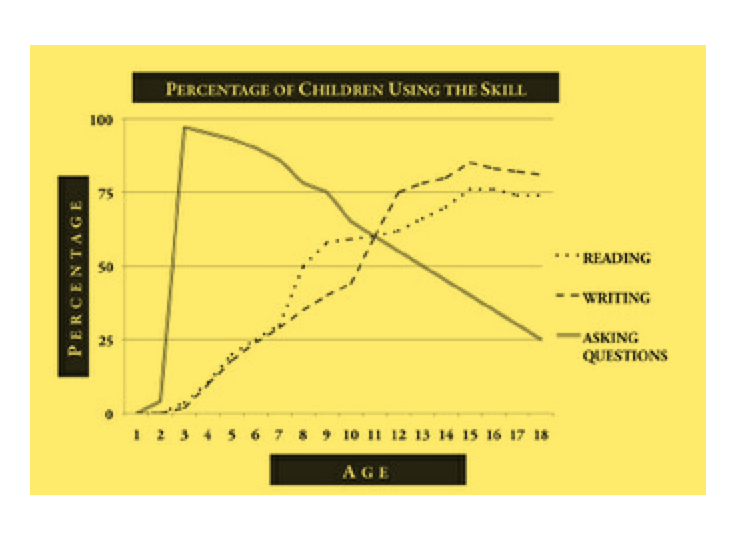
I am reading a book by Warren Berger called A More Beautiful Question.  In it he shares a study from the Right Question Institute tracking kids use of questions over time that identified a trend of students using questions less as reading and writing skills increased.  The use of questions peaks at around the age of 3, and by the age of 18 it is only used 1/3 as often as reading or writing.

From 2009 A Nation's Report Card.
From 2009 A Nation’s Report Card.

For parents, you are probably not surprised because you have lived through the WHY stage of three year olds and the grunting teenager.

This fascinates me, because I see this in adults as I work with leaders in their development and those that have gone through a career transition.  Too often EGO gets in the way of building the relationships needed to be successful in their next role.  One sign of EGO is the need to tell vs ask.  Think of that – I can read/write/Google (i.e. Figure it out) = EGO response to not knowing something.  As leaders, we battle our EGO overtaking us by leveraging the knowledge of our team to solve problems.  I believe one of the most important skills to battle EGO for adults/leaders is to learn is the ability to ask questions AND listen for the answer.  We do that by mastering the use of GREAT Questions over GOOD Questions.  Here are some examples:

GOOD Question:  Have you considered x and y as solutions?   GREAT Question:  What other solutions did you explore?

GOOD Question:  Why did this happen?   GREAT Question:  What has to happen next to make this problem go away?

GOOD Question:  How was your weekend?    GREAT Question:  What one word would you use to describe your weekend?  (What is the story behind that word?)

GOOD Question:  What do you want to share with the group before we start our meeting?       GREAT Question:  What is one personal best and one professional best you have to share with us?

My basic rule is to always start questions with What or How – that does not always make you perfect, but it makes you closer to perfect.  It is also important to be ready with – tell me a little more about that? or Tell me a little bit more about what options you considered?  Then listen.  The metric for you is to have a ratio of questions to statements of 5 to 1.

Hopefully you have already answered the question What if we asked more questions? 🙂

3 Questions that help create a culture that SUPPORTS performance

3 Questions that help create a culture that SUPPORTS performance

As a coach and consultant, performance conversations tend to start with emotions and adjectives.  One of the challenges in gaining clarity is to have a conversation that gets down to the root cause, and it also means talking to both the frustrated leader and the individual. Here are the questions I ask:

  1. Do they/you know what is expected of you at work?  What are they?
  2. Do they/you have the tools and resources to do your job well?  (see question 3 for how to deep dive on the specifics)
  3. If Yes to both 1 and 2, do you feel you/they GWC the role.  (G = Get It,  W = Want It, C = Capacity to do it)  *GWC is from a strategic planning tool I use called EOS


I don’t look at creating a performance focused culture, because my experience has shown me that leaders take this path by starting with accountability and expecting work to get done.  I have learned through Denison, a partner company I use for surveys, and my own experience that it is important to focus on creating a culture that supports performance.  It aligns with my own belief that individuals own their performance and development, and the organization owns support.

When we start with defining the target together and supporting the work to get there (frequent one on ones, asking what they need, following through, repeating often), more often than not it ends in a trusting relationship where the important things can get talked about.  Leaders, this is your work in SUPPORTING performance through the culture you create.

When people ask you what they can do to help, tell them.  Beware of asking for the extremes – no help (because you are frustrated, angry at someone, or your EGO is on overdrive) or having them do everything.  Sales is a great example because of the frequent ups and downs in a challenging market.  When you are missing sales numbers – role playing, prioritizing your leads, reviewing your pipeline are all great support activities.  Maybe even asking some people to make some calls for you or leverage relationships they have in some of your maybe companies.

Support is a two way street, it has to be offered and it has to be accepted.  The times we get in life when it has to be forced are the tough times.  Just ask an adult child who has arranged assisted living or nursing home care for a parent.  If the point is reached where a leader feels they need to force assistance in getting work done (what individuals often call micro-managing) it is probably time for you to leave.

I know it is never that easy, but it is that simple.  If that outcome is not what you want, then start back at the beginning and make a commitment to change your half of the conversation.


Jackhammers and Leadership

I learned a very valuable leadership lesson when I was 19.  I was working as a laborer on a curb repair crew for the summer.  Part of the job was breaking up the old curbs using a jackhammer.  I remember the first time I was asked to operate it I was very excited – it was loud, dirty, and made me feel very manly.  I received the instructions from my crew chief, and off I went to break up 100ft of curb.  After 5 minutes I started to feel weak and I was sweating profusely.  After 10 minutes I was light headed and almost ready to throw up when I had to stop. It was then I noticed the whole crew standing back laughing at me as they saw the fatigue and nausea overtake me.  When I shut the jackhammer off, my crew chief came over and gave me my first leadership lesson.

“Kid, you have to learn to let the jackhammer do the work.  When you learn to work with it and not try and control it, then you really get work done.”

That summer I gradually learned to let the jackhammer do the work, and as I look back on that day, I realize how it was a lesson for every important role I would ever have – leader, husband, parent, friend, and facilitator.

As I work with new leaders – The biggest mistake I see new leaders make is to over-manage their teams and not focus on setting clear goals and working to remove the things that are getting in the way of their people.  Leadership is exhausting if you opt for total control vs working with it.

As I lead entrepreneurs and their leadership teams through a process to build a strategy and culture focused on performance – I have to stand back and let them work through the change, learn what works for them, and struggle with growing up as a team.  They have to delegate the work that will allow them to lead more effectively.  I have to be patient and persistent.  If either of us tries to do too much for others, it will exhaust us and the effort will not be successful.

In my work as a coach – If I go into a coaching session trying to guess the answers ahead of time and force knowledge into my coachee – it is exhausting.  When I go in with the intent of being present and working through the process of coaching with a coachee, they leave with the strength of conviction and ownership, and I leave amazed at the work that gets done when I am present and allow space for exploration.

As a parent of teenagers – If I go into conversations armed with the intent that I will convince them they are wrong and I am right, it usually ends with tears and loud voices.  If I am patient and work on listening and drawing out what is on their mind and gather their reflections on the event, it does not alway end in a hug with music playing in the background, but it generally ends with energy in reserve for us to work on the next challenge or to celebrate the next victory.

Kid, you have to let the jackhammer do the work.  Leader, you have to let your people do the work.

Coach/Leader, you have to listen well and draw out the reality and possibilities from your partners in performance.

Dad, you have to let your daughter grow up a little, and feel loved on their journey.

Friend, sometimes you just have to sit there and listen, because you can’t cure the cancer, fix the marriage, or bring their child back to life.

What are you challenged with today that you have to learn to let the jackhammer do the work?

Lead well – in whatever role you take on today.

The talent shortage – and 4 tips for what you can do today

I saw an economist yesterday describe a perfect storm around talent with numbers.  These are for my immediate area:

  • Unemployment under 5.5%
  • Job listings outpacing job seekers
  • Flat wages for 3 straight years

The good news:

  • People are coming back into the workforce that were not in it a year ago
  • People are leaving organizations for new roles (see wages info above – seems to be the only way to get a raise)

So what does that all mean to you as an employer?

My observation – if you are not skilled at looking for talent, you will likely live into the headlines and feel the shortage.  Let me explain:

I do a couple of hiring projects a year for some of my partner organizations that are struggling finding people.  Here are the two things that I always see when I start a project.  (Always is a risky word – but these have been true for all of the roles I have helped with):

  • A posting that lacks a compelling reason to work for you.  Example:  I helped a charter school hire an HR leader.  They were struggling finding the right person and I noticed in their listing no mention of kids, the market they served (urban / high poverty), and their mission (every child deserves a quality education).  We made some of those critical changes, re-posted, and found a young and energetic candidate that was from the area and reflected the racial makeup of the district.  Recruiting is always a challenge – but step 1 is this simple.
  • A process that focuses on an external listing and does not leverage the greatest organizational sales team in the world – which is the people that come to work everyday.  LinkedIn is just another tool, but if it is used correctly it can be a way to leverage the networks some of your people have to get word out to their groups/networks to generate leads that helps you find people that might not be looking.  LinkedIn also gives candidates a way to rigorously check you out.  The question I got one time was “What if they ask a few ex-employees and they get scared away?”  My only thought is “What if they accept the job and get an earful at the next soccer game after it is too late?”

Here are four tips that build trust from Day 1:

  1. Spend time in the process.  Phone screen, initial in-person, 3-4 hours on-site, and a final conversation where they get to ask all the questions as you hand them an offer.  I use topgrading for all full interviews – no cat and mouse interviewing to test their skills at interviewing.  Candidate – You tell me your story that includes ups, downs, frustrations, and what your old bosses will tell me when I call them (and I will call all of them).  I don’t care if you were fired from a role, and it would be helpful to know why and what you learned from it.  My promise – Open access to anyone you want to talk to, plenty of time to ask questions, and  encouragement to contact anyone they know that is connected with the organization to vet what they are getting.  When candidates start commenting on how thorough your process is and how it stands out for them versus some of the other experiences they have had you know you are doing it well.
  2. As soon as there is personal contact – all communications happen with a phone call.  This  includes the “Sorry, we are not going to ask you back for a next round of interviews.  Do you have any questions for me about the process or feedback?”  There is always the time argument, especially the hiring managers.  I don’t argue, because the more people that think that the better chance I have of taking your best people.
  3. All of my time commitments are hit – no excuses.  Note to hiring managers – if you get busy and two weeks pass without you being active in your selection process you send a very strong message to candidates – my time is more important than yours and I will likely lead that way.  Most people will choose NOT to work for leaders like that, except the desperate ones.  If I commit to a call by Thursday, even if the process is going slow, I call Thursday.  I am amazed at the positive feedback from people for just using the manners I was taught as a child.
  4. The admin/receptionist is part of the interview – through observing and interacting.  I want to know how they treat people that they think are not part of the decision making process.  That is why they always come through the front door several times and I ask the admin to watch and give me their opinion.  This is the same reason senior leaders go to dinner with the CEO and spouses are included.  If the vibe from the spouse is not positive, then the candidate is not hired.

Here is a link to the role summary and focus sheet I use to either build or boil down a job description to something that can be used.  I also offer other templates around talent and performance if you are interested.

Talent is tight, and yet there are still things you can do to stand out because too many companies still don’t get it.


Becoming Adaptable

Are you adaptable?

I am reminded of a conversation I had with Greg Hartle who spent 18 months doing something I thought was crazy.  He started with $10 and a laptop and travelled around the US meeting people in transition and helping them.  He blogged about it, took odd jobs when he could, and spoke to groups about his journey (fyi – before his trip he almost died from kidney failure – so there was quite a story there).

One observation he made was that the key ability he saw as critical to the people he was meeting in career transitions was the ability to learn, unlearn, and relearn.  For me, it was a simple, yet profound statement as I work with organizations and leaders in growth transitions.  Here are two thoughts . . .

1.  It does not mean abandon your values and beliefs.  Adaptable is ‘able to change or be Are you adaptable?  Success in business and in life means understanding and managing the changes that approach.  Transitions as leaders, parents, spouses, friends are full of moments where the current way of doing things/reacting will not work, and we have to ask ourselves – in order to fit or work better in some situation or for some purpose.’  If you have to work for an organization with a social focus – great!  If we are being asked to build a process around sales so others can do what we do and do it the same way and we resist – hmm?

2. It does mean that when we find ourselves stuck or frustrated, the first question we need to ask is “What about this situation frustrates me?”  At the core of our answer is the issue, and in my experience most often the issue is in our recognition of the change and how we will have to adapt to operate in the new normal.

One habit that helps this – When entering change conversations – once we process the issue and the end goal, to simply ask “To be successful, what do we need to: Keep doing? Start doing?  Stop doing?”

As a person – I go back to Greg’s observation – “Based on what challenges I face – What do I need to: Learn?  Unlearn? Relearn?”