Rule 3 – NEVER cancel without rescheduling

Enough said?  You can stop here if you get it.  If you need more convincing here are 451 more words to get some clarity.

In his book The Speed of Trust, Stephen M.R. Covey said We judge ourselves based on our intentions.  We judge others based on their actions. Never is that statement more true than in the relationship between a leader and follower.  Do any of these examples ring true?

1.  A leader cancels a one on one because of a customer issue.  Does not reschedule it because he/she just talked to the person as they walked around the office yesterday.

Leader intention:  Customer is critical and everything stops when they call.  Plus we just talked yesterday and you know I care about you.

Leader action (as interpreted by follower):  Here we go again.  Your issues always trump mine and this issue could have been handled by the field service team with just a little support from us.  This is the 6th time this has happened in the last 8.5678 months (slight exaggeration on the number – but do not be surprised at the human mind to keep a key measure like this).

2.  A leader has the one on one and interrupts the conversation three times because of calls from home.

Leader intention:  Apology issued before each call, and since it was his wife on all three occasions and it was an emergency it was okay because family comes first.  Family is a core value of our organization.  (Emergency = at the mechanic with their new Audi A8 and the repairs were not going well)

Leader action (as interpreted by follower):  Would it be okay if I did this?  His/her spouse is a great person, but can’t this wait 20 minutes?  Isn’t this my time?  I will just cut my time/agenda short and let them deal with their issues.  Afterthought – A8?  I wonder why my evaluation/increase is six months overdue?

3.  Leader leads the time with two things that went wrong last week and they want to know what happened and why.

Leader intention:  Accountability.  If we cannot have the hard conversations then I am not doing my job.

Leader action (as interpreted by follower):  What a jelly fish.  There have been four days to talk about these things since they happened, plus I owned them and fixed them.  What about the bad decision he/she made yesterday that kept me here until 8pm to fix?  Can there be accountability there?

Being a leader is tough.  It is tougher when priorities are not clear and the tyranny of the urgent rules over the one on one time.  Never break this rule – and if you do point back to the last date/time/location/reason that it happened so they know you are keeping score too. 🙂

Talent management is about great conversations.  Follow these three rules for one on ones and you can have some great conversations.

Links related to this post:

Performance plan = Coaching? 2 Arguments for NO

This leader has been underperforming and we have put a plan together to guide their efforts to climb back to a level of performance that will allow him/her to stay.

Have you ever been part of this conversation?  Every been the individual talked about in this conversation?

Personally, I can answer yes to both of the above questions.  Drawing on that experience, I have learned to ask two questions when I enter as the coach/consultant:

  1. Why do you want to keep them?
  2. How bad do you want to keep them?

I ask these questions mainly to listen for words of duty or passion.  To help a leader get back to a better place takes hard work.  To have that resolve, passion always trumps duty.  Duty to try because it is the ‘right thing to do’ will fail.  If the real passion of the leader is to look compassionate, then duty is the driver. Passion for helping this individual find success somewhere in the organization because the organization/team needs them results in a different level of resolve.  It is that resolve that comes through in the difficult conversations, and people will feel that.

I also log what I hear because it will need to be shared with the individual on the plan.  They may not believe it, which is their choice, but they at least need to hear it.  Too often these positive/supportive comments are the first they have heard in a while.

Now to the point of this whole post – Should coaching and performance plan be used in the same sentence? My advice is No, and here are two reasons.

1. Coaching should be a reward: Everyone is watching AND listening. By using the word coach people are now making the connection between I am in trouble and Coaching.  The reality of performance plans is most result in either the person being let go or them leaving for another job.  It is the right thing to give them a chance, both for the individual and for the culture of the organization – just call any effort to help or hire help what it is – performance consultant, advisor, or management.  Connecting Coaching with Reward will get you a greater return on your investment.

2.  It is really more telling than coaching: Coaching is about helping the individual craft a desired future and then working with them to move towards it.  Once a performance plan happens the panic button has been hit and the goal of the of individual is survival – whether that is leaving or doing whatever is on the list.  In this state, people need direction, will likely agree to anything, and will hide the most important information – which is how they are feeling.  Trust and truth is hard to share after the panic button is hit, and any talent management process without these is painful.

Talent management is about great conversations that lead to a higher level of performance.  Coaching can be a great tool for helping achieve this end, and the term should be reserved for people/situations where moving past good to excellent is the performance goal.

What is your experience?

Rule 2 – Individual (not leader) owns the agenda

(This is the second blog in a series outlining the key rules for making one on ones work.  Here is a link to the first:  Rule 1 – Be in the same room together)

I stood in front of a group of human resource professionals and asked them Whats the #1 reason leaders would resist a regular one on one schedule? Their answer – Time.  It is a reality that another commitment, especially one that takes preparation, is going to be an issue.  This is one of the key reasons that Rule #2 exists.  While this time together requires presence from the leader, it requires only minimal preparation because the agenda is 100% driven by the individual.  Here are two reasons why.

First, the number one need for people at work is knowing what is expected of them. Gallup created a twelve question survey they could use to assess employee engagement at work.  They called it the Q12, and the very first and most important question was I know what is expected of me at work. Each day, new problems or opportunities arise in a business, and with each comes an event that could change the nature of the work that someone has to do. The key to a one on one is doing the five R’s around work duties:  refine, revise, reorder, reinforce, or remove.  Since it is a fundamental need for every person to have some level of focus in their work, they will have the strongest desire to own any activity that helps them achieve that.  The one on one is that activity.

Secondly, it addresses one of the top issues with any leader, the ability to effectively delegate work. The #2 best-selling Harvard Business Review article of all time is Management Time:  Who’s Got the Monkey? Leaders have long struggled with taking on too much work from their people.  The inherent question from the leader in the one on one conversation is –What do you need from me? There are four basic needs a leader has to be ready to address.  The need for . . .

  • A listening year
  • Encouragement to overcome a frustration
  • Coaching to see/define other options for getting through a barrier
  • Help prioritizing/re-framing an overbooked to do list

Notice your work is not on the list.  There will likely be some commitments for a leader after a one on one, but most should revolve around working with other leaders to deal with competing organizational priorities.  There is a natural need for leaders to take on the work of their people (for that perspective read the article).  The one on one all about helping the individual achieve a state of 3 Mores/1 less:  MORE focused, MORE autonomous, MORE  successful, and LESS stressed.  In that state, everybody wins, especially the leader.

More to come on one on ones.  If you are interested, here is a sample template for getting started.

Rule 1 – Be in the same room together

According to a study done by the Kaiser Family Foundation, children 8-18 spend 7.5 hours per day using entertainment media, 4 minutes playing outside, and 3.5 minutes per day in meaningful conversation with their parents. Hmmm . . . .

I toured a company called Menlo Innovations in Ann Arbor last month and was shocked to find a technology company that did not use email to communicate.  All project management was done with post-its on the wall and communication happened face to face.  When someone needed to address the group they called out the name of the team, everyone stopped their work, and communication happened.  The business has experienced solid growth and the they have enabled several product launches that prove their methods are effective.  By the way, this is also a place where all coding is done in pairs – two people sitting next to each other and working together.  You cannot work alone on anything.

In a world where everything seems to be going faster, maintaining the right pace in how we interact is still important.

Great leadership starts with purposeful facetime with people.

Step 1 – Be physically present with the people you lead.

Yes, that is impossible for people leading virtual teams.  So to you I ask – What would that presence look like for you?  How close can you come to ‘physical’ presence?

After 20 years working on corporate teams, being married, and being a parent I am passionate about enabling one single thing – great conversations. When I created this template, I thought of a meaningful 30 minutes together between a leader and follower.  If we spend 30 minutes, one on one, every two weeks with each of our people, that works out to  a guaranteed 15 minutes of purposeful conversation per week with each person, or 3 minutes a day.

Hmmm . . . still only 3 minutes a day.  Too much . . . Really?

Watch yourself this week – How is the quality conversation time looking for you?

Everyone needs a Target. Everyone!

Great leaders paint their own destiny

Great leaders live/lead through ambiguity

All of these statement are true, and yet in the details of all of these statements is work.  Inherent in this work is the simple question of What is the work?

One of the core beliefs I have is that everyone needs a target. The details will vary based on the individual, their drive, experiences, self-confidence, etc.   That data that supports this is Gallup’s Q12 and the most critical question to measure employee engagement – I know what’s expected of me at work. There is no exception in the research saying This does not apply to executives.

Yesterday I saw some great training that a start-up organization had put together to help their new leaders understand the culture and expectations they were stepping into – and see the target.  I know it will make a difference as they grow, especially if their leaders provide the conversations to support the learning and build the bridge to performance.  This is the hidden ingredient to clear expectations – an ongoing conversation about wins, losses, and just being lost. This is called leadership.

When I sit down with leaders to create the one on one sheet, I am amazed at the conversation that often ensues.  Sometimes it is laced with frustration, but more often it is about relief because expectations are clear.

Everyone needs a target.  Everyone.


It must be the shoes – Yes and No, but mostly No

First it was Dorothy in the Wizard of Oz, wearing the ruby red shoes.  Then Michael Jordan did a whole ad campaign that immortalized the line It must be the shoes!

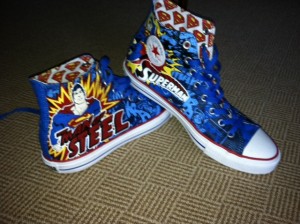
Yesterday, I received my own set of special shoes – Chuck Taylor Superman Shoes.  They were a gift from a group of people in the Shifting Gears Program where we spent over 100 hours together on a career transition journey.  I was part of a great team of people that facilitated the journey, but these 21 individuals did the work.  The shoes became a symbol that we needed to remember what strengths and talent are inside of each of us.  I love the shoes.

Performance can be attributed to a lot of things, but in the end it is about confidence and commitment to learn/grow through the peaks and the dips.  It is also about being in community with people, giving to that community, and leveraging the the strength of that community to celebrate the peaks and to climb out of the dips.  For 21 people in the Shifting Gears program, it was about coming together on 13 different days, spending 80+ hours working at a real company on a real business need, spending another 100+ hours networking/rebuilding a resume/mock interviewing and other work to move towards a preferred future.

One individual shared the story – I went back to a familiar place (my old company), but as I entered I could feel that it had stayed the same and I was a different person.

Is it the shoes?  No, it is what is inside of us that we need to see AND to unleash on something that we are passionate about.

But I do love the shoes. 🙂

Can the CEO Coach? 2 Myths that get in the way

I learned by diving in – Why can’t they?

This statement was not meant to be mean or pass the buck, it was born from the frustration of seeing senior level leaders not rising to the occassion after being given significantly more responsibility.  I see it happen too often.  It is a painful scenario, and it is one that can be avoided.

When the focus is put on answering the question – How did we get here?, the root cause ends up being some attitudes/assumptions that started the motion down the wrong path.  Here are the top two:

Myth #1 – I did it all on my own, why can’t they. Really?  As a parent, many times a day the thought creeps into my head “When I was little I had the same challenge, and I just figured it out .”  Nobody ascends on their own.  Whether its a spouse, mentor, friend, or some other significant person – someone stepped in hand helped you through rough spots.  Solution: Commit 30 minutes a week to review goals, review progress, and answer questions (called a one on one)  Here is a link to a template if you need one.

Myth #2 – It is okay to lose some of  my money while they learn.  Why do they not feel safe? Have you ever had the angst of telling your parents that you had an accident with their car?  It was one of those conversations that teens through the ages have crafted countless schemes to avoid.  We grow up, get a job, and all of the sudden we make a mistake that costs our organization thousands of dollars, and it is like we were a teenager again.  Solution: Make it okay to make a mistake, provided you own it and have a plan to fix it.

When people become leaders of leaders, they realize how difficult it is to work through others to get results, and sometimes the default is to either leave them alone to figure it out, or step into their lives and help manage the details.  Ken Blanchard called this Seagull Management.  Fly in, dump, then leave.

Find an answer somewhere in the middle.  Don’t be a Seagull.

Questions to help the work get done (and the team to be built)

Seth Godin had a recent post titled Two questions behind every diagreement.  In it he shares two questions that will help move through/solve every disagreement:

  • Are we on the same team?
  • What’s the right path forward?

By definition, you cannot have a team without common goals and group decision making power, and getting there requires conflict.  These are two great questions, but let me add a few more to help you apply this in your own team and move things forward:

1. Are we on the same team? –> What is the issue?  What is the outcome we want?

2. What’s the right path forward? –> What are three steps that will move us ahead?  What 1 step will I own?  What 1 step will you own?  What 1 step will we BOTH own?  (remember 1 + 1 + 1 = 3)

If you cannot answer/agree on #1 don’t skip/move ahead to #2.  The key to #1 is addressing the issue and not the person – ie.  If the issue is someone or what someone else needs to do to make my life easier, then the whole discussion is about winning and not solving a problem.  That means you are the problem –> so step back, take a deep breath, apologize, and step back into the discussion with a different mindset.

If you get to #2, the best way to build teamwork is to own work together.  If a solution takes 20 steps and 3 months, focus on the next 3 and 48-72 hours.  Progress/success builds relationships between people and teams are created along the way.  I can hear the complaints now – – But this is a very complex problem and 3 steps is too small. My next question:  Is the issue that the problem is too complex or We are not agreeing on/owning a solution as a team?  In either case – either start moving forward or punt the problem to another team.

fyi – If anyone on the team has a goal to sit back and let someone else fail so they can either:  a) Ride in and save the day or b) Play the I told you so card – – – they should be given one chance to hit the reset button, and then removed from the team.

Thanks for planting the seed Seth.

4 Things That Identify a Great Community

Tomorrow starts Cohort #12 of an amazing program created in Michigan called Shifting Gears that helps people through job transitions.  My involvement in the last year has been a blessing in many ways, not the least of which being the amazing team that I get to work with since starting as the lead facilitator of the program in June.

A cornerstone of the program is creating a community that supports the hard work of making a career transition.  Dr. Diana Wong, who is the creator of the program, added this unique aspect because she understands hard work and achievement.  She also is a master at creating community around herself as a normal habit, and how she does that is probably worth a couple more blog entries.

A great community, like a great team, has some unique characteristics that make it a special place.  Here are four that stand out as I think of Shifting Gears.  Great communities are:

  • Welcoming –  One habit in Shifting Gears is asking people to stand up and say their name when they speak.  When a guest speaker comes in that habit becomes a way to welcome every time someone speaks because they know the name of the person who is speaking.  We also put speakers before lunch so they can stay and share a meal/conversation with the participants.  As a facilitator, whenever someone stops in to share the space with us (ie. a guest) I stop whatever I am doing to make a proper introduction.  Taking time to get to know each other, knowing the names of new people, and greeting with a smile are welcoming steps.  Great communities do this out of habit.
  • Supportive – The formal time together might be meetings, learning events, or even organized gatherings.  Great communities go beyond that by asking How can I support you as you prepare for this networking event? or I noticed you are not yourself today – What is happening in your life right now?. Support is ultimately an action, but it starts with a question and the presence to work through a meaningful answer.
  • Require involvement/ownership – There is a charge of $500 to join Shifting Gears, and for someone who is without a job this is a sacrifice to spend this money.  It would be very easy (and happens often) to come into the room the first day with a customer centric approach that asks What can this program do for me? – after all that is what I paid for.  Joining a community is not about What can I get out of this?. We reframe that question to What is the work I need to be doing for/in this community? .  A great example is networking.  A program circulates want adds or connects job seeker to job boards.  Shifting Gears has a big focus on networking, connecting people to networking events, encouraging the sharing of networking events within the community, and asking people to own the work of networking.
  • Forgiving – Communities have high standards and challenging goals, and sometimes people fail to meet the standards.  Great communities circle around people when they have a setback, and help them work through it.

The four points above can be used by a leader to measure the progress of the team towards becoming a great community.

I look forward to walking with the 39 individuals that will show up tomorrow as we create a community within the new Cohort #12.

What is your learning BRAND?

There are two questions I love to ask people to get a sense for how they learn.

1. Where do you get your learning?

2. What is your favorite TED video?

These two questions help me understand their brand as a learner.  It helps me see how the trends in information flow and the tools that have emerged to create communities around topics have been absorbed into their lives.  For example, if I hear the standard – I am a reader, then I know they prepared for the interview, but question if they are prepared to help my business hit our 2020 goals.   If I hear the talk about a website I have never heard of, discuss what they learned on LinkedIn last week, or try to convince me to drop Business Week in favor of Inc or Wired, then I know I have someone that is hungry and resourceful.

So why TED? Over the past 12 months I have been blessed to be part of a program called Shifting Gears in Michigan, and it has exposed me to individuals in transition that have 15-20+ years of work experience.  When I ask the question, who watches TED videos, <25% of hands go up.  TED is free, it is thought provoking, and it is mostly normal people sharing amazing passion/knowledge for a topic.   It is also not new, and if you are not familiar with it or not plugged into it I will venture a guess that you are not a real active, self-driven learner.  It makes me smile to think of the Shifting Gears participants who begin to own their learning.  Your learning Brand is not about age, it is about attitude and energy.

Elliott Masie, a learning futurist, is having his annual conference this fall and will be talking about how learners want things customized just for them.  He is right (by the way – the answer is called Google or LinkedIn Groups and it is not in the future).  The good news for small businesses is that if you have Google and spend time with your people talking about what they need to learn or what they have learned and used at their job (fyi – development plan) – then customized learning can be mostly free.

Ask the questions.  Listen well to the answers.  For job seekers, work to make your answers compelling and authentic.  Help me get excited about your learning Brand.