Follow

Follow on Twitter  trU Group on Facebook  Connect with Scott on LinkedIn  RSS Feed

Subscribe

* = required field
Mailing List


Posts by Month

Search for:

Mini Tweets

Blog Featured In

Featured in Alltop

Posts Tagged ‘conflict management’

Questions to help the work get done (and the team to be built)

Tuesday, September 25, 2012 @ 08:09 AM
posted by Scott

Seth Godin had a recent post titled Two questions behind every diagreement.  In it he shares two questions that will help move through/solve every disagreement:

  • Are we on the same team?
  • What’s the right path forward?

By definition, you cannot have a team without common goals and group decision making power, and getting there requires conflict.  These are two great questions, but let me add a few more to help you apply this in your own team and move things forward:

1. Are we on the same team? –> What is the issue?  What is the outcome we want?

2. What’s the right path forward? –> What are three steps that will move us ahead?  What 1 step will I own?  What 1 step will you own?  What 1 step will we BOTH own?  (remember 1 + 1 + 1 = 3)

If you cannot answer/agree on #1 don’t skip/move ahead to #2.  The key to #1 is addressing the issue and not the person – ie.  If the issue is someone or what someone else needs to do to make my life easier, then the whole discussion is about winning and not solving a problem.  That means you are the problem –> so step back, take a deep breath, apologize, and step back into the discussion with a different mindset.

If you get to #2, the best way to build teamwork is to own work together.  If a solution takes 20 steps and 3 months, focus on the next 3 and 48-72 hours.  Progress/success builds relationships between people and teams are created along the way.  I can hear the complaints now – - But this is a very complex problem and 3 steps is too small. My next question:  Is the issue that the problem is too complex or We are not agreeing on/owning a solution as a team?  In either case – either start moving forward or punt the problem to another team.

fyi – If anyone on the team has a goal to sit back and let someone else fail so they can either:  a) Ride in and save the day or b) Play the I told you so card – - – they should be given one chance to hit the reset button, and then removed from the team.

Thanks for planting the seed Seth.

What if We Called It Your Individual Development Story?

Tuesday, July 31, 2012 @ 08:07 AM
posted by Scott

ACCOUNTABILITY. FOLLOW-THRU.

When we think of anything with the word PLAN in it, do these words quickly follow in your mind?

What if we called it something different?  For example, instead of your Individual Development Plan, what if we called it your Individual Development Story?Talent Management - Writing your story

If you think of it as a story, it would have a main character – You – in all your strengths, experiences, successes, weaknesses,  and moments of non-performance.

It would have . . .

. . . history that helps you frame your character with terms like talents, passions, rewards, and realities. (what I call your trUYou)

. . . a current story about where you are today and what might be changing for you.  It would also have some preferred future that gives us a sense of where the story might be going.

. . . ownership. It is our story and although we need to ask others for help, in the end it is ours to write and to tell.

. . . portability. Sometimes our story needs to go somewhere else to move ahead - another role, another project, and maybe another organization.

. . . help.  If we know you and understand where you desire to go, then we could choose to enter your story and join you on the journey as a mentor, a friend, a partner in accountability, or maybe even a fellow learner that desires the same journey.

If we know our journey will be challenging journey, then maybe we hire a coach.  They would help us step back and see things differently, or rewrite the journey so that the story takes us to some different places and outcomes that we might not see by ourselves.

I am thinking of renaming my template as I prepare to share it with the human resource professionals at the Illinois SHRM Conference next week.  Too many people do not have them based on the Talent Scorecards I have given leaders and too many I have seen lack the pieces that tell a great story.

I would like my story to say that I worked, with others, to change that.

It feels like a great conversation.  I love great conversations.

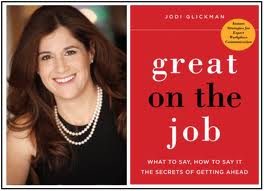
I am in the process of reading/reviewing Jodi Glickman’s book Great On The Job – What To Say, How To Say It – The Secrets of Getting Ahead.  As I go through it I will share some thoughts that make me go Hmmmm . . .  This posting is based on one of those moments.

What is the secret to speaking what you feel about someones performance and having it end up in a place where the relationship is still intact (or stronger) and your thoughts are heard?

The first and only tip – Focus on how you request and receive feedback from others.

I read Jodi Glickman’s book Great on the Job, and one quote is stuck in my head.  It is under the chapter of Ask for Feedback and the heading of Say Thank You.  The quote is (p. 129):

The goal, however, is continuous improvement and learning, not just feeling good.  If you have a tough feedback session, remind yourself that the goal of the session is not to make you feel good.  The goal is to make you better at your job.


Talent management is about great conversations, and the definition of a conversation is a form of interactive, spontaneous communication between two or more people who are following rules of etiquette. (wikipedia)  We all need to hear what is going well, but we have to be able to hear what we can do better.  At the heart of this conversation is a lot of smaller conversations around -  How am I doing?  What is going well and where do I need to improve?

How can we use this as individuals?

First, recognize that giving feedback is a lost art for many leaders who are, themselves, caught in a spot where nobody is telling them what they are doing well (when is the last time you told your leader about something they did well?) and the list of to do’s is only getting longer.  So, our job as individuals is to ask for it well,  stay calm in the moment of receiving it, and respond by saying thank you without our faces getting red or our jaws tightening.  Then do something with it that creates momentum for you and the organization.

Second, put extra focus into defining your role/objectives and own the one on one time with your leader.  This makes talking about performance  easier.  Here is a template if you want an example of what that looks like.

Getting and giving good feedback is not easy, but it is pretty simple.  I wonder what would happen if both leaders and followers read this one chapter together and tried it for a couple of months.  My guess is some great conversations would happen.

What tips do you have for giving/getting good feedback?

Friday Fun – The cumulative effect of Happy moments . . .

Friday, March 23, 2012 @ 08:03 AM
posted by Scott

In his interview about happiness in HBR, Daniel Gilbert makes the following statement:  “…the frequency of your positive experiences is a much better predictor of your happiness than is the intensity of your positive experiences.”  It is not the big initiatives, but the cumulative effect of the little things we do at work and at home to generate smiles that makes the biggest difference.  While we are thankful for some research – Did we really need some PhD to tell us that?

So what can we do with this?

Every culture treats humor differently.  For example, I am not sure a That Was Easy button or a zany sound effects box would work in a bank.  What about comments about what people are wearing, or smiles received or handing a sucker to a customer with a smile?  Anything where we purposely create one of those moments that Gilbert talks about will make a difference.

Maybe a good Friday goal would be to generate 6 smiles in other people.

Here is my first try:  A great video about how making people smile caused a shift in their behavior.  It made me smile, and is just good clean fun.  Take a look.


Are you a BUT or AND leader?

Tuesday, January 24, 2012 @ 09:01 AM
posted by Scott

A coach and mentor taught me the lesson of substituting the word AND for BUT in my statements.

BUT . . .

  • sends the message that the important part of the message is coming.
  • begins the process of rebuilding a thought or action plan.
  • says start listening.
  • is an accountability word.

AND . . .

  • recognizes progress and paints a picture of a preferred future.
  • begins the process of building upon a thought or action plan.
  • says keep listening
  • is an accountability and problem solving word.

Assignment:  Listen to how you and those around you use BUT / AND today.  What do you notice?

I would welcome a few posts of BUT or AND sentences that you hear.

Universal truths: Leadership, Parenting . . . and conflict

Monday, January 23, 2012 @ 09:01 AM
posted by Scott

I recently reviewed a book on these pages by David C. Baker, and in my interview with him he talked about parenting being a place where leaders can learn.  He related it to his own experience where the things unsaid often consumed more energy than the things that were said.  Reminding us, as leaders, parents, wives, husbands, and friends – we need to find ways to share the truths as we see them.

I was reminded how being a parent or leader is so similar, and the things we learn to be effective at both roles are the same.  It hit home for me when I want to a parenting seminar from celebratecalm.com and Kirk Martin talk about dealing with teen children.  First he described the boiling over of emotions that often happens in tense situations,  and for me and several friends it was a familiar reaction.  Then he talked about a more effective way to acknowledge what was happening, step back (find another place), and then address it.  He even talked about using the simple action of sitting to help put ourselves in a physical position to effectively deal with conflict.  It was obvious how these skills, used consistently, would alter the conversation and help create a more positive outcome on many levels.

It is important to recognize the roles we play in life (parent, leader, teammate, spouse, friend), our priorities for those roles, and the actions that need to accompany our commitments in these roles.  Too often we think we have to shift gears to play those roles, when in reality many of the skills that make us a good leader will make us a good parent, a good neighbor, or a good friend. 

And if we are an overbearing/directive leader – well maybe that is why teenagers were created. :)

Leadership: The Power (And Trap) Of Non-Verbals

Thursday, January 19, 2012 @ 02:01 PM
posted by Scott

We have been studying nonverbal communications in class and it is interesting how you can tell what people are thinking by their actions – especially when they are inconsistent with their words.  Is it important for leaders to know this?

I received this note from a leader who also loves to learn.  It reminded me of a couple of things:

  1. 60-70% of our communication is non-verbal 
  2. Great communicators have mastered non-verbal cues
  3. Stress behaviors for leaders (according the the Birkman Method) often shows up as us sending the wrong nonverbal signals

My big concern about teaching leaders how to read non-verbal signs is that we fail to teach them the skills needed to use it to have a great conversation about how a person really feels.

It is a slippery slope if we start taking a nonverbal cue as their statement.  Imagine the power of a leader saying “I heard you say you supported the decision, but I sense that support is not 100%.  What % would most accurately gauge your support? . . . . “ 

Understanding non-verbals gives leaders/individuals a tool to know when to hit pause in a conversation and allow someone space to share what they are thinking/feeling. 

My admission (I am supposed to be skilled at this) - Today I read a nonverbal (watery eyes) cue and my interpretation was someone is done reviewing their Birkman results after a 90 minute discussion.  They had absorbed all they could in one sitting. When I shared that perception it turns out it was allergies, and that launched us into 15 minutes of great conversation.  I was wrong, and I am glad I found out before I unilaterally shut the conversation down.

Read them – yes.  But remember that it is a cue to keep talking / listening.

For my blog readers – the following is a post inspired by questions received from HR leaders that I will be talking with tomorrow as I share with them my talent scorecard presentation.  My pledge is that I will answer questions they have, and these were submitted as part of a survey I asked them to take.  It is in the vein of what I normally talk about, but exceeds my personal 200-300 word limit that I try and stick to because I want our conversation to fit into your busy schedule. :)

Question:  How do you create an employee development program specific to the needs of each employee?

I found out an interesting fact several months ago – 99.9% of organizations in the United States have less than 500 employees.   These organizations employ about half of the people in our economy.  This feeds into this question because the traditional answer to the question from training and development is to:  1) Develop job descriptions  2) Define competencies/measures for each role  3) Perform a gap analysis  4) Create a plan based on gaps  5) Revisit yearly with a performance evaluation.  Most organizations do not have the time, HR expertise, and patience to do all of these things.   Two things that are critical in developing people:  1) A trusting relationship between leader and follower  2)  A conversation around what they need (both company and individual) that is captured in a plan   2.5)  A follower ready to own the plan and a leader committed to supporting it.  Here is a link to the development plan and other templates I provide that will drive the right conversations and capture key information in a written form that can be managed.    fyi – it is that simple, but not necessarily easy.  I can blog on that at another time if you would like – just ask.  ANY size organization can put development plans in place for their people, and it is the key to helping people develop.

It states in Crucial Conversations that “one study of 500 stunningly productive organizations revealed that peak performance had absolutely nothing to do with forms, procedures, and policies that drive performance management.”  From my experience, I agree.  Please discuss how the process you are presenting makes a true difference in peak performance, including the aspects of the process which are most crucial to success. 

The reference to Crucial Conversations is a series of two books published by and sold by a consulting group called Vital Smarts.  My belief system on performance was actually born out of a conversation I had with one of their partners and a co-author from another book they published, Influencer.  I spent a couple of days with David Maxfield listening to him teach and working with him on a rollout plan.  Let me say the guy is brilliant, experienced, and their focus on helping organization/leaders become great at having difficult conversations is world class.  But in one conversation I asked “Do you assume that organizations you are trying to help already have a culture in place where regular one on one discussions are already happening, because it seems that is the key place where it would be easiest to practice what you are teaching.”  His answer was “Yes’.  What I knew based on my conversations with leaders in this growing organization was the one on one habit was not firmly in place.  As a result, the implementation of this key leadership skill was spotty at best.  I agree that conflict management is a critical leadership skill to enable great performance, but  I base performance/talent management on the relationship first, and then the other pieces/habits build off that.  I also agree that it is not policy, procedures first – - but I also know from experience that in order to Build Rhythm there has to be some structure in place.

I love talking to groups and want to make the conversation longer than an hour long keynote.  Feel free to comment or ask follow-up questions.  I welcome them.

My Top Shelf – Books that I love

Wednesday, December 7, 2011 @ 09:12 AM
posted by Scott

Everyone should have a top shelf – the one you share with people at work when they ask for a reading recommendation.  A few caveats on my list:

  1. I generally only recommend books <200 pages, with a few exceptions.  (I favor authors who have mastered clarity, passion, and brevity)
  2. These are around business and/or personal development books.
  3. I will explain any selection, but not apologize or argue about it.  It is my shelf – so build your own if you disagree. :)
  4. I do not loan these out, but will often buy people a copy.  They are marked up and I would hate to lose them.

It has expanded over the years, but my general rule is that the number has to be limited.  Now to add one I have to take one off.  I had a shelf with about 8 books for many years, then I got a bigger shelf. 

Here is my top shelf:

(they are in no particular order – but left to right in the picture)

  1. The Mindful Coach – Doug Silsbee
  2. Co-Active Coaching – Whitworth/Kimsey-House, Sandahl
  3. Sway – Ori/Ram Brafman
  4. Outliers – Malcolm Gladwell
  5. All Things New, A Fable of Renewal – Rodger Price
  6. Confessions of a Public Speaker – Scott Berkun
  7. Good to Great – Jim Collins
  8. First, Break all the Rules – Marcus Buckingham/Curt Coffman
  9. Fierce Conversations – Susan Scott
  10. Linchpin – Seth Godin
  11. Strengthsfinder 2.0 – Tom Rath
  12. How Full is Your Bucket – Tom Rath/Don Clifton
  13. Mastering the Rockefeller Habits – Verne Harnish
  14. Drive – Daniel Pink
  15. One Minute Manager – Ken Blanchard/Spencer Johnson
  16. For Men Only – Shaunti and Jeff Feldhahn
  17. Mastery – George Leonard
  18. Let Your Life Speak – Parker Palmer
  19. Rework – Jason Fried/David Heinemeier Hansson
  20. The Five Dysfunctions of a Team – Patrick Lencioni
  21. Death By Meeting – Patrick Lencioni
  22. The Will of God As A Way of Life – Gerald Sittser
  23. Season of Life – Jeffrey Marx
  24. The Servant – James Hunter
  25. Who Moved My Cheese – Spencer Johnson
  26. Into The Wild – Jon Krakauer
  27. HalfTime – Bob Buford
  28. Tribes – Seth Godin
  29. The Five People You Meet In Heaven – Mitch Albom
  30. Jonathan Livingston Seagull – Richard Bach
  31. Do the Work – Steve Pressfield

Some are great books, and some have achieved significance for other reasons.  In the end, I will recommend other books on occassion, but I love these selections.  In addition, I also have 2-3 Harvard Business Review articles I love for people not having time to read.

Looking for a good question to ask your new leader?  What two books stand out in your mind as great?  (might be a good idea to read them – it will often explain how they think and what they value)

Submit a question to this posting if you want a more detailed explanation on any of these selections.

A trap: Over Leading and Under Caring

Monday, November 21, 2011 @ 09:11 AM
posted by Scott

I have seen several recent posts about leadership vs management.  Here is a link to one from Seth Godin .  They made me think.  First let me say that when I see this topic come up I roll my eyes, because most discussions seem to elevate the importance of leadership and the confining nature of management.   Here is my take . . .

It is important to be a leader.  Vision has to be cast, the rallying cry needs to be heard, and the organization needs to see relentless energy towards the goal.  But, the relationships that make your team really go are built when you manage.  Managing is about connecting to people one on one, knowing their struggles, understanding their needs, and being familiar with their lives(distractions/support) outside work.  One piece of evidence I point to is something a peer shared with me about executive onboarding.   Her business is built 100% around helping executives make successful transitions.  Part is to highlight/fix communication issues and help navigate the complexities of organizations.  But part is to just bring some of the ‘other’ things into the discussion like:   What is my true job description? and How prepared is my family for this change?.

We need to be careful about outsourcing managing.  Is it wise to spend $xx,xxx on a successful transition of a $xxx,xxx executive?  An ROI can be easily proven based on the leader’s impact on the income statement and the balance sheet. 

The hidden benefit of spending a little time as a manager/CEO gives you a glimpse into the person, not the leader.  This is where the relationships are built.

I think back to a ‘relationship/leadership’ session I lead one time with a CEO and leadership group.  The day after that session the CEO quietly asked the HR team to assemble a list of  family members for all the people on the team.  I celebrated the request, but was reminded that some of these people had worked for him for 3+ years.

My advice for leaders - Don’t forget to manage a little.

Post tomorrow – 3 Habits That Will Help Leaders Manage Well

This site is protected by Comment SPAM Wiper.