
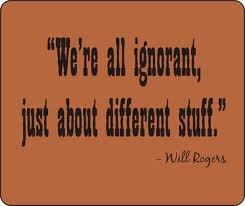
Can You Hire and Lead the Ignorant?

In a meeting recently I was with a group of people deliberating the hiring of a leader for a not for profit organization.  One observation was a lack of experience in a fairly important area.  A wise member of our group pointed out that it could be a good thing because ignorance = fresh eyes.  We all agreed that it was a good choice, but only if we all committed to supporting this new leader and connected her with a mentor.  We committed.

I like the word ignorance.  I like using it in front of groups because people snicker, almost like it is some sort of soft cussing word.  I have to remind people that it just means I don’t know.  Not I can’t know or I will never know . . . just I don’t know.

Here are some rules for hiring ignorance:

  1. DO IT if you see passion and gifts that get you excited about having this person thinking with you AND you are committed to #2.
  2. DO IT if you are ready to actively support (mentor/coach) for 6-12 months and forgive some mistakes.
  3. DON’T DO IT if your industry is too complex/specialized, you are too busy, and your team is too talented to be patient with a learner.  You might read this as sarcasm – but I really mean don’t do it.  If any of these three things are true or perceived to be true it is not a good place to shed ignorance.
  4. DON’T DO IT if you sense a comfort with the ignorance – if there is not hunger to leave that state.  Look somewhere else.

Ignorance is actually the basis of a good development question for leaders and followers alike. 

  • What do you feel ignorant about right now? 
  • What would it mean to have that feeling go away?
  • What is one thing I could do to help make it go away?

Carry that word around with you for a couple days and see what you notice.

Written a note lately?

Yesterday I received a letter in the mail that said ‘thank you’ for something I had done.  I read it once, then a second time later in the evening, and started to throw it away when I realized I needed to keep it.  So I put it with some other letters I had received previously.  As I looked at the stack I realized some had been in my possession for over 10 years.  The written word has something special about it.  I read a statistic one time that said 3% of thank yous were written and over 80% of those notes were still being saved 12 months later. 

Written one of these lately?

A staple in any leadership development program is to write a note to someone thanking them for something they did that had real value.  A habit for any leader should be to have a stack of cards in their office and write 2 per month.  Here is the card I have used for 5+ years and having them ready removes the excuse of I will do it tomorrow when I have something to write on.

I always look at writing a thank you as making a deposit into a trust account.  There will be a point in time when I will have to say I am sorry for doing something that hurts a relationship.  My mental goal is thank you notes >= sorry statements.  If I am sorry > thank you then withdrawals are greater than deposits, and it is a bad trend. 

If you control this equation by never saying I am sorry as a leader then you win, but there will be a price to pay.

In my house there is a standing joke that anything Dad has that is older than the kids is special.  So far that list includes my marriage, some tools, some sporting equipment, a few t-shirts, underwear, and thank-you notes.  I know – too much information. 🙂

Watch yourself this week – How often did you say thank you?  How often did you say I am sorry?  . . . . and write just one note!

Knowing Someone Changes How We Treat Them

I joined the board of a great organization that cares for seniors and at my orientation they shared this story.

In building a new facility display cases were placed by each room.  Filled with pictures and items for residents of adjacent rooms, they were meant as landmarks to make finding rooms easier.  This practice had proven effective even with dimentia cases.  They received a surprise.  Employees and others observed a higher quality of care because these residents became people with an 80+ year history that was known to all those around them.  In one case, it explained why a resident veteran who had been a POW tried to crawl out a window because of loud noises.  Instead of medicating the resident they provided comfort. 

History gives us context for current decisions we see people make.

When a friend acts irrational we know the history – and work through it.

What a stranger acts irrational we judge the action – and walk away or around it.

When we ask and listen it sends a powerful signal – we care.

Under stress, we too often forget to stop and listen to stories.  We see ourselve as busy.  Others see us as cold and uncaring.

Here is a tool I use to jumpstart the work relationship building process.  Instead waiting to hear the question “Tell me about yourself”, I give this info and ask for the same in return.  It is just a start, but it is a good start.

One last story . . . I used this tool to kickoff a planning session for a leadership team.  The next day the CEO called the HR leader and quietly asked for a list of names of all family members for each executive on his team.

Some things are important no matter how old we are.  Knowing someone changes how we treat them – and how they treat us.

How do you motivate others to do more? #followership

For my regular readers of my blog – this is a longer than usual entry.  Here is why . . . . . . .

I taught my class on Leadership / Followership (Building Organizational Performance Through Teamwork and Understanding) at the Holland Chamber of Commerce on Thursday (May 19th) and pledged to the participants that I would blog answers to any questions they had that could not be answered in class.   Here is the question and my answer – for clarification make a comment and we will continue the discussion . . . .

Question:  How do you motivate a follower to move up to the next level(s) without influencing, or dragging down, the others on the team?  Example:  A Minimizer to a Doer?

Answer:  This is a big question, so I will focus on the toughest situation, which is working with a Minimizer to move to a Doer.  (Here is a link to a post where I define my 5 Levels of Followership)

First question:  Start by asking yourself if this person has demonstrated a positive attitude and commitment to the organization.  Is it someone you want to have around?  If the anser is “No” or Not really”, then follow whatever process you have, but make plans to move the employee out of your organization.  Minimizers take energy that could be given to other, more valuable people in your organization.  If the answer is yes I want to keep them read on.

Part 1:  Understand the Situation (especially your role)

My first thought is to recognize the role of the leader in this situation.  The basic information that people need about their role is: (these are from the Gallup Q12 that are explained in the book First, Break All The Rules)

  1. Clear understanding of their job duties and measures of success.
  2. The tools (skills, training, support) to do the job well.
  3. An opportunity to do what they do best every day.

The first question is one that you define for them, and it would be a good exercise for you to write down the 5 or 6 key things you expect them to do in their role.  Question 2 is one you should address together based on your knowledge of what specific things they need to know and their knowledge of what they need (or might be uncomfortable with).

The challenge you will have is in the conversation to get this information on the table and have a great discussion about it.  As a leader, your key role is to get this information on the table in such a way that it can be dealt with and decisions can be made.

Part 2 – The Traps

The second issue is around the harsh realities of these situations.  In your question you mention wanting to avoid dragging the team down.  Here are three things to think about:

  1. If there is a Minimizer on the team everyone knows it and are probably waiting for you to deal with it.  Your inaction is having a negative impact on the Trust they have in you as a leader.
  2. The Minimizer probably does not know they are thought of that way.  I know leaders always struggle with this, but after being pulled into dozens of situations like this, I can safely say that at least 90% of people being fired or getting talked with about their lack of performance are surprised when it happens.
  3. Ask yourself the questions Am I ready to let them go if their performance does not improve and Am I willing to put in some hard work for the next 60-90 days to help them be successful?  These are the two questions I ask in choosing to help save someone.  If either question is NO then it is a situation that cannot be fixed so live with it.  If it is a relative (as happens with small businesses) – Maybe pay the person to stay home and get on with work.  This sounds crazy, but if they are taking energy from you and making mistakes that are costing the organization dollars it is too expensive to have them around.

Part 3 – A solution:

1.  Meet to get the issue on the table.  The key to this conversation is to make your observations known about their performance.  When sharing your feedback, focus on the situation and not the person.  When sharing the performance use the format “Here is the behavior I see, Here is the impact, and here is how it makes me feel.  Any conflict management book uses this as the basic outline.  Here is an example of how this might sound in a sentence.

Joe, you have worked here a long time and I have appreciated your dedication to this organization.  I have observed a few things recently in your performance that I want to talk about.  Last Tuesday a customer called with a problem and I heard you say “That is the only answer I have so if you do not like it, tough.”  The outcome of that discussion is the customer has taken all of their business to a competitor.  I am feeling frustrated because we worked hard to land that customer and keeping customers happy is critical to the future success of the business. 

A great resource to explore this discussion is Fierce Conversations by Susan Scott.

They have two things to do in step 1 before things move on:  1) Take ownership for the performance issues you point out   2)  Express and demonstrate the desire to make the changes necessary to be successful.  If these both do not happen (give them 24 hrs to think about it if necessary) then there is no sense keeping them.

A key piece for you in this conversation is to be open to their feedback on things you could be doing differently that would help them be successful.  Maybe they need weekly check-ins or you have not been really prompt about returning calls.  It could also be that they are in the wrong role.  Be willing to listen and consider things they bring up.

2.  Create a plan for their success that includes:  1) Short term(1-4 weeks) and long term (3-6 month) goals   2)  Area of focus to improve their performance – Build Trust, Build Focus, Build Confidence, Build Rhythm  3)  Needs they express (in areas of Support and Personal Development)

This is not an area where there is a set recipe.  The key is to ask yourself the critical question up front (do you want to keep them) and then get the truth(of their performance) on the table and Build Trust by demonstrating that you want them to be successful. 

Here is a link to a trU Tips  and a video on the topic of dealing with low performers that might also be helpful.

Great question – thanks for asking.

Breaking a team impasse #followership

For my regular readers of my blog – this is a longer than usual entry.  Here is why . . . . . . .

I taught my class on leadership and followership (Building Organizational Performance Through Teamwork and Understanding) at the Holland Chamber of Commerce on Thursday (May 19th) and pledged to the participants that I would blog answers to any questions they had that could not be answered in the class.   Here is the questions and my answer – for clarification make a comment and we will continue the discussion . . . .

Question:  I am facilitating a team decision making activity and consensus has been a challenge.  Though my emphasis is on harmony, consensus isn’t always attainable.  What do you recommend to help move beyond the stalemate?  How can I act with boldness without offending or alienating?

Answer:  Getting teams to work together towards a common goal can be a challenge, especially when it seems that personal agendas are taking priority over a team goal.  Also, if you see behaviors that are keeping the team from moving things ahead, you will have to say some things that have the potential to offend or alienate.  So let me make some assumptions here:

  • This team has a leader, but it is not you – your role is the facilitator.
  • The team has a clear goal / outcome they are working towards.
  • The individuals want to be on the team.
  • You have the ability to walk away if the team is not working

A couple of questions:

  • How clear is the team goal?  (what they are supposed to accomplish)
  • What behaviors do you see happening that are distructive?
  • How strong is the Trust within the team?
  • Are you willing / able to tell them what you see?

I assume the team is stuck and they feel it.  First, meet with the leader and plan a team meeting focused on three things:  1)  Restating (and reaching agreement) on the problem the team was brought together to solve  2)  Documenting (on a board where all can see) the solutions that have been presented   3)  Asking:  How everyone is feeling about the team? (what one word would you use to describe your excitement towards this team / process right now?) 

Point 3 will tell you where people are and might give an opening for you to describe what you see.   The discussion then should focus around What can we do to get thing back on track so we reach a decision that we can all support.  It might also give you a window to address some of the behaviors that are not moving things forward, and you might even encourage the team to create a set of guidelines they all agree upon to guide future discussions. 

The key is getting them to see the goal, agree on it, and make a commitment to finding a solution.  This will give you a chance to share what you see and restart the process using some good brainstorming, documenting, and teaming techniques so people begin to understand the value each brings to the table.

If the commitment is not there, I would walk away.

Level 5 Followership – #TED style

TED Followership Video

I just watched a video from TED that made me think of what I have called a Level 5 Follower, which is an Influencer.  My definition of an Influencer is someone who works to alter strategies or activities that will have a big impact on the organization.  Measures their contribution by the things started and the opportunities to do more.

This video makes me think of the Influencer.  They don’t necessarily always think of the big ideas, but know a good idea when they see it and jump on board with their heart and soul as if it was their own.  Watch the video – – – think a little – – – and probably laugh a lot. 🙂

5 Levels of Followership

Great Followership is a choice – Why it matters

Leadership Assistance Program

One day an employee showed up at my office and spent 5 minutes sharing some very personal medical problems.  I listened, and her greatest fear was not about the procedure, but how to tell her actual direct boss because the solution would require her to miss work.  She was worried about losing her job.  I calmed her fears, and she was then able to go have a discussion that she should have had several weeks before, but couldn’t.

This ever happen to you?  While health issues are serious things, it felt good to be a trusted.  It also took me back to some coaching training I had years before that taught me to listen well, and to know where there might be boundaries to be drawn.  Some conversations stay within boundaries, but there are things as leaders that we need to direct people to get help.  Sometimes Leaders need an Assistance Program.

When I was a leading HR in an organization we implemented an employee assistance program.  EAP’s require organizations pay a monthly or yearly fee per employee and the employees and their families have access to basic personal counseling services, referral help for substance abuse issues, career counseling, and other forms of assistance.  It is confidential for the employee, and the employer only gets a report on the number of people who have used it and basic service information.  I remember getting the first usage report and our usage was a couple percentage points above their norm.  In people terms it equated to two individuals receiving help.

I was grateful that those 11 individuals had received the help, and that the leaders of those people had also benefited from this safety net.

Leadership is about being there for your people, and it is also about knowing when you need to get assistance.  Celebrate being asked to be part of a tough conversation, but know the limits of your burdens/responsibilities. 

Gallup research shows people are happier/more engaged if they have 1 to 3 best friends at work. 

Friendships is another form of Leadership Assistance Program – and it is a free.

Stress and Leadership – Measuring the impact on self, what about others?

A thought hit me several months ago – If being a CEO is such a difficult job (it is), then what the divorce rate is versus other jobs?  As it turns out a study was done, and chief executives had a 40% lower divorce rate than the overall average of all occupations in the study.  Their rate was 70% lower than dancers, bartenders, and massage therapists.  Here is a link to the study. Based on this measure, it can be said that leaders personally handle a lot of stress.

Conversation done?  Not exactly.  In working with teams and leaders I have seen it from another perspective.  What is the effect of a stressed leader on the rest of the organization.  For leadership and team development I use a tool called the Birkman Method.  The advantage I have found in this assessment is that Dr. Roger Birkman has found a way to measure not only surface behaviors, but underlying needs and the stress behaviors that result from needs not being met.  Here is an example.

Many senior leaders I have worked with have a work pace that is very fast, and have a high need for practical and tangible results. The Birkman uses phrases like a need for practical results, opportunities for physical action, and activities that focus on practical results.  When these needs are not met, Birkman describes the stress behaviors as acts without thinking, generates restless tension, and impatient/edgy. 

While leaders have to be able to handle lots of stress, do these behaviors sound familiar?  What is the impact of these behaviors on a team?  Peer relationships?  An organization?

It is great leaders can handle the stress.  But what about the impact it has on everything else?

Developing People = Crockpot Cooking, not a microwave

I once stood in front of a group of nursing leaders and thetopic was developing people.  In order to help them better understand what it took to develop people I used the analogy of a crockpot vs a microwave.  One of the challenges in a healthcare is the strength of the organization / culture of the organization is focused on managing emergencies.  Hospitals are at their best when the situation is most difficult – which we should all be thankful for.

Developing people is not an ’emergency item’ or like cooking in a microwave, it is more like a crockpot.  Put in the key ingredients, make sure the temperature is right, then walk away.  You might check how things are cooking a few times, but once you start the process your main concern is whether the power is still on.

Why do leaders struggle with a consistent focus on developing people?  I would offer one simple explanation – most leaders are wired to drive for immediate results and overcome anything that gets in their way.  What a gift!  Developing people is about starting the ‘cooking’ by sitting down and listening to where the person is with their role, helping to paint a picture of a future level of performance that is the goal, assisting in defining some key actions that can be taken, and then delegating ownership to the person for their plan with the promise to circle back with them quarterly to ‘check to see if the power is still on’.

Questions for leaders?

  • Does you approach to development look more like a microwave or a crock pot?
  • What % of the people working for you have development plans?
  • How often do you sit down with your people to spend time on their development?

The 5 Levels of Followership

A recent blog posting from Kate Nasser got me thinking.  She made the case that the opposite of leader is not follower.  Here is her post.

I agree with her, but struggle with a word that captures how people work AND facilitates a discussion that allows a leader and follower to share their perception of performance.  I propose the 5 levels, with Kate’s term being level 5.  Yes, I did borrow the concept from Jim Collins, but these are my words.  So here are the Five levels of Followership.

  1. Minimizer   – An individual that consumes oxygen in the workplace.  They are present, but getting things done is not a priority.  They measure their contribution by getting just enough done to stay employed.
  2. Doer – Do what they are asked consistently and with very little negative emotion.  Solid and very dependable.  Measure their contribution by getting done what is asked by when it was asked.
  3. Attractor – Do their job with joy, attracting customers both inside and outside of their organization.  Measure their contribution by the smiles they receive back and the work they get done.
  4. Improver – Does the work presented and looks for ways to improve the efficiency.  Measure their contribution by the dollars/time that they save or the improvements they make in the lives of their customers.
  5. Influencer – Someone who sees opportunities to alter strategies or activities that will have a big impact on the direction of the organization and the work that is being done.  Measure their contribution by the big things they get started and the opportunities they have to engage in work they consider to be significant.

It is always a great conversation to ask people how they perceive their contribution, then compare that with what you see.  Gaps drive more conversations.  Perpetual gaps indicate outcomes of conversations need to be written down.  Words and labels do matter, but great conversations matter more.