Leadership as a Buffer

Leadership as a Buffer

My job was to be a buffer between the media, the president, and all the other parties so General Schwarzkopf could do his job.”

I saw General Colin Powell speak last night, and this is the comment he made when asked about his relationship with Stormin Norman.  It made me think about situations I hear about and have experienced before, especially as I try and streamline decision making in high growth companies and help leaders create processes that support decentralized decision making and yet still help the organization effectively balance priorities.

I often here the word politics or territory in conversations about how work gets done.  One of my goals when working with clients around the EOS process is helping them lead more effectively by NOT making all the decisions, and yet giving up some instant access to everyone in the company.  You see – no matter what size the company, when the CEO comes in and says something most people will take anything they say as a ‘to do’ and drop everything.  I think back to a CEO’s surprise that his suggested reading list had become a must do item for new leaders and totaled 2,461 pages.  When executives speak, whether it is an order or a suggestion, it either becomes a deliverable or a source of extreme frustration for people who won’t object .  In my experience a majority of the time it becomes both.

It is hard to have an open and honest conversation between the top and bottom of the organization, and yet it is critical to figure out a way to make it happen.

  • What if we asked other leaders to talk to us before talking to our people not because we wanted to protect our people/agenda, but because we wanted to be a buffer so we could help our team re-prioritize work when needed?
  • What if we did it because we had an amazing performer that was a hot head, and being a buffer allowed us to work with them on not swearing when they get frustrated – and it was okay if they made a few mistakes with us for now?
  • What if we did it because you wanted to make sure our people knew how to constructively share their opinions with executives, and being a buffer gave us a chance to coach them on speaking up?
  • What if you had one of these three reasons above AND you shared them with your peers up front so they did not see your actions as SILO Building but TALENT Building?  It might also put you in a position to support their development on listening more effectively and clearly communicating the WHY behind their requests.

There are lots of reasons to respect and admire Colin Powell, and my 90 minutes with him last night certainly reinforced that.  He is definitely a leader worth listening to.

If you want to go fast, go alone . . .

If you want to go fast, go alone . . .

If you want to go FAST, go Alone.

If you want to go FAR, go Together.

go fast go far image

As a leader, have you ever wondered “Why can’t people do what I tell them?” or made the statement “I will just do it myself.”  I once wrote a trUTips to talk about moving past that to become a more effective and healthy person/leader.  Alone in leadership is not ‘without’ people, it is more just about leveraging the talent/resources around me to just do my work in the way I want it done.  From the outside, it looks more like dependence and less like a true team or relationship.

Going alone as a leader means adopting a method of leading where your ideas always trump others.

Going alone as a leader means having meetings where information is exchanged but nobody solves any problems together – after all, working alone as a leader means creating a culture where that is the norm.

Going alone means running into an invisible barrier repeatedly that serves as a cap to your business.

Alone is one way to do it, but it becomes just that – Lonely.

In a tool I use to help leaders and teams move past Alone towards really working together.

The fundamentals are simple, and yet hard.

  1. Start with asking the fundamental questions – “What are the roles we need to grow?” and “Who is willing, able, and capable of doing those roles?”
  2. The second piece is creating a vision for the next 90 days by establishing the BIG priorities for the organization – or ROCKS.
  3. Finally, commit to meeting weekly to connect, prioritize the work, solve problems together, and support each other in the work.

That is together, and to go FAR past where you want it is about learning to work together first (gain Traction) then defining FAR together (Strategic Plan) and learning to lead towards that point.

Leaders can go alone if they want, but that is not really leadership.  Look around – which part of this quote describes your team?

Writing More Effective Goals – Some tools that will help

The most important part of professional development is writing the goals.  We can talk about it, we can get excited about attending a great class or program, but in the end what we do with what we have learned is the ROI!  Sure it takes support, maybe some coaching, but it has to start with defining a target we can focus on.  The goals and action plan are critical.

I was leading a book study with a group of entrepreneurial leaders, and as usual one of the conversations we had inspired me.  Also, as usual I had about 15 minutes to share some tips I have learned around writing goals and it was not enough.  So I wrote an article on LinkedIn titled Leaders – Write Better Goals for Yourself: 3 Critical Mistakes And How to Fix Them.   If you are at or near evaluation time for yourself or delivering evaluations for others, take a look.  My goal, as always, is to equip leaders with the tools they need to have more impactful conversations around growth and development.

Could you share it with your LinkedIn community?  Thanks for the help in starting a conversation around this.

Also – Here is a worksheet I use with clients to help them write better goals as they go through their own evaluation/development


What do I do?

I connect students to parents and grandparents.

What do you think the person who made that statement does as a chosen profession?

Lt. Col. Paul Scheidler has served our country for over 20 years, has served multiple deployments in the Middle East, and has been awarded the bronze star.  Oh, and he also happens to be an American History Teacher at Heartland High School in  Hartland, Michigan.  The DAR (Daughters of the American Revolution) in Michigan recognized him as the 2015 Outstanding American History Teacher.

We have a choice each day to do our job or to make our work about our purpose, cause or passion.  It is always a choice.

It was a treat to be in the same room and feel the magnetic pull of the purpose that oozed out of Lt. Col./Mr. Scheidler.  I bet his students feel the same way.

Your job does not matter as much as the reason you do it.  What is your reason?  Just ask your teammates – I am sure they know.

Leadership and EGO: Words of Wisdom from Alan Mulally

Below is an excerpt from Eric Schurenberg’s column in the March 2015 edition of Inc. Magazine.  He is the editor.  I also think Inc. is the best source of leadership advice for entrepreneurial minded leaders.  Here is the full post.

. . . ideas alone don’t build companies.  Building takes leadership, and leadership takes continuous, counterintuitive, ego-minimizing work.  That was one lesson I took from a recent half-day meeting led by Alan Mulally, retired CEO of Ford and Boeing. . . . . “Keep reminding yourself,” he kept reminding the room, “it’s not about you.”  It’s about the plan.  The leader’s job is to ensure that the team has a compelling vision; to help everyone understand the strategy for realizing that vision; and to see that everyone is working together to implement the plan.  When teams truly need to mesh, it doesn’t matter whether you were once the world’s best coder or salesperson or idea man.  Your job is now facilitator.  Behavior matters. . . . what was allowed at Boeing and Ford: admitting problems and asking for help.  What was not: texting in meetings, finger-pointing, putdowns, or anything else that interfered with a sense of shared effort. “Working together works,” says Mulally.  “Smart people working together always works.”

In my second chapter of my book(People-Centered Performance) I talk about the OBN leader – the one who knows what they OUGHT to do, BUT they DON’T.  Mulally’s gives some practical advice for fighting the OBN trap.

Good Question – Great Question

What if we asked more questions?

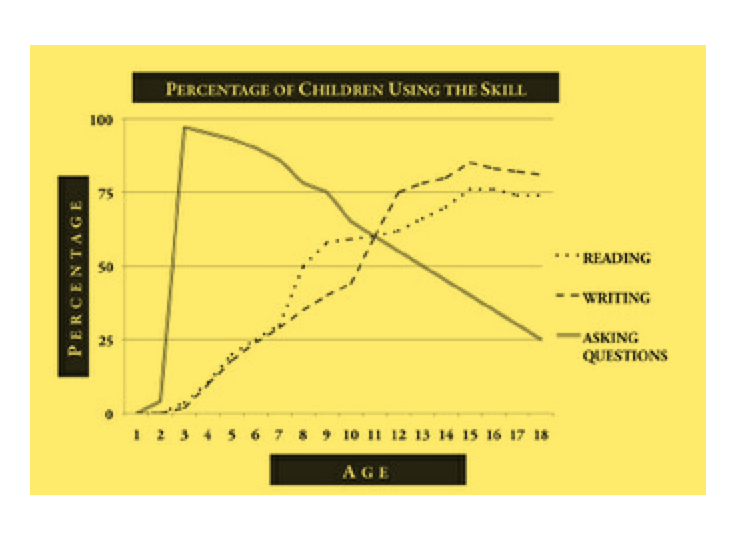
I am reading a book by Warren Berger called A More Beautiful Question.  In it he shares a study from the Right Question Institute tracking kids use of questions over time that identified a trend of students using questions less as reading and writing skills increased.  The use of questions peaks at around the age of 3, and by the age of 18 it is only used 1/3 as often as reading or writing.

From 2009 A Nation's Report Card.
From 2009 A Nation’s Report Card.

For parents, you are probably not surprised because you have lived through the WHY stage of three year olds and the grunting teenager.

This fascinates me, because I see this in adults as I work with leaders in their development and those that have gone through a career transition.  Too often EGO gets in the way of building the relationships needed to be successful in their next role.  One sign of EGO is the need to tell vs ask.  Think of that – I can read/write/Google (i.e. Figure it out) = EGO response to not knowing something.  As leaders, we battle our EGO overtaking us by leveraging the knowledge of our team to solve problems.  I believe one of the most important skills to battle EGO for adults/leaders is to learn is the ability to ask questions AND listen for the answer.  We do that by mastering the use of GREAT Questions over GOOD Questions.  Here are some examples:

GOOD Question:  Have you considered x and y as solutions?   GREAT Question:  What other solutions did you explore?

GOOD Question:  Why did this happen?   GREAT Question:  What has to happen next to make this problem go away?

GOOD Question:  How was your weekend?    GREAT Question:  What one word would you use to describe your weekend?  (What is the story behind that word?)

GOOD Question:  What do you want to share with the group before we start our meeting?       GREAT Question:  What is one personal best and one professional best you have to share with us?

My basic rule is to always start questions with What or How – that does not always make you perfect, but it makes you closer to perfect.  It is also important to be ready with – tell me a little more about that? or Tell me a little bit more about what options you considered?  Then listen.  The metric for you is to have a ratio of questions to statements of 5 to 1.

Hopefully you have already answered the question What if we asked more questions? 🙂

3 Questions that help create a culture that SUPPORTS performance

3 Questions that help create a culture that SUPPORTS performance

As a coach and consultant, performance conversations tend to start with emotions and adjectives.  One of the challenges in gaining clarity is to have a conversation that gets down to the root cause, and it also means talking to both the frustrated leader and the individual. Here are the questions I ask:

  1. Do they/you know what is expected of you at work?  What are they?
  2. Do they/you have the tools and resources to do your job well?  (see question 3 for how to deep dive on the specifics)
  3. If Yes to both 1 and 2, do you feel you/they GWC the role.  (G = Get It,  W = Want It, C = Capacity to do it)  *GWC is from a strategic planning tool I use called EOS


I don’t look at creating a performance focused culture, because my experience has shown me that leaders take this path by starting with accountability and expecting work to get done.  I have learned through Denison, a partner company I use for surveys, and my own experience that it is important to focus on creating a culture that supports performance.  It aligns with my own belief that individuals own their performance and development, and the organization owns support.

When we start with defining the target together and supporting the work to get there (frequent one on ones, asking what they need, following through, repeating often), more often than not it ends in a trusting relationship where the important things can get talked about.  Leaders, this is your work in SUPPORTING performance through the culture you create.

When people ask you what they can do to help, tell them.  Beware of asking for the extremes – no help (because you are frustrated, angry at someone, or your EGO is on overdrive) or having them do everything.  Sales is a great example because of the frequent ups and downs in a challenging market.  When you are missing sales numbers – role playing, prioritizing your leads, reviewing your pipeline are all great support activities.  Maybe even asking some people to make some calls for you or leverage relationships they have in some of your maybe companies.

Support is a two way street, it has to be offered and it has to be accepted.  The times we get in life when it has to be forced are the tough times.  Just ask an adult child who has arranged assisted living or nursing home care for a parent.  If the point is reached where a leader feels they need to force assistance in getting work done (what individuals often call micro-managing) it is probably time for you to leave.

I know it is never that easy, but it is that simple.  If that outcome is not what you want, then start back at the beginning and make a commitment to change your half of the conversation.


Change – 3 things you can do to lead it from ANY role

Change is relatively easy, when it’s our choice.  They key is how you react when it is not your choice.

  • I wanted to try a different haircut.  Easy.  Mom takes you to the salon and ‘the stylist was terrible’.  Not so easy and you cry and tell her you hate her.
  • You make a choice to leave a job for a new one.  relatively Easy.  Your employer decides you need a new job.  Hard and you stop trusting leaders and companies.
  • Your leader involves you in a conversation about a restructuring of the work in your company. relatively Easy.  Your leader brings you into a room to share the new organizational structure they created in the last few months AND your job changes.  Hard and you tell your leader it is a dumb idea and you will not support it under any circumstances.

Leaders involve people in conversations that drive change.  Effective leaders do anyway.

It is also a harsh reality that we cannot expect our leaders to involve us in everything.  There are lots of reasons why you will not be involved – time, leader decides not to ask, leader can’t tell you, you are viewed as bringing little value to strategic conversations, they forgot to ask, etc.

Here are three things individuals need to do to reset themselves for change:

  1. Get emotional – constructively!  Go work out, write an email – then DELETE it, put your corporate logo/leaders picture on a dart board and play darts, or go watch Office Space.  Bottling it up is no good.  Just let it out in a way that does not pollute the atmosphere around the change.  Not everything we are thinking needs to be heard, and it is normal to experience a strong voice of resistance in our heads when the change hits.
  2. Make a choice: Are you ready to lead it or explore what it means and what role you can play?  Not asking you to be a lemming, just telling you not to be the person who silently tries to make it fail.  If you decide to become the resistance to change, don’t be surprised if your role in future changes becomes smaller.
  3. Ask questions:  Information is needed for us to process change and it will help the leader share the why for the change.  The only way for you to effectively lead the change is to be able to talk about it with the passion and knowledge of your leader.  Asking great questions will help that.

You should expect your leaders to manage change well, and give them a little grace when it does not go so well.  You can help by mastering the process of going through change as someone who contributes and participates in it.  As Seth Godin would say – those people are Linchpins.  Leaders need more Linchpins!

When we don’t react, and Listen

Great conversations start with a question.  As a regular reader, you probably are tiring of hearing this statement from me.

A friend reminded me yesterday of a lesson she was re-learning with her kids.  They were testing her with statements meant to shock her, and while her impulse was to react, her intuition told her to take a deep breath and simply say “Tell me a little bit more about that?”  Then keep breathing and listen.

She also reminded me that I taught her that through watching me facilitate a group.  I was flattered, and also secretly glad she did not follow me around as a parent. 🙂

The goal is never to mask what you are thinking and be seen as a Teflon person who is never rattled.  The real goal (and my intent when I do it as a facilitator)  is to delay reaction until more is learned.

Here are two methods I have designed this kind of listening into key conversations I encourage leaders to have:

  1. Performance conversations:  What are 3 things you want to accomplish with this review?
  2. One-on-ones:  What is energizing you right now?  What is frustrating you right now? What do you want to make sure we cover today?

It is important for you, as a leader, to remain calm and focus on understanding before reacting.  Certainly, there is a case to be made that the words Fire or a gunshot going off demands a quick response.  Yet those who are professionals in responding to such events are trained to assess even as they react.  Leaders need to learn that – and it begins with having the discipline to ask a couple of questions to lead them past the emotion to the core reasons they are making that statement.  Behind a reason is a need, and leading with their needs in mind is what leaders do when they actually care.

Put another way, to care is to listen.

Great conversations start with a question.  Questions put us, as leaders, in the position of listening.  Listening is good, and remember to breathe.


What Leaders Do – To Serve

What is a leader?

What does a leader DO?

How do I become the leader that I aspire to be?

Great conversations start with a question.  Becoming a leader requires someone to ask the three questions posed above, and then commit to the work of making the beliefs you have about leadership show up in the habits and skills you develop as a leader.

Six months ago I started a journey with a group of leaders in their field to launch a program designed to help a leader explore these questions, and start DOing the work of being a leader.  The group is called LeaderWork, and we are actually launching a year long leadership development program through our local university (Grand Valley State University).  If you are interested in learning more, here is a link .

One answer to this that is a core belief of mine and shared by the rest of our group – Leaders Serve.

To serve you have to care about the needs and goals of others first.  Not exclusively, but first.

To serve you have to be willing to take time to listen first, and find ways to make the priorities of your people your priorities.

To serve you have to be quick to say I am sorry, because the reality is that things will happen when things people want to do have to be put off for a time because of the needs of the business.  Or you will just forget.

To serve, you have to DO things like:

  1. Getting to know your people at a little deeper level – Why did they join the company?  What do they like about the role?  What are their talents and passions?  What are other ways they can see to contribute?
  2. Let them get to know you – All of the questions in #1 plus things like,  What are my priorities this week?  What keeps me up at night?  What people inspire me?  Why did I become a leader?
  3. Be ready to allow others to help you.  No relationship is healthy if it is only one way, and when we stay open to opportunities for others to help us and for us to help others, good things happen.

What is a leader?

What does a leader DO?

How do I become the leader that I aspire to be?

I believe that if you aspire to be a leader that has great impact, it is critical to start with these questions.

What do you believe?