Leadership Journey – Strengths to overused Strengths

They were a year into their first leadership role and the feedback was You do not care.  How could that be – because I do! was the defense.  The proof to the contrary was two valuable people leaving the organization and the final expert doing everything they could to help the leader fail.

A universal truth of most people that write about competencies or personality profiles is the simple fact that if we have a strength (example:  getting work done) and if that strength is overused, it becomes a weakness (example:  so task focused that people do not care).  This is and should be one of the number one focuses of developing leaders, and if you look at a leadership program that is laced with classroom time and lite on self awareness/feedback – run.

If you need a second opinion and are not afraid of a 200+ page business book, read Flip Side by Flip Flippen. The Flip Side: Break Free of the Behaviors That Hold You Back

If you are a coach, and you want this conversation in the voice of a coach – read What Got You Here Won’t Get You There by Marshall Goldsmith
What Got You Here Won’t Get You There: How Successful People Become Even More Successful

If I had you at hello with this conversation and you want to jump in and try to avoid the mistake again, here is a simple way to start that conversation and get to an action plan:

  1. What are the reasons you got this leadership role? (list as many as you would like, pick the top 3)  *as their leader, feel free to correct their list after they have created it.
  2. How are these reasons (actually they are strengths) going to help you in this leadership role?
  3. How are these same reasons going to get in the way of your success?  What actions do you need to take to be successful and how can I best support you in this transition? (fyi . . if they don’t ask for help, so at a minimum meet with them weekly for the first 3 months)

The other solution is to speed past this conversation, let the situation play itself out, and try and fix it later.

fyi – Michael Watkins found that 40% of outside leaders hired into an organization fail in the first 18 months.  Brad Smart contends that a bad leadership hire takes 18 months to fire and the cost is 14.6x their base compensation.

Hmmm . . . .
You don’t need more data

An email came from the Gallup organization yesterday inviting me to buy a full ranking of my Strengthsfinder results for the bargain price of $89.  It promised my 34 talent themes ranked from strongest to weakest.  For those of you that have never taken it, when you buy Strengthsfinder 2.0 or Now, Discover Your Strengths from Gallup you get a code that will allow you to take an assessment that gives you your top 5 talents.  It is a great assessment.

Great move by Gallup, because the popularity of this assessment has resulted in tens of millions of people taking it.  If 1% get excited about this offer it will be very profitable.

I have personally helped over 500 people understand their Strengthsfinder results, and in every group there is always one person who wants more data – all 34 talent themes ranked.

My standard response has been – “What would you do with more data?”  The answers I hear includes statements like Then I will really know or words like certain, exact, and total clarity.

My response – Talent themes start the conversation.  The rest of the conversation is about understanding them, self-observing to see them at work, building on them, refining your understanding of them, and then repeating this process endlessly.  It is not a neat and clean project that ends with a deliverable.  In the end, someone tells you something like You are wise or You do a great job adapting to different situations.  In that is the inherent belief that You get yourself.

Self-awareness is a journey.  It is more about the work than the data.  Would you respond to an ad that claimed Receive total consciousness on your death bed for $74.99? (this is for Caddy Shack fans)

Feel free to buy more data, but you don’t need more data.  Do the work.

My Top 4 Learning Tools

A thought was shared from Greg Hartle (@greghartle) last week about his impressions of people he meets that are in career transitions.

Many people are perfectly prepared for a world that no longer exists.

One area people struggle with is learning.  We wait for events, programs, our leader to direct us, a performance review, time away from our job to learn, or ___________(fill in the blank).  In a corporate class, experience shows me that 70% of people come to class without a clear objective.  In a personal study I have done, 100% of people who went to Google and typed in a “How do you . . . . ” search question had a clear learning objective.  Email me if you would like the full results of my study. 🙂

My favorite places to learn:

  • LinkedIn – I believe Greg’s perspective can be substantiated based on how someone leverages LinkedIn.  This tool is as much about setting up learning communities as it is about building a professional network.  Joining groups and asking/answering questions on a weekly basis.  This should be a cornerstone of your learning strategy.
  • Inc – I still get a paper copy.  It makes me old school, but the information I get from people trying things out is so valuable for me as an entrepreneur and an advisor to growing companies.  For a close friend it is Wired magazine.  I added that for 2013.  More to come . . .
  • TED – At the end of the day every TEDx video is still an event.  Given that, I am still shocked by how many people I work with that have never heard of this.
  • YouTube – 48 hours of new video is uploaded to YouTube every minute.  (see graphic) I once had a friend with a health issue that needed to start giving himself monthly shots.  He is a bit impatient, so after trying to find someone to help he went on YouTube, found instructions, and did it.  I do not recommend this course of action for everyone – but he is clearly not the person Greg was talking about.

As I watch my teenagers interact with the Internet I realize the line between living and learning is non-existent for them.   The mantra that separates boomers from a millennial is a simple shift from I will outwork you to I will out-learn you.  The hardest worker is not the automatic winner anymore.

What are your favorite places to learn?

Good advice for new or old grads – Effective Immediately Post 1

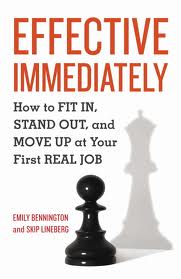
I am in the process of reading/reviewing a book by Emily Bennington and Skip Lineberg called Effective Immediately – How to FIT IN, STAND OUT, and MOVE UP at Your First REAL JOB.  As I go through it I will share some thoughts that make me go Hmmmm . . .  This posting is based on one of those moments.

As I started through this book I found myself grinning at some of the helpful hints.  Not because they were funny (other than the statement – If someone farts, ignore it), but they were the kind of things that are simple, obvious, and too often lost in the shuffle of starting something new.

Advice I liked:

Under the heading Have Patience – a quote from Sir William Osler (a pioneer of modern medicine): The best preparation for tomorrow is to do today’s work superbly well. A great reminder not to get caught in the who is looking and what is the next project.  Just focus on what is in front of you.

Professional etiquette:  Listen more than you talk – Obvious, but how often do nerves translate to communication misses such as talking too much.  Remember that when someone talks about themselves it stimulates the brain in the same way as when someone is eating or receives money.  Get others talking about themselves and listen.

Professional etiquette:  Always clean up after yourself. This one makes me smile, because my first job was in a steel mill where nobody every cleaned up after lunch and expected the janitor to do it for them.  Then I worked for a company that had a cultural norm around this, and every place I have been since I still wipe down the counter in the coffee counter when I leave.  I watch for this habit.

Reality check: Traditional HR departments are either gone or spread thin.  Most new people do not really know the function of the HR department, so they will not miss them.  But this statement is true, and even more true for smaller organizations.  The book goes on to give a list of Macro and Micro items that could be used by anyone to do their own onboarding plan.  For example:  Macro item:  What are the key responsibilities of your job? and Micro item:  Who is your supervisor or boss you report to directly, and who do they report to?

So far I like it.  As with all business books I believe they need to be read with a partner or small groups.  This book is written in short sections that fits that model very well, and is a great reference tool because each short chapter equals a skill.

More to come . . . .


Make Good Decisions Dad

As I was preparing for a board meeting my 9 year old daughter asked me what I was doing.  She had just told me about her first student council meeting, so I told her about my meeting and that we were going to be approving a budget for the year.  She thought for a second and said in a very matter of fact tone, “Make good decisions Dad.”

Sometimes we forget the basics, and if we are listening there are reminders all around us about what those are.  We just need to stop, listen, understand, and reset our perspective.

Here was my reset based on the wisdom that she shared with me:

  • Goal of a leader:  Make sure the best decisions get made more than not.
  • Development goal #1 of a leader:  Continue to learn and grow so the definition of best for yourself and your team is always being redefined in a positive direction.
  • Development goal #2 for a leader:  Challenge your team to embrace the same goal.

Maybe a good goal today is lead with the eyes and heart of a 9 year old.


4 Performance Words – What Seth said, and What I think

Seth Godin recently blogged about performance, and outlined four kinds:  Bad, Good, Remarkable, and Personal.  Here is the whole post.

In a world where we too often treat performance with labels like Right person/Right seat or A player / B player / C player – it is good to just use words that we all know.

Leading performance is about not walking by the work without letting people know what you see.  It is about getting their view of the work and what they see in others.  It about celebrating things being done, asking a few questions to plant seeds that might lead to a different view of the work, and challenging people to a different level of involvement and ownership.  Try these:

  • Where did you see passion in someone else’s work this week?  How can we celebrate that?
  • How did you personalize your work this week and who benefited from it?
  • What work do you have in front of you that has a chance to be remark-able in how you do it?  What will make it worthy of that label?

Of course you ask these questions, listen, and always revisit them.

Personally, I would drop Bad and Good in favor of Absent and Solid.

I like reading Seth – his thoughts are generally remark-able.


Everyone needs a Target. Everyone!

Great leaders paint their own destiny

Great leaders live/lead through ambiguity

All of these statement are true, and yet in the details of all of these statements is work.  Inherent in this work is the simple question of What is the work?

One of the core beliefs I have is that everyone needs a target. The details will vary based on the individual, their drive, experiences, self-confidence, etc.   That data that supports this is Gallup’s Q12 and the most critical question to measure employee engagement – I know what’s expected of me at work. There is no exception in the research saying This does not apply to executives.

Yesterday I saw some great training that a start-up organization had put together to help their new leaders understand the culture and expectations they were stepping into – and see the target.  I know it will make a difference as they grow, especially if their leaders provide the conversations to support the learning and build the bridge to performance.  This is the hidden ingredient to clear expectations – an ongoing conversation about wins, losses, and just being lost. This is called leadership.

When I sit down with leaders to create the one on one sheet, I am amazed at the conversation that often ensues.  Sometimes it is laced with frustration, but more often it is about relief because expectations are clear.

Everyone needs a target.  Everyone.


It must be the shoes – Yes and No, but mostly No

First it was Dorothy in the Wizard of Oz, wearing the ruby red shoes.  Then Michael Jordan did a whole ad campaign that immortalized the line It must be the shoes!

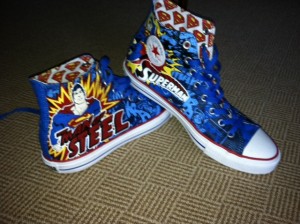
Yesterday, I received my own set of special shoes – Chuck Taylor Superman Shoes.  They were a gift from a group of people in the Shifting Gears Program where we spent over 100 hours together on a career transition journey.  I was part of a great team of people that facilitated the journey, but these 21 individuals did the work.  The shoes became a symbol that we needed to remember what strengths and talent are inside of each of us.  I love the shoes.

Performance can be attributed to a lot of things, but in the end it is about confidence and commitment to learn/grow through the peaks and the dips.  It is also about being in community with people, giving to that community, and leveraging the the strength of that community to celebrate the peaks and to climb out of the dips.  For 21 people in the Shifting Gears program, it was about coming together on 13 different days, spending 80+ hours working at a real company on a real business need, spending another 100+ hours networking/rebuilding a resume/mock interviewing and other work to move towards a preferred future.

One individual shared the story – I went back to a familiar place (my old company), but as I entered I could feel that it had stayed the same and I was a different person.

Is it the shoes?  No, it is what is inside of us that we need to see AND to unleash on something that we are passionate about.

But I do love the shoes. 🙂

What is your learning BRAND?

There are two questions I love to ask people to get a sense for how they learn.

1. Where do you get your learning?

2. What is your favorite TED video?

These two questions help me understand their brand as a learner.  It helps me see how the trends in information flow and the tools that have emerged to create communities around topics have been absorbed into their lives.  For example, if I hear the standard – I am a reader, then I know they prepared for the interview, but question if they are prepared to help my business hit our 2020 goals.   If I hear the talk about a website I have never heard of, discuss what they learned on LinkedIn last week, or try to convince me to drop Business Week in favor of Inc or Wired, then I know I have someone that is hungry and resourceful.

So why TED? Over the past 12 months I have been blessed to be part of a program called Shifting Gears in Michigan, and it has exposed me to individuals in transition that have 15-20+ years of work experience.  When I ask the question, who watches TED videos, <25% of hands go up.  TED is free, it is thought provoking, and it is mostly normal people sharing amazing passion/knowledge for a topic.   It is also not new, and if you are not familiar with it or not plugged into it I will venture a guess that you are not a real active, self-driven learner.  It makes me smile to think of the Shifting Gears participants who begin to own their learning.  Your learning Brand is not about age, it is about attitude and energy.

Elliott Masie, a learning futurist, is having his annual conference this fall and will be talking about how learners want things customized just for them.  He is right (by the way – the answer is called Google or LinkedIn Groups and it is not in the future).  The good news for small businesses is that if you have Google and spend time with your people talking about what they need to learn or what they have learned and used at their job (fyi – development plan) – then customized learning can be mostly free.

Ask the questions.  Listen well to the answers.  For job seekers, work to make your answers compelling and authentic.  Help me get excited about your learning Brand.

What do I do?

What are the top 5-7 responsibilities in my job?  The things that if I do them well will have the greatest impact on my success and the success of my team?

Can you answer this question?  This is the first question asked in the One on One form that I use with clients because it does one of two things:  1) Prioritizes a job description to a few key items that help define success in a role  2)  Creates a meaningful job description for someone that has never had one.

Ken Blanchard defines leaders as an influence process.  It is about working with people to accomplish their goals and the goals of the organization. The cornerstone of leadership is in the conversation around: What are you doing?  What should you be doing?  What can I do to help? If that conversation happens repeatedly over a 3-6 month timeframe things will get done if everyone involved makes a habit out of following through on their commitments.

Finally, here are three hints that will help guide you through this part of the job description:

  1. Don’t be too general. For example, when someone says Lead my team, it is too general.  At worst, I would plug in the Blanchard definition of leadership and make the measurement the simple activity of sitting down with each team member twice a month.
  2. Summarize repeated items. If there are 1o projects listed, that means managing projects is a core job requirement and the measure would be delivery, quality, cost, and customer satisfaction.
  3. Ask for input. Leaders, peers, customers will all have an opinion on this.  Ask them and use the input to create and clarify your list.

A study was done by the Ken Blanchard Companies and Training Magazine to define what were key motivating factors at work and who owned them?  A unique part of the survey was the ability to assign ownership to Myself, My Leader, or Senior Leadership.  In the end, the one organizational factor around motivation that was assigned to My Leader(80+% ownership) was performance expectations.

Remember to ask the question and have the patience to work towards a great answer.