
Listen: If you hear any of these 3 things you/we have a problem

Leading people is hard.  It is even harder when leaders are in a mode of talking more than they listen.  When you lead knowledge workers, remember that when you are doing most of the talking their brain is focused on processing what you tell them and reacting to it versus using their own brain to think what they want to do and what questions they need to have answered.

I always promote more conversations – which means two people in direct contact with each other sharing the burden of talking and listening.

As I coach leaders and teams through the transition of having more purposeful conversations, here are things I hear that alert me that someone is not being honest or they are stuck in a place that will keep great conversations for ever happening unless they make a choice to move forward.

  1. It is someone else’s fault: It might be, and if we are talking about what help you need to get to a different level of performance, identify a target job for yourself, or maybe to find more joy/commitment in your work . . . . does it really matter whose fault it is?  If this becomes the primary focus there is a problem.  If accountability is the ultimate goal, then making fixing the problem the priority will make it easier to have the conversation of – What can we do to make sure this never happens again?
  2. I cannot do ANYTHING until you do your job: Really? I used to do a junior achievement activity around production. Each person had a job to do in assembling an item, and there was always one person who could not work fast enough.  Sometimes, people just stood and watched the person struggle.  In other groups, the people around this individual helped out so that the bottleneck went away.  If you choose to watch or chose to say no to any offers of help, then you are really the problem.
  3. I am too busy to have this conversation: Okay, if you are too busy now when would be a good time? This is a flag for me that something else is going on. Imagine not wanting to have a discussion about what we can do to make your job better, to improve the support I provide you as your leader, or to make career plans for you?  Too busy? Hmmm . . . .

It is messy to start the habit of more conversations with your people.  If you are a leader that has not made a habit of slowing down to listen to what your people need, it will be a hard change.  If people are used to you telling them what to do and not listening to their ideas, or not always explaining your decisions, then it will be hard for them to make the shift to owning things that are hard – like offering their own ideas and fixing their own mistakes.

If you work for someone trying to make a shift in their leadership style and you give one of these responses, then you are effectively saying “I do not support the change you are trying to make and I would like to work towards you staying the same”.  Really?

If you are a leader trying to improve the conversations you have with your people, here are some templates that might help you get started.

 

Rule #1: Sleep

A friend who has never read a business book recommended Rework by the founders of 37signals.  It has made my top shelf and there is one message that helped preserve my sanity during the start-up of my business.  When you are tired, sleep.

Seems simple, but in our drive to complete everything and show any customer in the world that comes in contact with us what an amazing performer we are, the bar gets raised to a point that most of them cannot even see or appreciate.  For me, I was so focused on getting it all done that I forgot I was skilled at my craft and that many of these tasks took a third of the time if I was rested.  So since then I have just gone to bed, and here are a few outcomes for those who need data:

  • 0 missed deliverables
  • 0 feedback from clients indicating I was unprepared
  • 0 feedback from anyone that I appear more rested

The benefit was that it also allowed me to hone in on my new rule that when the house shuts down and my spouse goes to bed, I put everything down and go to bed.  A simple rule, but it has made all the difference.  Nobody else will care that you slept, except the people that have to live with you.  Doesn’t that matter?  It should . . .

Holidays is about being present and putting things down that can be handled later.  It should not take a book or a blog to tell us go to sleep, but sometimes these messages need to be spelled out and we need to be in a place to hear them.

My message for you:  Thanks for listening and sharing your stories with me.  I will not bother you until Jan 7, so stay present with the people that matter in your life.

Have a great holiday.

You don’t need more data

An email came from the Gallup organization yesterday inviting me to buy a full ranking of my Strengthsfinder results for the bargain price of $89.  It promised my 34 talent themes ranked from strongest to weakest.  For those of you that have never taken it, when you buy Strengthsfinder 2.0 or Now, Discover Your Strengths from Gallup you get a code that will allow you to take an assessment that gives you your top 5 talents.  It is a great assessment.

Great move by Gallup, because the popularity of this assessment has resulted in tens of millions of people taking it.  If 1% get excited about this offer it will be very profitable.

I have personally helped over 500 people understand their Strengthsfinder results, and in every group there is always one person who wants more data – all 34 talent themes ranked.

My standard response has been – “What would you do with more data?”  The answers I hear includes statements like Then I will really know or words like certain, exact, and total clarity.

My response – Talent themes start the conversation.  The rest of the conversation is about understanding them, self-observing to see them at work, building on them, refining your understanding of them, and then repeating this process endlessly.  It is not a neat and clean project that ends with a deliverable.  In the end, someone tells you something like You are wise or You do a great job adapting to different situations.  In that is the inherent belief that You get yourself.

Self-awareness is a journey.  It is more about the work than the data.  Would you respond to an ad that claimed Receive total consciousness on your death bed for $74.99? (this is for Caddy Shack fans)

Feel free to buy more data, but you don’t need more data.  Do the work.

My Top 4 Learning Tools

A thought was shared from Greg Hartle (@greghartle) last week about his impressions of people he meets that are in career transitions.

Many people are perfectly prepared for a world that no longer exists.

One area people struggle with is learning.  We wait for events, programs, our leader to direct us, a performance review, time away from our job to learn, or ___________(fill in the blank).  In a corporate class, experience shows me that 70% of people come to class without a clear objective.  In a personal study I have done, 100% of people who went to Google and typed in a “How do you . . . . ” search question had a clear learning objective.  Email me if you would like the full results of my study. 🙂

My favorite places to learn:

  • LinkedIn – I believe Greg’s perspective can be substantiated based on how someone leverages LinkedIn.  This tool is as much about setting up learning communities as it is about building a professional network.  Joining groups and asking/answering questions on a weekly basis.  This should be a cornerstone of your learning strategy.
  • Inc – I still get a paper copy.  It makes me old school, but the information I get from people trying things out is so valuable for me as an entrepreneur and an advisor to growing companies.  For a close friend it is Wired magazine.  I added that for 2013.  More to come . . .
  • TED – At the end of the day every TEDx video is still an event.  Given that, I am still shocked by how many people I work with that have never heard of this.
  • YouTube – 48 hours of new video is uploaded to YouTube every minute.  (see graphic) I once had a friend with a health issue that needed to start giving himself monthly shots.  He is a bit impatient, so after trying to find someone to help he went on YouTube, found instructions, and did it.  I do not recommend this course of action for everyone – but he is clearly not the person Greg was talking about.

As I watch my teenagers interact with the Internet I realize the line between living and learning is non-existent for them.   The mantra that separates boomers from a millennial is a simple shift from I will outwork you to I will out-learn you.  The hardest worker is not the automatic winner anymore.

What are your favorite places to learn?

1 on 1’s – Do you ask this question?

Shortly after publishing my last trU Tips on doing effective One-on-Ones (read it here), I received a note from a leader I respect.  I have never worked with him, but every time we talk he asks me questions that make me think.  He is also very willing to try new things.  He is a very valuable part of my network.

Let me call this trU Tips 22.1. In addition to the two questions I recommend once you mastered the basic One-on-one conversation, a third question to ask is – What should I keep doing the same?

Remember the goal of a One-on-One is to build trust and focus by creating space for your people to talk about what they are getting done, where they need help, and get a sense for how they are performing vs the standards you have set for them.  The advanced questions are about getting feedback for you that will help you continuously refine your own effectiveness as a leader.  Think of these three questions:

  • What do I need to do more of?
  • What should I keep doing the same? (the new question)
  • What do I need to do less of?

If you ask these questions and log in the answers over a 3-6 month period, I guarantee it will give you the same results as a professionally administered 360 feedback tool.  In financial terms, the choice is listen for free or spend five figures having someone else listen for you.

I love my network – they make me better.  I am listening.

4 Performance Words – What Seth said, and What I think

Seth Godin recently blogged about performance, and outlined four kinds:  Bad, Good, Remarkable, and Personal.  Here is the whole post.

In a world where we too often treat performance with labels like Right person/Right seat or A player / B player / C player – it is good to just use words that we all know.

Leading performance is about not walking by the work without letting people know what you see.  It is about getting their view of the work and what they see in others.  It about celebrating things being done, asking a few questions to plant seeds that might lead to a different view of the work, and challenging people to a different level of involvement and ownership.  Try these:

  • Where did you see passion in someone else’s work this week?  How can we celebrate that?
  • How did you personalize your work this week and who benefited from it?
  • What work do you have in front of you that has a chance to be remark-able in how you do it?  What will make it worthy of that label?

Of course you ask these questions, listen, and always revisit them.

Personally, I would drop Bad and Good in favor of Absent and Solid.

I like reading Seth – his thoughts are generally remark-able.


Rule 3 – NEVER cancel without rescheduling

Enough said?  You can stop here if you get it.  If you need more convincing here are 451 more words to get some clarity.

In his book The Speed of Trust, Stephen M.R. Covey said We judge ourselves based on our intentions.  We judge others based on their actions. Never is that statement more true than in the relationship between a leader and follower.  Do any of these examples ring true?

1.  A leader cancels a one on one because of a customer issue.  Does not reschedule it because he/she just talked to the person as they walked around the office yesterday.

Leader intention:  Customer is critical and everything stops when they call.  Plus we just talked yesterday and you know I care about you.

Leader action (as interpreted by follower):  Here we go again.  Your issues always trump mine and this issue could have been handled by the field service team with just a little support from us.  This is the 6th time this has happened in the last 8.5678 months (slight exaggeration on the number – but do not be surprised at the human mind to keep a key measure like this).

2.  A leader has the one on one and interrupts the conversation three times because of calls from home.

Leader intention:  Apology issued before each call, and since it was his wife on all three occasions and it was an emergency it was okay because family comes first.  Family is a core value of our organization.  (Emergency = at the mechanic with their new Audi A8 and the repairs were not going well)

Leader action (as interpreted by follower):  Would it be okay if I did this?  His/her spouse is a great person, but can’t this wait 20 minutes?  Isn’t this my time?  I will just cut my time/agenda short and let them deal with their issues.  Afterthought – A8?  I wonder why my evaluation/increase is six months overdue?

3.  Leader leads the time with two things that went wrong last week and they want to know what happened and why.

Leader intention:  Accountability.  If we cannot have the hard conversations then I am not doing my job.

Leader action (as interpreted by follower):  What a jelly fish.  There have been four days to talk about these things since they happened, plus I owned them and fixed them.  What about the bad decision he/she made yesterday that kept me here until 8pm to fix?  Can there be accountability there?

Being a leader is tough.  It is tougher when priorities are not clear and the tyranny of the urgent rules over the one on one time.  Never break this rule – and if you do point back to the last date/time/location/reason that it happened so they know you are keeping score too. 🙂

Talent management is about great conversations.  Follow these three rules for one on ones and you can have some great conversations.

Links related to this post:

Everyone needs a Target. Everyone!

Great leaders paint their own destiny

Great leaders live/lead through ambiguity

All of these statement are true, and yet in the details of all of these statements is work.  Inherent in this work is the simple question of What is the work?

One of the core beliefs I have is that everyone needs a target. The details will vary based on the individual, their drive, experiences, self-confidence, etc.   That data that supports this is Gallup’s Q12 and the most critical question to measure employee engagement – I know what’s expected of me at work. There is no exception in the research saying This does not apply to executives.

Yesterday I saw some great training that a start-up organization had put together to help their new leaders understand the culture and expectations they were stepping into – and see the target.  I know it will make a difference as they grow, especially if their leaders provide the conversations to support the learning and build the bridge to performance.  This is the hidden ingredient to clear expectations – an ongoing conversation about wins, losses, and just being lost. This is called leadership.

When I sit down with leaders to create the one on one sheet, I am amazed at the conversation that often ensues.  Sometimes it is laced with frustration, but more often it is about relief because expectations are clear.

Everyone needs a target.  Everyone.


It must be the shoes – Yes and No, but mostly No

First it was Dorothy in the Wizard of Oz, wearing the ruby red shoes.  Then Michael Jordan did a whole ad campaign that immortalized the line It must be the shoes!

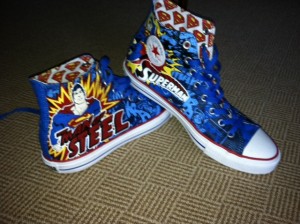
Yesterday, I received my own set of special shoes – Chuck Taylor Superman Shoes.  They were a gift from a group of people in the Shifting Gears Program where we spent over 100 hours together on a career transition journey.  I was part of a great team of people that facilitated the journey, but these 21 individuals did the work.  The shoes became a symbol that we needed to remember what strengths and talent are inside of each of us.  I love the shoes.

Performance can be attributed to a lot of things, but in the end it is about confidence and commitment to learn/grow through the peaks and the dips.  It is also about being in community with people, giving to that community, and leveraging the the strength of that community to celebrate the peaks and to climb out of the dips.  For 21 people in the Shifting Gears program, it was about coming together on 13 different days, spending 80+ hours working at a real company on a real business need, spending another 100+ hours networking/rebuilding a resume/mock interviewing and other work to move towards a preferred future.

One individual shared the story – I went back to a familiar place (my old company), but as I entered I could feel that it had stayed the same and I was a different person.

Is it the shoes?  No, it is what is inside of us that we need to see AND to unleash on something that we are passionate about.

But I do love the shoes. 🙂

Can the CEO Coach? 2 Myths that get in the way

I learned by diving in – Why can’t they?

This statement was not meant to be mean or pass the buck, it was born from the frustration of seeing senior level leaders not rising to the occassion after being given significantly more responsibility.  I see it happen too often.  It is a painful scenario, and it is one that can be avoided.

When the focus is put on answering the question – How did we get here?, the root cause ends up being some attitudes/assumptions that started the motion down the wrong path.  Here are the top two:

Myth #1 – I did it all on my own, why can’t they. Really?  As a parent, many times a day the thought creeps into my head “When I was little I had the same challenge, and I just figured it out .”  Nobody ascends on their own.  Whether its a spouse, mentor, friend, or some other significant person – someone stepped in hand helped you through rough spots.  Solution: Commit 30 minutes a week to review goals, review progress, and answer questions (called a one on one)  Here is a link to a template if you need one.

Myth #2 – It is okay to lose some of  my money while they learn.  Why do they not feel safe? Have you ever had the angst of telling your parents that you had an accident with their car?  It was one of those conversations that teens through the ages have crafted countless schemes to avoid.  We grow up, get a job, and all of the sudden we make a mistake that costs our organization thousands of dollars, and it is like we were a teenager again.  Solution: Make it okay to make a mistake, provided you own it and have a plan to fix it.

When people become leaders of leaders, they realize how difficult it is to work through others to get results, and sometimes the default is to either leave them alone to figure it out, or step into their lives and help manage the details.  Ken Blanchard called this Seagull Management.  Fly in, dump, then leave.

Find an answer somewhere in the middle.  Don’t be a Seagull.