Greg Hartle – Wisdom from walking around

I had a chance to share a meal with Greg Hartle.  Does his name sound familiar?  It shouldn’t.

Not that he is not remarkable, but he is not trying to be remarkable and famous.  He is just traveling around the country, making enough, and trying to rebuild his life as he works towards some goals – one of which being to help 500 people.

Really?  After a near death experience and asking himself some big questions, he decided to take $10, a laptop, and some clothes – and go help people.  If you want to know more here is his link. I want to brand him with some statement like – Meet Mother Theresa wearing jeans.  But the truth is that would do a disservice to Mother Theresa and to Greg.  You see, he is just trying to be a better Greg, and that should be good enough for all of us.

I loved listening to Greg.  What hit me was the perspective he has gained from sitting in the living rooms or across the table from over 250+ people across this country trying to help them through their life transitions.  He is focused on micro-micro economics.  In that world the graphs go away and we can talk in names, addresses, and challenges.  He is also one of those genuine people that makes you want to shut out the world for a while and enjoy being present.

Two thoughts he left me with that continue to roll around –

He sees lots of people fully prepared for a world that no longer exists. If you are not ready to personally manage the cycle of learn, unlearn, and relearn – then in a few missed cycles you risk becoming stuck in a difficult place.  Learn, do, do, do, do better, do, do, do, do, do a little better – does not exist.

Purpose + Passion + Skill for their craft.  Many people have purpose and passion, but too often the gap is in the level of skill they have for their intended craft.  You see, the skill piece takes a dedication to something, over the course of time, to work towards mastery.  (see Gladwell’s 10,000 hour rule)  Also, see point number one.

The rest of Greg Hartle’s story can be followed on Facebook, or check out the business he just launched at newmethods.org.  He was also a great speaker if you are looking for someone to inspire your group.

Thanks Greg.
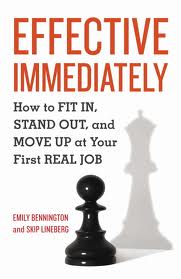
 

Good advice for new or old grads – Effective Immediately Post 1

I am in the process of reading/reviewing a book by Emily Bennington and Skip Lineberg called Effective Immediately – How to FIT IN, STAND OUT, and MOVE UP at Your First REAL JOB.  As I go through it I will share some thoughts that make me go Hmmmm . . .  This posting is based on one of those moments.

As I started through this book I found myself grinning at some of the helpful hints.  Not because they were funny (other than the statement – If someone farts, ignore it), but they were the kind of things that are simple, obvious, and too often lost in the shuffle of starting something new.

Advice I liked:

Under the heading Have Patience – a quote from Sir William Osler (a pioneer of modern medicine): The best preparation for tomorrow is to do today’s work superbly well. A great reminder not to get caught in the who is looking and what is the next project.  Just focus on what is in front of you.

Professional etiquette:  Listen more than you talk – Obvious, but how often do nerves translate to communication misses such as talking too much.  Remember that when someone talks about themselves it stimulates the brain in the same way as when someone is eating or receives money.  Get others talking about themselves and listen.

Professional etiquette:  Always clean up after yourself. This one makes me smile, because my first job was in a steel mill where nobody every cleaned up after lunch and expected the janitor to do it for them.  Then I worked for a company that had a cultural norm around this, and every place I have been since I still wipe down the counter in the coffee counter when I leave.  I watch for this habit.

Reality check: Traditional HR departments are either gone or spread thin.  Most new people do not really know the function of the HR department, so they will not miss them.  But this statement is true, and even more true for smaller organizations.  The book goes on to give a list of Macro and Micro items that could be used by anyone to do their own onboarding plan.  For example:  Macro item:  What are the key responsibilities of your job? and Micro item:  Who is your supervisor or boss you report to directly, and who do they report to?

So far I like it.  As with all business books I believe they need to be read with a partner or small groups.  This book is written in short sections that fits that model very well, and is a great reference tool because each short chapter equals a skill.

More to come . . . .


1 on 1’s – Do you ask this question?

Shortly after publishing my last trU Tips on doing effective One-on-Ones (read it here), I received a note from a leader I respect.  I have never worked with him, but every time we talk he asks me questions that make me think.  He is also very willing to try new things.  He is a very valuable part of my network.

Let me call this trU Tips 22.1. In addition to the two questions I recommend once you mastered the basic One-on-one conversation, a third question to ask is – What should I keep doing the same?

Remember the goal of a One-on-One is to build trust and focus by creating space for your people to talk about what they are getting done, where they need help, and get a sense for how they are performing vs the standards you have set for them.  The advanced questions are about getting feedback for you that will help you continuously refine your own effectiveness as a leader.  Think of these three questions:

  • What do I need to do more of?
  • What should I keep doing the same? (the new question)
  • What do I need to do less of?

If you ask these questions and log in the answers over a 3-6 month period, I guarantee it will give you the same results as a professionally administered 360 feedback tool.  In financial terms, the choice is listen for free or spend five figures having someone else listen for you.

I love my network – they make me better.  I am listening.

4 Performance Words – What Seth said, and What I think

Seth Godin recently blogged about performance, and outlined four kinds:  Bad, Good, Remarkable, and Personal.  Here is the whole post.

In a world where we too often treat performance with labels like Right person/Right seat or A player / B player / C player – it is good to just use words that we all know.

Leading performance is about not walking by the work without letting people know what you see.  It is about getting their view of the work and what they see in others.  It about celebrating things being done, asking a few questions to plant seeds that might lead to a different view of the work, and challenging people to a different level of involvement and ownership.  Try these:

  • Where did you see passion in someone else’s work this week?  How can we celebrate that?
  • How did you personalize your work this week and who benefited from it?
  • What work do you have in front of you that has a chance to be remark-able in how you do it?  What will make it worthy of that label?

Of course you ask these questions, listen, and always revisit them.

Personally, I would drop Bad and Good in favor of Absent and Solid.

I like reading Seth – his thoughts are generally remark-able.


Rule 3 – NEVER cancel without rescheduling

Enough said?  You can stop here if you get it.  If you need more convincing here are 451 more words to get some clarity.

In his book The Speed of Trust, Stephen M.R. Covey said We judge ourselves based on our intentions.  We judge others based on their actions. Never is that statement more true than in the relationship between a leader and follower.  Do any of these examples ring true?

1.  A leader cancels a one on one because of a customer issue.  Does not reschedule it because he/she just talked to the person as they walked around the office yesterday.

Leader intention:  Customer is critical and everything stops when they call.  Plus we just talked yesterday and you know I care about you.

Leader action (as interpreted by follower):  Here we go again.  Your issues always trump mine and this issue could have been handled by the field service team with just a little support from us.  This is the 6th time this has happened in the last 8.5678 months (slight exaggeration on the number – but do not be surprised at the human mind to keep a key measure like this).

2.  A leader has the one on one and interrupts the conversation three times because of calls from home.

Leader intention:  Apology issued before each call, and since it was his wife on all three occasions and it was an emergency it was okay because family comes first.  Family is a core value of our organization.  (Emergency = at the mechanic with their new Audi A8 and the repairs were not going well)

Leader action (as interpreted by follower):  Would it be okay if I did this?  His/her spouse is a great person, but can’t this wait 20 minutes?  Isn’t this my time?  I will just cut my time/agenda short and let them deal with their issues.  Afterthought – A8?  I wonder why my evaluation/increase is six months overdue?

3.  Leader leads the time with two things that went wrong last week and they want to know what happened and why.

Leader intention:  Accountability.  If we cannot have the hard conversations then I am not doing my job.

Leader action (as interpreted by follower):  What a jelly fish.  There have been four days to talk about these things since they happened, plus I owned them and fixed them.  What about the bad decision he/she made yesterday that kept me here until 8pm to fix?  Can there be accountability there?

Being a leader is tough.  It is tougher when priorities are not clear and the tyranny of the urgent rules over the one on one time.  Never break this rule – and if you do point back to the last date/time/location/reason that it happened so they know you are keeping score too. 🙂

Talent management is about great conversations.  Follow these three rules for one on ones and you can have some great conversations.

Links related to this post:

Rule 2 – Individual (not leader) owns the agenda

(This is the second blog in a series outlining the key rules for making one on ones work.  Here is a link to the first:  Rule 1 – Be in the same room together)

I stood in front of a group of human resource professionals and asked them Whats the #1 reason leaders would resist a regular one on one schedule? Their answer – Time.  It is a reality that another commitment, especially one that takes preparation, is going to be an issue.  This is one of the key reasons that Rule #2 exists.  While this time together requires presence from the leader, it requires only minimal preparation because the agenda is 100% driven by the individual.  Here are two reasons why.

First, the number one need for people at work is knowing what is expected of them. Gallup created a twelve question survey they could use to assess employee engagement at work.  They called it the Q12, and the very first and most important question was I know what is expected of me at work. Each day, new problems or opportunities arise in a business, and with each comes an event that could change the nature of the work that someone has to do. The key to a one on one is doing the five R’s around work duties:  refine, revise, reorder, reinforce, or remove.  Since it is a fundamental need for every person to have some level of focus in their work, they will have the strongest desire to own any activity that helps them achieve that.  The one on one is that activity.

Secondly, it addresses one of the top issues with any leader, the ability to effectively delegate work. The #2 best-selling Harvard Business Review article of all time is Management Time:  Who’s Got the Monkey? Leaders have long struggled with taking on too much work from their people.  The inherent question from the leader in the one on one conversation is –What do you need from me? There are four basic needs a leader has to be ready to address.  The need for . . .

  • A listening year
  • Encouragement to overcome a frustration
  • Coaching to see/define other options for getting through a barrier
  • Help prioritizing/re-framing an overbooked to do list

Notice your work is not on the list.  There will likely be some commitments for a leader after a one on one, but most should revolve around working with other leaders to deal with competing organizational priorities.  There is a natural need for leaders to take on the work of their people (for that perspective read the article).  The one on one all about helping the individual achieve a state of 3 Mores/1 less:  MORE focused, MORE autonomous, MORE  successful, and LESS stressed.  In that state, everybody wins, especially the leader.

More to come on one on ones.  If you are interested, here is a sample template for getting started.

Questions to help the work get done (and the team to be built)

Seth Godin had a recent post titled Two questions behind every diagreement.  In it he shares two questions that will help move through/solve every disagreement:

  • Are we on the same team?
  • What’s the right path forward?

By definition, you cannot have a team without common goals and group decision making power, and getting there requires conflict.  These are two great questions, but let me add a few more to help you apply this in your own team and move things forward:

1. Are we on the same team? –> What is the issue?  What is the outcome we want?

2. What’s the right path forward? –> What are three steps that will move us ahead?  What 1 step will I own?  What 1 step will you own?  What 1 step will we BOTH own?  (remember 1 + 1 + 1 = 3)

If you cannot answer/agree on #1 don’t skip/move ahead to #2.  The key to #1 is addressing the issue and not the person – ie.  If the issue is someone or what someone else needs to do to make my life easier, then the whole discussion is about winning and not solving a problem.  That means you are the problem –> so step back, take a deep breath, apologize, and step back into the discussion with a different mindset.

If you get to #2, the best way to build teamwork is to own work together.  If a solution takes 20 steps and 3 months, focus on the next 3 and 48-72 hours.  Progress/success builds relationships between people and teams are created along the way.  I can hear the complaints now – – But this is a very complex problem and 3 steps is too small. My next question:  Is the issue that the problem is too complex or We are not agreeing on/owning a solution as a team?  In either case – either start moving forward or punt the problem to another team.

fyi – If anyone on the team has a goal to sit back and let someone else fail so they can either:  a) Ride in and save the day or b) Play the I told you so card – – – they should be given one chance to hit the reset button, and then removed from the team.

Thanks for planting the seed Seth.

What do I do?

What are the top 5-7 responsibilities in my job?  The things that if I do them well will have the greatest impact on my success and the success of my team?

Can you answer this question?  This is the first question asked in the One on One form that I use with clients because it does one of two things:  1) Prioritizes a job description to a few key items that help define success in a role  2)  Creates a meaningful job description for someone that has never had one.

Ken Blanchard defines leaders as an influence process.  It is about working with people to accomplish their goals and the goals of the organization. The cornerstone of leadership is in the conversation around: What are you doing?  What should you be doing?  What can I do to help? If that conversation happens repeatedly over a 3-6 month timeframe things will get done if everyone involved makes a habit out of following through on their commitments.

Finally, here are three hints that will help guide you through this part of the job description:

  1. Don’t be too general. For example, when someone says Lead my team, it is too general.  At worst, I would plug in the Blanchard definition of leadership and make the measurement the simple activity of sitting down with each team member twice a month.
  2. Summarize repeated items. If there are 1o projects listed, that means managing projects is a core job requirement and the measure would be delivery, quality, cost, and customer satisfaction.
  3. Ask for input. Leaders, peers, customers will all have an opinion on this.  Ask them and use the input to create and clarify your list.

A study was done by the Ken Blanchard Companies and Training Magazine to define what were key motivating factors at work and who owned them?  A unique part of the survey was the ability to assign ownership to Myself, My Leader, or Senior Leadership.  In the end, the one organizational factor around motivation that was assigned to My Leader(80+% ownership) was performance expectations.

Remember to ask the question and have the patience to work towards a great answer.


What if We Called It Your Individual Development Story?

ACCOUNTABILITY. FOLLOW-THRU.

When we think of anything with the word PLAN in it, do these words quickly follow in your mind?

What if we called it something different?  For example, instead of your Individual Development Plan, what if we called it your Individual Development Story?Talent Management - Writing your story

If you think of it as a story, it would have a main character – You – in all your strengths, experiences, successes, weaknesses,  and moments of non-performance.

It would have . . .

. . . history that helps you frame your character with terms like talents, passions, rewards, and realities. (what I call your trUYou)

. . . a current story about where you are today and what might be changing for you.  It would also have some preferred future that gives us a sense of where the story might be going.

. . . ownership. It is our story and although we need to ask others for help, in the end it is ours to write and to tell.

. . . portability. Sometimes our story needs to go somewhere else to move ahead – another role, another project, and maybe another organization.

. . . help.  If we know you and understand where you desire to go, then we could choose to enter your story and join you on the journey as a mentor, a friend, a partner in accountability, or maybe even a fellow learner that desires the same journey.

If we know our journey will be challenging journey, then maybe we hire a coach.  They would help us step back and see things differently, or rewrite the journey so that the story takes us to some different places and outcomes that we might not see by ourselves.

I am thinking of renaming my template as I prepare to share it with the human resource professionals at the Illinois SHRM Conference next week.  Too many people do not have them based on the Talent Scorecards I have given leaders and too many I have seen lack the pieces that tell a great story.

I would like my story to say that I worked, with others, to change that.

It feels like a great conversation.  I love great conversations.

5 Key Outcomes – Individual Development Plan Conversation

Talent Management is about putting the relationship first, building a process full of great conversations, and using goals to drive individual ownership

Based on surveying 150+ human resource and business leaders 20% seems to be the magic number.  Only 20% of organizations have development plans for ALL their high potentials and for their executive teams.   This is a key conversation because it allows for a great conversation around past, present, and future.  My standard measure for a great conversation around performance and development is 30 / 30 / 40.  30% focused on the past, 30% focused on where you are right now, and 40% focused on where things need to be in the future.5 Benefits from doing development plans

So why do development plans?  Below are five outcomes that happen when we invest 60 minutes 1-2x per year to update development plans:

1. Refined knowledge of talents/nontalents: Wisdom is knowledge gained from our experiences that we apply to influence the outcomes of some present or future situation.  When individuals develop wisdom about their talents/non-talents the success rate for taking on new assignments or successfully building a relationship with a new leader goes way up.  Development plans (see my template) always start with refining our picture of ourselves.

2.  Creates the building block for performance – A Strength: Gallup shared the formula Strength = Talent + Skill + Knowledge in their book First, Break All The Rules.  Research has also shown that achieving mastery in a discipline takes 10,000 hours of effort (see Malcolm Gladwell’s book – Outliers).  The core of the development plan is to script the building of skills and knowledge so that the effort people are putting into personal growth moves them towards mastery.

3.  Get Feedback From Others: Where a plan or measure exists, feedback has the best chance of happening.  Author Jodi Glickman (Great On The Job) says the goal of feedback – “. . . . is not to make you feel good.  The goal is to make you better at your job.”  We do not get better without understanding the perceptions of others.  In our own minds, we are all amazing performers. 🙂  A great development conversation confirms and challenges this belief.

4.  Proactively Deal With A Weakness: Weaknesses are either non-talents that are required for success in your current job or strengths that are being overused.  Whichever the case, spending time talking about weaknesses before a performance evaluation is done or before they evolve into a crisis provides an opportunity for that individual to make a conscious shift to address an issue before it becomes a big problem.

5.  Self Management of Stress: Development plans get people thinking about what their preferred future looks like, whether it is 6 months out or two years.  This includes what has to change in how they are feeling about their role – ie:  stress, balance, and focus.  It is not a leader’s job to fix how their team members are feeling, but it is their job to ask the questions, be present for the answers, and support the plans that are created.

When I first created the Talent Scorecard over two years ago this list was not in my mind.  Since learning that only a small number of teams have development plans for all their people (20%) and personally leading 30+ leaders through the creation of Individual Development Plans this list has emerged.   It is one of the new additions to my Talent Scorecard presentation that I will be sharing at the Illinois SHRM State Conference in a couple of weeks – and it has become one of my favorite conversations.

If you are interested in what your Talent Scorecard looks like – here is a link to an on-line version that will give you a printout of your results and some hints for what your priorities should be.