4 Performance Words – What Seth said, and What I think

Seth Godin recently blogged about performance, and outlined four kinds:  Bad, Good, Remarkable, and Personal.  Here is the whole post.

In a world where we too often treat performance with labels like Right person/Right seat or A player / B player / C player – it is good to just use words that we all know.

Leading performance is about not walking by the work without letting people know what you see.  It is about getting their view of the work and what they see in others.  It about celebrating things being done, asking a few questions to plant seeds that might lead to a different view of the work, and challenging people to a different level of involvement and ownership.  Try these:

  • Where did you see passion in someone else’s work this week?  How can we celebrate that?
  • How did you personalize your work this week and who benefited from it?
  • What work do you have in front of you that has a chance to be remark-able in how you do it?  What will make it worthy of that label?

Of course you ask these questions, listen, and always revisit them.

Personally, I would drop Bad and Good in favor of Absent and Solid.

I like reading Seth – his thoughts are generally remark-able.
 

Rule 1 – Be in the same room together

According to a study done by the Kaiser Family Foundation, children 8-18 spend 7.5 hours per day using entertainment media, 4 minutes playing outside, and 3.5 minutes per day in meaningful conversation with their parents. Hmmm . . . .

I toured a company called Menlo Innovations in Ann Arbor last month and was shocked to find a technology company that did not use email to communicate.  All project management was done with post-its on the wall and communication happened face to face.  When someone needed to address the group they called out the name of the team, everyone stopped their work, and communication happened.  The business has experienced solid growth and the they have enabled several product launches that prove their methods are effective.  By the way, this is also a place where all coding is done in pairs – two people sitting next to each other and working together.  You cannot work alone on anything.

In a world where everything seems to be going faster, maintaining the right pace in how we interact is still important.

Great leadership starts with purposeful facetime with people.

Step 1 – Be physically present with the people you lead.

Yes, that is impossible for people leading virtual teams.  So to you I ask – What would that presence look like for you?  How close can you come to ‘physical’ presence?

After 20 years working on corporate teams, being married, and being a parent I am passionate about enabling one single thing – great conversations. When I created this template, I thought of a meaningful 30 minutes together between a leader and follower.  If we spend 30 minutes, one on one, every two weeks with each of our people, that works out to  a guaranteed 15 minutes of purposeful conversation per week with each person, or 3 minutes a day.

Hmmm . . . still only 3 minutes a day.  Too much . . . Really?

Watch yourself this week – How is the quality conversation time looking for you?

It must be the shoes – Yes and No, but mostly No

First it was Dorothy in the Wizard of Oz, wearing the ruby red shoes.  Then Michael Jordan did a whole ad campaign that immortalized the line It must be the shoes!

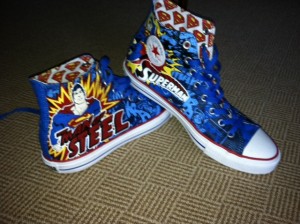
Yesterday, I received my own set of special shoes – Chuck Taylor Superman Shoes.  They were a gift from a group of people in the Shifting Gears Program where we spent over 100 hours together on a career transition journey.  I was part of a great team of people that facilitated the journey, but these 21 individuals did the work.  The shoes became a symbol that we needed to remember what strengths and talent are inside of each of us.  I love the shoes.

Performance can be attributed to a lot of things, but in the end it is about confidence and commitment to learn/grow through the peaks and the dips.  It is also about being in community with people, giving to that community, and leveraging the the strength of that community to celebrate the peaks and to climb out of the dips.  For 21 people in the Shifting Gears program, it was about coming together on 13 different days, spending 80+ hours working at a real company on a real business need, spending another 100+ hours networking/rebuilding a resume/mock interviewing and other work to move towards a preferred future.

One individual shared the story – I went back to a familiar place (my old company), but as I entered I could feel that it had stayed the same and I was a different person.

Is it the shoes?  No, it is what is inside of us that we need to see AND to unleash on something that we are passionate about.

But I do love the shoes. 🙂

Questions to help the work get done (and the team to be built)

Seth Godin had a recent post titled Two questions behind every diagreement.  In it he shares two questions that will help move through/solve every disagreement:

  • Are we on the same team?
  • What’s the right path forward?

By definition, you cannot have a team without common goals and group decision making power, and getting there requires conflict.  These are two great questions, but let me add a few more to help you apply this in your own team and move things forward:

1. Are we on the same team? –> What is the issue?  What is the outcome we want?

2. What’s the right path forward? –> What are three steps that will move us ahead?  What 1 step will I own?  What 1 step will you own?  What 1 step will we BOTH own?  (remember 1 + 1 + 1 = 3)

If you cannot answer/agree on #1 don’t skip/move ahead to #2.  The key to #1 is addressing the issue and not the person – ie.  If the issue is someone or what someone else needs to do to make my life easier, then the whole discussion is about winning and not solving a problem.  That means you are the problem –> so step back, take a deep breath, apologize, and step back into the discussion with a different mindset.

If you get to #2, the best way to build teamwork is to own work together.  If a solution takes 20 steps and 3 months, focus on the next 3 and 48-72 hours.  Progress/success builds relationships between people and teams are created along the way.  I can hear the complaints now – – But this is a very complex problem and 3 steps is too small. My next question:  Is the issue that the problem is too complex or We are not agreeing on/owning a solution as a team?  In either case – either start moving forward or punt the problem to another team.

fyi – If anyone on the team has a goal to sit back and let someone else fail so they can either:  a) Ride in and save the day or b) Play the I told you so card – – – they should be given one chance to hit the reset button, and then removed from the team.

Thanks for planting the seed Seth.

Building a Leadership Development Program from Scratch

I was presenting at the SHRM conference in Illinois and had a chance to sit in on a presentation by Benjamin McCall.  It was a solid and thought provoking presentation, and my big takeaway was the question How would I build a leadership development program from scratch?

It reminded me how times have changed around doing things from scratch.  A personal example for me is baking.  I grew up thinking everything – pie crusts, cakes, and even muffins were only made from scratch.  While I love to make bread, cinamon roles, and even pancakes from scratch, most of the time it is much easier to get it from a box or a store.  I started my leadership development career thinking the stuff from the box was what needed to happen.  If the name Ken Blanchard, Center for Creative Leadership, Executive MBA, University of Michigan, or Harvard was on the label then it was great.

Then I went to a small company and was asked to build one from scratch, for one person, and with a limited budget.  The other condition was that it had to work because our business growth strategy was depending on the leaders from this program to open the offices in our plan.

What I learned is that there are some core benefits that all participants in these programs takeaway, and it has very little to do with content.  I also learned that the two core benefits, self-awareness and peer communities could be provided even if it is a small company.  trU Tips 21 is coming out next week and I will provide an outline of how I would answer this question.

I still stop when I hear the words Center for Creative Leadership or Ross School of Business or Harvard, but I know now that anyone can make something  really good from scratch.

Finally – the key currency to support this being done well and on your own – time from you and the rest of the leadership team.  That is the magic ingredient.  More to come in trU Tips 21 . . . . . .


What if We Called It Your Individual Development Story?

ACCOUNTABILITY. FOLLOW-THRU.

When we think of anything with the word PLAN in it, do these words quickly follow in your mind?

What if we called it something different?  For example, instead of your Individual Development Plan, what if we called it your Individual Development Story?Talent Management - Writing your story

If you think of it as a story, it would have a main character – You – in all your strengths, experiences, successes, weaknesses,  and moments of non-performance.

It would have . . .

. . . history that helps you frame your character with terms like talents, passions, rewards, and realities. (what I call your trUYou)

. . . a current story about where you are today and what might be changing for you.  It would also have some preferred future that gives us a sense of where the story might be going.

. . . ownership. It is our story and although we need to ask others for help, in the end it is ours to write and to tell.

. . . portability. Sometimes our story needs to go somewhere else to move ahead – another role, another project, and maybe another organization.

. . . help.  If we know you and understand where you desire to go, then we could choose to enter your story and join you on the journey as a mentor, a friend, a partner in accountability, or maybe even a fellow learner that desires the same journey.

If we know our journey will be challenging journey, then maybe we hire a coach.  They would help us step back and see things differently, or rewrite the journey so that the story takes us to some different places and outcomes that we might not see by ourselves.

I am thinking of renaming my template as I prepare to share it with the human resource professionals at the Illinois SHRM Conference next week.  Too many people do not have them based on the Talent Scorecards I have given leaders and too many I have seen lack the pieces that tell a great story.

I would like my story to say that I worked, with others, to change that.

It feels like a great conversation.  I love great conversations.

5 Key Outcomes – Individual Development Plan Conversation

Talent Management is about putting the relationship first, building a process full of great conversations, and using goals to drive individual ownership

Based on surveying 150+ human resource and business leaders 20% seems to be the magic number.  Only 20% of organizations have development plans for ALL their high potentials and for their executive teams.   This is a key conversation because it allows for a great conversation around past, present, and future.  My standard measure for a great conversation around performance and development is 30 / 30 / 40.  30% focused on the past, 30% focused on where you are right now, and 40% focused on where things need to be in the future.5 Benefits from doing development plans

So why do development plans?  Below are five outcomes that happen when we invest 60 minutes 1-2x per year to update development plans:

1. Refined knowledge of talents/nontalents: Wisdom is knowledge gained from our experiences that we apply to influence the outcomes of some present or future situation.  When individuals develop wisdom about their talents/non-talents the success rate for taking on new assignments or successfully building a relationship with a new leader goes way up.  Development plans (see my template) always start with refining our picture of ourselves.

2.  Creates the building block for performance – A Strength: Gallup shared the formula Strength = Talent + Skill + Knowledge in their book First, Break All The Rules.  Research has also shown that achieving mastery in a discipline takes 10,000 hours of effort (see Malcolm Gladwell’s book – Outliers).  The core of the development plan is to script the building of skills and knowledge so that the effort people are putting into personal growth moves them towards mastery.

3.  Get Feedback From Others: Where a plan or measure exists, feedback has the best chance of happening.  Author Jodi Glickman (Great On The Job) says the goal of feedback – “. . . . is not to make you feel good.  The goal is to make you better at your job.”  We do not get better without understanding the perceptions of others.  In our own minds, we are all amazing performers. 🙂  A great development conversation confirms and challenges this belief.

4.  Proactively Deal With A Weakness: Weaknesses are either non-talents that are required for success in your current job or strengths that are being overused.  Whichever the case, spending time talking about weaknesses before a performance evaluation is done or before they evolve into a crisis provides an opportunity for that individual to make a conscious shift to address an issue before it becomes a big problem.

5.  Self Management of Stress: Development plans get people thinking about what their preferred future looks like, whether it is 6 months out or two years.  This includes what has to change in how they are feeling about their role – ie:  stress, balance, and focus.  It is not a leader’s job to fix how their team members are feeling, but it is their job to ask the questions, be present for the answers, and support the plans that are created.

When I first created the Talent Scorecard over two years ago this list was not in my mind.  Since learning that only a small number of teams have development plans for all their people (20%) and personally leading 30+ leaders through the creation of Individual Development Plans this list has emerged.   It is one of the new additions to my Talent Scorecard presentation that I will be sharing at the Illinois SHRM State Conference in a couple of weeks – and it has become one of my favorite conversations.

If you are interested in what your Talent Scorecard looks like – here is a link to an on-line version that will give you a printout of your results and some hints for what your priorities should be.

What Staking A Web Claim Says About You

So what domain names do you own?

This was my response to someone who told me they were creative and skilled at seeing a problem and generating new ideas.

Answer: Silence, with kind of an uncomfortable look.

I have a hard time believing someone is a creative/problem solver/idea person if they have not staked a claim on the web.

Maybe every resume or LinkedIn profile should have a space for the domains we own.  It says something.

You can’t be a farmer without a farm – right?

Just something to think about.

Our Talent / Self Awareness Language – Have One?

How do you talk about what you are good at doing?  Does it sound like a list of your educational accomplishments?  Do you share the last three job titles you have?  Does some answer come out as you look awkwardly at the floor?

Developing a language around who you are, what you bring to a role, and how the learning from your past will be a fuel for your future success is where talent management starts.trUYou: our model for developing self-awareness

The challenge – making the journey for wisdom a habit and not just something you do once and then just put your head down and work for the next 10 years.

Not sure what this Journey looks like? Read the book Mastery by George Leonard or LinchPin by Seth Godin

Are you stuck with thinking of yourself as a degree or a role? Buy the book Strengthsfinder 2.o by Tom Rath and take the assessment.

What are the key things I need to understand about myself? Take a look at my trUYou™ model and fill in the boxes.  Where are your gaps?  How confident are you in the picture it paints?

I was talking to a community organization this week about coming to their area to provide a keynote for a community leadership program.  I thought  what seeds can I plant in that community to help each individual move it along and initiate some conversations among the people that will keep things going long after I leave. One tool – Strengthsfinder 2.0 and one model – trUYou™ are great ways to begin any journey towards development and performance.

Once we share a language, the conversation becomes more impactful and a learning community is born.

Sound like a great journey?


Development Tips: Communication that Creates Momentum

This week I will be publishing a review of the book Great on the Job by Jodi Glickman.  One request I get often is for ideas for helping develop the skills/capabilities of people.  This book provides an opportunity for some great conversations around communication and initiative.

Here are 4 ways Great on the Job could be used as a development tool for people on your team.  Each is a 30-60 minute conversation, that could go longer depending on how much actual skill practice you do.  Always ask for a commitment to use it on the job and plan a time to debrief/share at the next team meeting.

1. Calling people they do not know: Sounds simple, but in the world of texting you will be hiring people that are used to providing sound-bits and not professional introductions.  This book has a great chapter that will help people get to the point on a phone call with a busy client/customer.  It is very applicable advice for friends doing a job or to build communication skills/professionalism of your team. Here is a sample outline of what learning time is with an individual/team:

  • Provide them with a scenario that requires them to call someone they do not know with a request.
  • Give them 5 minutes to craft a 30 second message they would leave.
  • Ask them to share their message.  Do very little editing/correction.
  • Follow-up questions.  What was the biggest challenge of this assignment?  Who gave the most effective message in your opinion?  Why was it so effective? (write answers on the board for comparing to GOTJ content later.
  • Review Chapter 1 with them in the book.
  • Give them 3 minutes to rewrite their introduction.
  • Go around the room sharing revised introductions.
  • Go around the room and ask for each person to make a commitment on how they will use it in the next week.  Some examples – “I commit to posting this on my phone and tracking how many times I use it this week . . ”  “I commit to meeting with ____ for 30 minutes and practicing it.”
  • Spend 10 minutes at next staff meeting reviewing commitments and learnings.

2.  Interacting with Executives/Leaders: The #1 question asked at work to start conversations is –  How is it going? It is a crappy question, but it happens and it does provide an opportunity for people to give a BRIEF update on one thing they are focused on.  Here is an example of how this could be used with a group of high potentials or new hires:

  • Put people in groups of 3 and give them a scenario that you run into the CFO in the elevator and he/she asks “How is it going?”  Craft a great answer.  Craft a terrible answer.
  • Go around the room asking for both to be shared.  (this should generate laughter . . . )
  • Debrief:   What is the difference between a great answer and a poor answer?  Which was easier?  (write answers on a white board)
  • Review the GOTJ chapter for Status Update and Outstanding Answer.  Give half the groups the class of doing a Status Update answer and half to do an Outstanding Answer update.
  • Go around and ask for both to be shared.
  • Assignment:  Ask groups of 3 to be learning partners and test each other randomly, either face to face or during the work day until the individual provides a solid response.  (ie:  When your learning partner asks How is it going? – answer them as if they were the CFO.
  • Set 30 minutes to get back together in a week to review commitments and debrief the practice.

3.  What to say when you are asked something that you do not know: Job scopes generally change before people get hired, and after they start there will be continuous creep into areas where they are not experts.  The formula presented in the book is simple:  Here is what I know / Here is what I do not know / Here’s how I’ll figure it out.  Here is how this would fit into an onboarding session for new employees:

  • Day 1 with new employee, share your support for them and acknowledge that you will be asking them questions they do not know the answers to.
  • Share the GOTJ methodology.
  • Ask them a question they do not know the answer to – and have them use the GOTJ method to answer it.
  • Commit, as their leader, to help them by being willing to pause a conversation where they are rambling and asking each one of these questions to lead them through an answer.

4.  Asking for feedback: Leave the “millennials need more feedback” excuse behind.  Everyone needs to know how they are doing, and yet asking for that feedback is tricky.  GOTJ offers some great advice for how to ask in such a way that it is easy for people to give you feedback.  Here is how a work team could use this:

  • Ask everyone to read Chapter 6: Ask for Feedback.  Set the expectation that you will spend 30 minutes on the topic at the next meeting.
  • Facilitate a discussion around feedback: How do you feel about getting feedback?  How do you like to receive feedback?  Share a time when you received some great feedback/poor feedback?
  • Focus on how it works today:  What are ways you receive feedback today?  What are two parts of your job that would be easy/beneficial for others to give you feedback?
  • Using the Chapter 6 material in GOTJ, what is one commitment you make for gather feedback this week?  (What feedback will you ask for? How will you ask for it (script). Which teammate will help you? When will it be done?)
  • Practice your response when people give you great feedback – Thank you. 🙂
  • Go around the room and ask everyone to share their commitment for the week on using this material.
  • Set 10 minutes at the next staff meeting to revisit commitments and talk about next steps.

90% of development/learning happens outside of the classroom.  Any of these activities is 30-60 minutes of focused time spent on skills that can help people of any age/experience levels.  If people are just afraid or nervous to speak, one year in a Toastmasters group is still the best option, but as a leader this book can be used to empower and refine the skills of your team.  The result, they will become better at communicating to each other and you – which will make your life as a leader easier.

Talent management is about great conversations.  Go have one.