
The Smartest Person In The Room

Have you ever met the smartest person in the room?

Yesterday I had the opportunity to see Captain John Meier, the commanding officer of the Commanding Officer of the USS Gerald R. Ford.  He asked this question as he talked about steps he was taking to build the team that will launch this new aircraft carrier in 2016.  The one thing I will say about Captain Meier is that he spoke simply about leadership, and showed a deep understanding of the power of serving others first as a leader.  Another great thing is he was not selling a book, he was just taking time out of his busy day to tell his story.

How many of you walk into a room chanting “I am not the smartest person in this room . . . “?  I would never ask a leader to do that, and yet there are ways our actions can say it.

Captain Meier shared a couple of tips he had for living this mantra through your actions as a leader:

  • Always keep an open mind in problem solving sessions – challenge your team to bring/share solutions and just listen.
  • Make Learning a part of your day.

Imagine the power of spending time each day having someone on your team teach you something?  You implement Salesforce?  Ask someone to show you how to enter a new customer and then do 2 on your own with their help.  When we make a habit out of the two tips shared above we are demonstrating our intent to serve first as a leader.  It is never that easy, but it is always that simple.

Great conversations start with a question.  I spend time with leaders like Captain Meier because they ask great questions.

If you have never met the smartest person in the room you are not looking hard enough.
Never Start With Do

Last week I had the privilege of delivering a 3.5 day leadership training to a group of emerging leaders.  One of the things I cherish about new leaders is their hunger for learning, and it is infectious.  Great conversations start with a question – that is my mantra.  Our time together was structured around questions and each learner had a learning log in the form of a poster that they put on the wall.  It turned out to be an amazing way to watch the journey of 20 different leaders as the answered questions like:

  • What is your definition of leadership?
  • What makes your job critical to this organization?
  • What are my strengths?
  • What skills/knowledge do I already possess?
  • What capacity do I need to build as a leader?

Our time ended with action plans and I heard many of the same things – I need to go DO . . . . .

My one piece of advice is always make your first DO = self observation, not DO = practice the behavior.  Here is why.  In my new book I talk about the OBN leader(Ought But Not) and the trap of thinking you are doing things in a way that are most effective for your people.  Just taking time to watch yourself in the situations where you think you are being an effective leader will help you test your belief.

For example, one leader mentioned that she realized through observing herself in an active listening exercise we did in class that spending 3 minutes (even 30 seconds) listening to someone was impossible because her mind started to swirl with how to fix their problem.  For her practice, I advised her spend a week watching herself in listening situations and practicing active listening to see what she did well and where she struggled the most.  At the end of each day email herself what she experienced and how her capacity to be present with others showed up for her.

Then – set a goal (that is SMART) and enlist the support you need to be successful.  This includes asking one person to serve as an accountability/feedback person for you.

It is that simple, but never that easy.  I get that.  It is powerful to watch people ignited by learning, and when individuals start owning their learning it is cause for celebration.

The moment I knew the learning was working was when 3 leaders formed a group to read Crucial Conversations together, with the goal of increasing their capacity to manage conflict.  It was priceless!

What are your answers to the questions I posed above?

At its core, talent management is about great conversations.  Go have one.


When we don’t react, and Listen

Great conversations start with a question.  As a regular reader, you probably are tiring of hearing this statement from me.

A friend reminded me yesterday of a lesson she was re-learning with her kids.  They were testing her with statements meant to shock her, and while her impulse was to react, her intuition told her to take a deep breath and simply say “Tell me a little bit more about that?”  Then keep breathing and listen.

She also reminded me that I taught her that through watching me facilitate a group.  I was flattered, and also secretly glad she did not follow me around as a parent. 🙂

The goal is never to mask what you are thinking and be seen as a Teflon person who is never rattled.  The real goal (and my intent when I do it as a facilitator)  is to delay reaction until more is learned.

Here are two methods I have designed this kind of listening into key conversations I encourage leaders to have:

  1. Performance conversations:  What are 3 things you want to accomplish with this review?
  2. One-on-ones:  What is energizing you right now?  What is frustrating you right now? What do you want to make sure we cover today?

It is important for you, as a leader, to remain calm and focus on understanding before reacting.  Certainly, there is a case to be made that the words Fire or a gunshot going off demands a quick response.  Yet those who are professionals in responding to such events are trained to assess even as they react.  Leaders need to learn that – and it begins with having the discipline to ask a couple of questions to lead them past the emotion to the core reasons they are making that statement.  Behind a reason is a need, and leading with their needs in mind is what leaders do when they actually care.

Put another way, to care is to listen.

Great conversations start with a question.  Questions put us, as leaders, in the position of listening.  Listening is good, and remember to breathe.


What Leaders Do – To Serve

What is a leader?

What does a leader DO?

How do I become the leader that I aspire to be?

Great conversations start with a question.  Becoming a leader requires someone to ask the three questions posed above, and then commit to the work of making the beliefs you have about leadership show up in the habits and skills you develop as a leader.

Six months ago I started a journey with a group of leaders in their field to launch a program designed to help a leader explore these questions, and start DOing the work of being a leader.  The group is called LeaderWork, and we are actually launching a year long leadership development program through our local university (Grand Valley State University).  If you are interested in learning more, here is a link .

One answer to this that is a core belief of mine and shared by the rest of our group – Leaders Serve.

To serve you have to care about the needs and goals of others first.  Not exclusively, but first.

To serve you have to be willing to take time to listen first, and find ways to make the priorities of your people your priorities.

To serve you have to be quick to say I am sorry, because the reality is that things will happen when things people want to do have to be put off for a time because of the needs of the business.  Or you will just forget.

To serve, you have to DO things like:

  1. Getting to know your people at a little deeper level – Why did they join the company?  What do they like about the role?  What are their talents and passions?  What are other ways they can see to contribute?
  2. Let them get to know you – All of the questions in #1 plus things like,  What are my priorities this week?  What keeps me up at night?  What people inspire me?  Why did I become a leader?
  3. Be ready to allow others to help you.  No relationship is healthy if it is only one way, and when we stay open to opportunities for others to help us and for us to help others, good things happen.

What is a leader?

What does a leader DO?

How do I become the leader that I aspire to be?

I believe that if you aspire to be a leader that has great impact, it is critical to start with these questions.

What do you believe?


Ignorant vs Stupid vs Agile

Ignorance is defined (Merriam-Webster.com) as lack of knowledge, education, or awareness.  In contrast, the definition of stupid (Merriam-Webster.com) is having or showing a lack of ability to learn and understand things.  The fine line between being ignorant and stupid is the ability to learn.

Taking that one step further, in research done by Michael Lombardo and Robert Eichinger they identified one competency common to all people that became successful leaders – learning agility.  It is defined as the ability and willingness to learn from experience, and subsequently apply that learning to perform successfully under new or first-time conditions.  People with this quality fail, but don’t normally fail multiple times on the same issue and find a way to apply learning from the past to new situations so they can find success.

I also recognize that some lack the ability to learn certain things, and yet I have dozens of examples from clients who work with people with disabilities or special needs that have seen learning happen because they raised their expectations of those individuals and stopped treating them like the labels that had been put on them were permanent.

There is not test for learning agility, but there are some practices that allow people to share their capacity and willingness to learn.  You know my mantra – Great conversations start with a question.  When we have honest conversations that lead to thoughtful actions, the outcome is improved performance.  That is learning agility in action.   Here are some questions that test for it:

For yourself:

  • What do I want to learn this year?
  • What did I learn this past week / month / year?   Did I do it  the easy way (someone helped me) or the hard way?

For individuals:

In One-on-One:

  • What were recent successes and failures?
  • What do you need to learn faster?  What support do you need?

In Performance Conversation:

  • What did you do well this past year?
  • What could you do better?
  • What do you need to learn?

In the end, there is no difference to a leader from those who don’t have the ability and those who do not want to demonstrate the ability.  All organizations have these individuals, and hopefully do not have too many of them.  The latter reason is the most prevalent from my experience.

Sometimes I wonder if removing labels from our politically correct society soften feedback to the point that it is hard to hear.  Maybe we should use the words ignorant and stupid more to help people see their options more clearly.  People with learning agility will see the challenge in the direct feedback.  People without it will be offended – at least we would know who is who.

Inviting the Voice of Ownership

I remember the conversation vividly.  His call came two weeks after my Situational Leadership class and his frustration was evident.

I am asking all the questions you gave us in the training, but they are not giving me any answers.   The How can I support you? question is just creating awkward silence, when I know they are buried and complaining.  I feel like that training was a waste of time.

That conversation was over a decade ago, and started me on a quest to better support leaders and those they lead in having more meaningful conversations.

So here is my response after years of working with other leaders and individuals in this space.

1.  Be patient – The lens of a leader is generally one where they see themselves as nice and approachable, so not answering questions confuses them.  Too often, people do not see them as approachable.  I can think back to an extremely approachable leader I was working with, and the feedback from her team was She is so busy, I hate to bother her with my problems.  Her approachability was impacted by people liking her too much and not wanting to bother her.

Her fault?  No.

Her problem?  Yes.

Creating the space and continuing to share WHY you believe this time is important is the step to focus on.

2.  Look for opportunities to DO support – Talking about support is one thing, but people need proof.  Your best people will only need a little proof.  Your lowest performers will need a lot of proof.  Focus your time and energy on your best people, and continue to provide evidence of your commitment and INVITE your other team members to join the performance conversation.

Notice I did not say try to convince them of your commitment.  People have to make their own choices, and you need to focus on what you control which is your actions and keeping what you are thinking in the OPEN part of the Johari Window.  (see my video to hear about the JoHari Window)

3.  Be patient, and celebrate your successes.

Summer can be a good time to re-start relationships because people are relaxed and have lots of things to talk about.  Use this time to build relationships and invite people into more meaningful conversations about their future and the future of your business.

Just don’t get bogged down by the people that do not want to go there.

If you are interested – here is a presentation I created to support individuals in managing their own career and performance.  A full whitepaper is available on request – just ask.

Relationships: Building vs Maintaining

Relationships are tricky.  They start at random places – soccer games, first days of a new job, school functions, board meetings.  They only actually become a relationship, a thing that we can point to or hold up as something that has been created if we continue to deal with each other or are connected in some way.  See the basic definition:

Relationship (noun) – (Merriam-Webster.com)

  • the way in which two or more people, groups, countries, etc., talk to, behave toward, and deal with each other
  • the way in which two or more people or things are connected

We have to be careful to define it as a TRUe relationship just because we are connected through something like Facebook, Twitter or Instagram.  This connection could be a great way to maintain a relationship, but is it how we create one?

There is a difference between creating and maintaining a relationship, and especially when onboarding a new person or leader into your organization.  Creating is the intentional work of forging connections and establishing positive behaviors towards each other.  Maintaining is the work you do to make sure trust continues to exist and there is a pull (not a push) to stay connected in some way.

It is easy to call something a relationship.  Great relationships take some work.  Slow down and build first.  Summer is a good time to slow down and build.

Just Add Joy – Just ask Rich Sheridan

A book that I really like right now is from Rich Sheridan, and it is called Joy, Inc.  How We Built a Workplace People Love.  Two reasons I like it.

  1. It is from a CEO/leader who built his business from scratch and he is intimately involved in his business.  99.9% of businesses in the United States are less than 500 people, and I love a leadership voice from the leader that most people can identify with.  Rich is CEO of Menlo Innovations.
  2. It reintroduces emotions into the conversation, not just theories and actions.  Joy, Love, Excitement, Jubilation – – – we need more of these things.  When our professional reputations, paychecks, support network, friends are all tied into our jobs, and 8.4 million of those jobs disappear in an economic downturn, there is a lot of anger, frustration, sadness, worry, fear, and hunger to overshadow the feelings that great cultures are built on.  Leaders cannot make other people feel better.  But here is one leaders journey to building a company around a culture.

Rich was our guest speaker at our local chamber breakfast this week, and I had the pleasure of introducing him.  I have toured his business, Menlo Innovations, several times (the give public tours to see their culture up close), we share a mentor/friend,  and I invited him to speak because my community/state needed to hear his message.

In talking with Rich, he shared one big question he gets from business owners:- “Great message Rich.  But where do I start?”  As a preview, here is what Rich says:

Try Small, Simple Experiments:  To jump-start the exploration of joy in your own workplace, surprise your team with some simple experiments. Here are a few you might consider. They won’t cost anything.

The two experiments he recommends are:

  1. Where do you sit?  If you are in an office, move out and near your people.
  2. Try a stand-up meeting for a week:  He describes a daily Menlo meeting that is quick, effective, and done standing up.

Finally, he invites everyone to visit Menlo and see the culture in person.  If you are looking for a speaker on leadership in your community that will talk about culture I recommend Rich.  He has a great story.

If you are looking for a good outing for your leadership team and you can get to Ann Arbor – I recommend going to visit to help you start your own conversation around culture.

#joymatters

Just Add Fear – Is this a line in your Leadership Recipe?

Do you ever intentionally try and scare your people?  Is it a tool you use in your leadership toolbox?

Let me rephrase that:

  • Have you ever initiated changes without an adequate explanation  to anyone why the change is important?
  • Do you go long periods of time without bringing the team together to celebrate wins of the past and talk about what the focus is for the future?
  • Does your travel schedule dictate how often you bring your team together?
  • Do customer needs always trump team communication/gatherings?
  • Do you allow months to pass without giving people feedback on their work and asking what support they need?
  • Do you let people hole up in their cubicles and just work for hours/days on end?
  • Do you celebrate birthdays, anniversaries, births, and show up at funerals for your people and their families?

The hands on work of leaders, the habits we commit to say everything about our leadership.  Fear is like water, it always finds it’s way into where it should not be and the damage starts without us knowing about it.  Any builder will tell you that creating a 100% waterproof house is impossible, but building well and adequately venting things will help us avoid major damage.  My experience tells me in any new building you wait for the first heavy rain and watch closely for those things that are not built well.  Leaks will show up.  They are always there. Some tips – Don’t start with the question – What is everyone afraid of today?  Here are some questions that will help you watch for/listen for fear:

  • What questions are hanging out there that need answers?
  • What should be our top 3 priorities for the next 6 months?
  • Where are you making progress?  Where are you stuck?  What support do you need to get unstuck?

Listen for confusion or emotions that will distract from our ability to solve problems and work together.  Those are the slow leaks of fear filling up the space in our heads that we need to use for thinking and reasoning to do our best work. Great conversations start with a question.  When it works, we have honest conversations, leading to thoughtful actions, and improved performance.  Fear is always looking to creep in and it will, just develop the habits that does not allow it to stay for long. When we do it well, we allow fear a voice, and we create conditions that don’t allow it to stay long.

To build great culture you have to give fear a voice, and also not give it a place to stay.

4 Words That Frame the Succession Conversation, 2 Tips to Reframe it

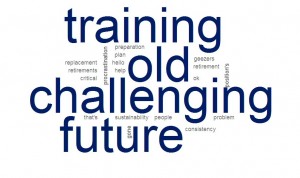
Great conversations start with a question.  A question I asked to a group recently during a keynote was What one word comes to mind when you think of succession planning?   The answers tell a pretty clear story – it is hard, it carries with it a message that we do it when we are old, and it is a future thing.

I agree with two of the issues highlighted:  It is challenging and it is future focused.

Succession_Wordsthatcometomind

The two pieces I would like to reframe for a more effective conversations are old and training.

  1. Old to Valued:  The #1 reason we do not do this – getting old is hard and minimizing people by not respecting their value will start a fight.  How many of us are at our best if we feel  we are no longer needed?  To have a different conversation, we must first reframe the conversation into key people/key roles.  People discussed in these conversation provide great value to the organization, and most would agree that the ongoing success of the organization is important.   Talking about valued people sends two messages:  You are important to our business and it is important that our business continues to be successful.  I am glad the age piece gets put on the table so it can be addressed directly.  Perception is reality, and this one will never go away as long as people are getting older and younger people are working with them and looking for opportunities.  We quiet this conversation when we make it safe to express changing life priorities and continue to focus on performance with development/support.
  2. Training to Development:  90% of development happens outside a classroom.  A message I share is most training returns nothing to the organization.  What this conversation provides for people is direction for development activities that will increase their capacity to lead in the future – both real skills/experiences for them and perceived capacity for the leaders that will be making decisions on their next move.  Capacity is the key word, and it is what your best people want.  Assignments that challenge them and show them they are valued.

A final pitch for One-on-Ones.  When we are continuing to have conversations with people and supporting them in their work it is like making deposits into a Trust account.  Each time we show people they matter and we care (by meeting with them, listening, and supporting) we build trust.  When we ask the question of someone 50+, what are your 1-2 year plans and 3-5 year plans we will need to draw on that trust to have an honest conversation.

Go build some trust, and go have some honest conversations, that lead to thoughtful actions and improved performance.