Forget your brand. What is your art?


Art is a personal gift that changes the recipient.  the medium doesn’t matter. ~ Seth Godin (Linchpin, p.83)

It is popular now to talk about our reputation in terms of our Brand.  Just this week I received an email touting a class to define and grow your brand.  Coincidentally this week has also been a big week for another brand that is working hard to salvage its reputation.  Have you read anything about Livestrong?

Inherent to every coaching or development conversation I have is focusing on the foundational understanding of who you are, what you bring, and the experience you are creating for others.  I don’t like using the word brand because it is a word that too easily moves into the area of spin and perception.  I follow Seth Godin’s quote (fyi – he is also a world class marketer, among other things) to use the word Art.  Inherently, Art is personal and carries with it a passion for creation and sharing.  In the age of flat organizations, fuzzy job descriptions, and leaders too busy to provide daily care and leadership to their people – the world needs more artists.  An artist sees their gifts and finds ways to practice it because they love it.  An artist finds community naturally because they understand other artists and express sincere appreciation for what they do.

The other quote that Godin shares on the same page is from Roy Simmons ~ Most artists can’t draw.

Quit worrying about your brand.  Worry about your art and your medium.

(If you want to explore this further is to read Linchpin by Seth Godin.  I also use a model called trUYou to help clients frame this conversation.)

For a full list of books/resources I recommend here is my library.

Leadership Journey – Strengths to overused Strengths

They were a year into their first leadership role and the feedback was You do not care.  How could that be – because I do! was the defense.  The proof to the contrary was two valuable people leaving the organization and the final expert doing everything they could to help the leader fail.

A universal truth of most people that write about competencies or personality profiles is the simple fact that if we have a strength (example:  getting work done) and if that strength is overused, it becomes a weakness (example:  so task focused that people do not care).  This is and should be one of the number one focuses of developing leaders, and if you look at a leadership program that is laced with classroom time and lite on self awareness/feedback – run.

If you need a second opinion and are not afraid of a 200+ page business book, read Flip Side by Flip Flippen. The Flip Side: Break Free of the Behaviors That Hold You Back

If you are a coach, and you want this conversation in the voice of a coach – read What Got You Here Won’t Get You There by Marshall Goldsmith
What Got You Here Won’t Get You There: How Successful People Become Even More Successful

If I had you at hello with this conversation and you want to jump in and try to avoid the mistake again, here is a simple way to start that conversation and get to an action plan:

  1. What are the reasons you got this leadership role? (list as many as you would like, pick the top 3)  *as their leader, feel free to correct their list after they have created it.
  2. How are these reasons (actually they are strengths) going to help you in this leadership role?
  3. How are these same reasons going to get in the way of your success?  What actions do you need to take to be successful and how can I best support you in this transition? (fyi . . if they don’t ask for help, so at a minimum meet with them weekly for the first 3 months)

The other solution is to speed past this conversation, let the situation play itself out, and try and fix it later.

fyi – Michael Watkins found that 40% of outside leaders hired into an organization fail in the first 18 months.  Brad Smart contends that a bad leadership hire takes 18 months to fire and the cost is 14.6x their base compensation.

Hmmm . . . .

Listen: If you hear any of these 3 things you/we have a problem

Leading people is hard.  It is even harder when leaders are in a mode of talking more than they listen.  When you lead knowledge workers, remember that when you are doing most of the talking their brain is focused on processing what you tell them and reacting to it versus using their own brain to think what they want to do and what questions they need to have answered.

I always promote more conversations – which means two people in direct contact with each other sharing the burden of talking and listening.

As I coach leaders and teams through the transition of having more purposeful conversations, here are things I hear that alert me that someone is not being honest or they are stuck in a place that will keep great conversations for ever happening unless they make a choice to move forward.

  1. It is someone else’s fault: It might be, and if we are talking about what help you need to get to a different level of performance, identify a target job for yourself, or maybe to find more joy/commitment in your work . . . . does it really matter whose fault it is?  If this becomes the primary focus there is a problem.  If accountability is the ultimate goal, then making fixing the problem the priority will make it easier to have the conversation of – What can we do to make sure this never happens again?
  2. I cannot do ANYTHING until you do your job: Really? I used to do a junior achievement activity around production. Each person had a job to do in assembling an item, and there was always one person who could not work fast enough.  Sometimes, people just stood and watched the person struggle.  In other groups, the people around this individual helped out so that the bottleneck went away.  If you choose to watch or chose to say no to any offers of help, then you are really the problem.
  3. I am too busy to have this conversation: Okay, if you are too busy now when would be a good time? This is a flag for me that something else is going on. Imagine not wanting to have a discussion about what we can do to make your job better, to improve the support I provide you as your leader, or to make career plans for you?  Too busy? Hmmm . . . .

It is messy to start the habit of more conversations with your people.  If you are a leader that has not made a habit of slowing down to listen to what your people need, it will be a hard change.  If people are used to you telling them what to do and not listening to their ideas, or not always explaining your decisions, then it will be hard for them to make the shift to owning things that are hard – like offering their own ideas and fixing their own mistakes.

If you work for someone trying to make a shift in their leadership style and you give one of these responses, then you are effectively saying “I do not support the change you are trying to make and I would like to work towards you staying the same”.  Really?

If you are a leader trying to improve the conversations you have with your people, here are some templates that might help you get started.


Rule #1: Sleep

A friend who has never read a business book recommended Rework by the founders of 37signals.  It has made my top shelf and there is one message that helped preserve my sanity during the start-up of my business.  When you are tired, sleep.

Seems simple, but in our drive to complete everything and show any customer in the world that comes in contact with us what an amazing performer we are, the bar gets raised to a point that most of them cannot even see or appreciate.  For me, I was so focused on getting it all done that I forgot I was skilled at my craft and that many of these tasks took a third of the time if I was rested.  So since then I have just gone to bed, and here are a few outcomes for those who need data:

  • 0 missed deliverables
  • 0 feedback from clients indicating I was unprepared
  • 0 feedback from anyone that I appear more rested

The benefit was that it also allowed me to hone in on my new rule that when the house shuts down and my spouse goes to bed, I put everything down and go to bed.  A simple rule, but it has made all the difference.  Nobody else will care that you slept, except the people that have to live with you.  Doesn’t that matter?  It should . . .

Holidays is about being present and putting things down that can be handled later.  It should not take a book or a blog to tell us go to sleep, but sometimes these messages need to be spelled out and we need to be in a place to hear them.

My message for you:  Thanks for listening and sharing your stories with me.  I will not bother you until Jan 7, so stay present with the people that matter in your life.

Have a great holiday.

You don’t need more data

An email came from the Gallup organization yesterday inviting me to buy a full ranking of my Strengthsfinder results for the bargain price of $89.  It promised my 34 talent themes ranked from strongest to weakest.  For those of you that have never taken it, when you buy Strengthsfinder 2.0 or Now, Discover Your Strengths from Gallup you get a code that will allow you to take an assessment that gives you your top 5 talents.  It is a great assessment.

Great move by Gallup, because the popularity of this assessment has resulted in tens of millions of people taking it.  If 1% get excited about this offer it will be very profitable.

I have personally helped over 500 people understand their Strengthsfinder results, and in every group there is always one person who wants more data – all 34 talent themes ranked.

My standard response has been – “What would you do with more data?”  The answers I hear includes statements like Then I will really know or words like certain, exact, and total clarity.

My response – Talent themes start the conversation.  The rest of the conversation is about understanding them, self-observing to see them at work, building on them, refining your understanding of them, and then repeating this process endlessly.  It is not a neat and clean project that ends with a deliverable.  In the end, someone tells you something like You are wise or You do a great job adapting to different situations.  In that is the inherent belief that You get yourself.

Self-awareness is a journey.  It is more about the work than the data.  Would you respond to an ad that claimed Receive total consciousness on your death bed for $74.99? (this is for Caddy Shack fans)

Feel free to buy more data, but you don’t need more data.  Do the work.

4 Performance Words – What Seth said, and What I think

Seth Godin recently blogged about performance, and outlined four kinds:  Bad, Good, Remarkable, and Personal.  Here is the whole post.

In a world where we too often treat performance with labels like Right person/Right seat or A player / B player / C player – it is good to just use words that we all know.

Leading performance is about not walking by the work without letting people know what you see.  It is about getting their view of the work and what they see in others.  It about celebrating things being done, asking a few questions to plant seeds that might lead to a different view of the work, and challenging people to a different level of involvement and ownership.  Try these:

  • Where did you see passion in someone else’s work this week?  How can we celebrate that?
  • How did you personalize your work this week and who benefited from it?
  • What work do you have in front of you that has a chance to be remark-able in how you do it?  What will make it worthy of that label?

Of course you ask these questions, listen, and always revisit them.

Personally, I would drop Bad and Good in favor of Absent and Solid.

I like reading Seth – his thoughts are generally remark-able.


It must be the shoes – Yes and No, but mostly No

First it was Dorothy in the Wizard of Oz, wearing the ruby red shoes.  Then Michael Jordan did a whole ad campaign that immortalized the line It must be the shoes!

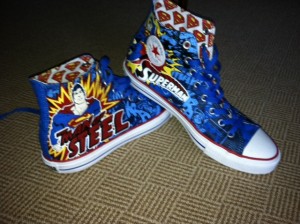
Yesterday, I received my own set of special shoes – Chuck Taylor Superman Shoes.  They were a gift from a group of people in the Shifting Gears Program where we spent over 100 hours together on a career transition journey.  I was part of a great team of people that facilitated the journey, but these 21 individuals did the work.  The shoes became a symbol that we needed to remember what strengths and talent are inside of each of us.  I love the shoes.

Performance can be attributed to a lot of things, but in the end it is about confidence and commitment to learn/grow through the peaks and the dips.  It is also about being in community with people, giving to that community, and leveraging the the strength of that community to celebrate the peaks and to climb out of the dips.  For 21 people in the Shifting Gears program, it was about coming together on 13 different days, spending 80+ hours working at a real company on a real business need, spending another 100+ hours networking/rebuilding a resume/mock interviewing and other work to move towards a preferred future.

One individual shared the story – I went back to a familiar place (my old company), but as I entered I could feel that it had stayed the same and I was a different person.

Is it the shoes?  No, it is what is inside of us that we need to see AND to unleash on something that we are passionate about.

But I do love the shoes. 🙂

Questions to help the work get done (and the team to be built)

Seth Godin had a recent post titled Two questions behind every diagreement.  In it he shares two questions that will help move through/solve every disagreement:

  • Are we on the same team?
  • What’s the right path forward?

By definition, you cannot have a team without common goals and group decision making power, and getting there requires conflict.  These are two great questions, but let me add a few more to help you apply this in your own team and move things forward:

1. Are we on the same team? –> What is the issue?  What is the outcome we want?

2. What’s the right path forward? –> What are three steps that will move us ahead?  What 1 step will I own?  What 1 step will you own?  What 1 step will we BOTH own?  (remember 1 + 1 + 1 = 3)

If you cannot answer/agree on #1 don’t skip/move ahead to #2.  The key to #1 is addressing the issue and not the person – ie.  If the issue is someone or what someone else needs to do to make my life easier, then the whole discussion is about winning and not solving a problem.  That means you are the problem –> so step back, take a deep breath, apologize, and step back into the discussion with a different mindset.

If you get to #2, the best way to build teamwork is to own work together.  If a solution takes 20 steps and 3 months, focus on the next 3 and 48-72 hours.  Progress/success builds relationships between people and teams are created along the way.  I can hear the complaints now – – But this is a very complex problem and 3 steps is too small. My next question:  Is the issue that the problem is too complex or We are not agreeing on/owning a solution as a team?  In either case – either start moving forward or punt the problem to another team.

fyi – If anyone on the team has a goal to sit back and let someone else fail so they can either:  a) Ride in and save the day or b) Play the I told you so card – – – they should be given one chance to hit the reset button, and then removed from the team.

Thanks for planting the seed Seth.

What is your learning BRAND?

There are two questions I love to ask people to get a sense for how they learn.

1. Where do you get your learning?

2. What is your favorite TED video?

These two questions help me understand their brand as a learner.  It helps me see how the trends in information flow and the tools that have emerged to create communities around topics have been absorbed into their lives.  For example, if I hear the standard – I am a reader, then I know they prepared for the interview, but question if they are prepared to help my business hit our 2020 goals.   If I hear the talk about a website I have never heard of, discuss what they learned on LinkedIn last week, or try to convince me to drop Business Week in favor of Inc or Wired, then I know I have someone that is hungry and resourceful.

So why TED? Over the past 12 months I have been blessed to be part of a program called Shifting Gears in Michigan, and it has exposed me to individuals in transition that have 15-20+ years of work experience.  When I ask the question, who watches TED videos, <25% of hands go up.  TED is free, it is thought provoking, and it is mostly normal people sharing amazing passion/knowledge for a topic.   It is also not new, and if you are not familiar with it or not plugged into it I will venture a guess that you are not a real active, self-driven learner.  It makes me smile to think of the Shifting Gears participants who begin to own their learning.  Your learning Brand is not about age, it is about attitude and energy.

Elliott Masie, a learning futurist, is having his annual conference this fall and will be talking about how learners want things customized just for them.  He is right (by the way – the answer is called Google or LinkedIn Groups and it is not in the future).  The good news for small businesses is that if you have Google and spend time with your people talking about what they need to learn or what they have learned and used at their job (fyi – development plan) – then customized learning can be mostly free.

Ask the questions.  Listen well to the answers.  For job seekers, work to make your answers compelling and authentic.  Help me get excited about your learning Brand.

Building a Leadership Development Program from Scratch

I was presenting at the SHRM conference in Illinois and had a chance to sit in on a presentation by Benjamin McCall.  It was a solid and thought provoking presentation, and my big takeaway was the question How would I build a leadership development program from scratch?

It reminded me how times have changed around doing things from scratch.  A personal example for me is baking.  I grew up thinking everything – pie crusts, cakes, and even muffins were only made from scratch.  While I love to make bread, cinamon roles, and even pancakes from scratch, most of the time it is much easier to get it from a box or a store.  I started my leadership development career thinking the stuff from the box was what needed to happen.  If the name Ken Blanchard, Center for Creative Leadership, Executive MBA, University of Michigan, or Harvard was on the label then it was great.

Then I went to a small company and was asked to build one from scratch, for one person, and with a limited budget.  The other condition was that it had to work because our business growth strategy was depending on the leaders from this program to open the offices in our plan.

What I learned is that there are some core benefits that all participants in these programs takeaway, and it has very little to do with content.  I also learned that the two core benefits, self-awareness and peer communities could be provided even if it is a small company.  trU Tips 21 is coming out next week and I will provide an outline of how I would answer this question.

I still stop when I hear the words Center for Creative Leadership or Ross School of Business or Harvard, but I know now that anyone can make something  really good from scratch.

Finally – the key currency to support this being done well and on your own – time from you and the rest of the leadership team.  That is the magic ingredient.  More to come in trU Tips 21 . . . . . .