
Powerful Question For Leaders – What is within your control?

What is within your control?

As I talked to the leader he explained a very complex situation that included a hierarchical leadership structure, a workforce that had to stay, and a customer that often spoke up in frustration.  I listened for ten minutes and then asked a single question – What is within your control?  The first response was all the things he did not control – so I repeated myself.  What is within your control?  The next response was the feelings that were created by the whole situation, so I repeated myself with a twist – What part of this situation do you control?  His final response was a list of a couple of things that mattered and a great conversation ensued.

Great conversations start with a question.  Many conversations with leaders start with challenges, frustrations, and sometimes just pleasantries.  It is when we get to the place where we name our place in an issue and what we see as our goal/ownership that the conversation becomes great.  What makes it great is that we demonstrate our trust in the person/relationship by sharing our absolute version of the truth – regardless of the risk.  What also makes it great is that we can openly disagree as part of the conversation by allowing space for others to offer their truth.

I believe trust is a gift, and when someone around me is willing to share something that could be used to hurt them or could cause conflict with a teammate my first move is to be grateful they are willing to share.  The next step is to identify what needs to be done with the idea.  As leaders, recognize there are three reasons behind a powerful statement:

  1. Just needs to be said. (We just need to listen).
  2. It raises and issue/problem that needs to be solved.
  3. It raises the thought of a potential issue/problem that needs to be explored.

The challenge is that leaders are too often wired for #2 and #3 happens by accident because we choose to ignore it vs just parking it in a place that allows further inquiry or conversation.  And #1 – that is in the Husband 101 class that we all need to keep retaking. 🙂

Listen differently today.  What do you hear?  What is your natural response to truth being expressed?
 

The ONE key to performance

What is the single greatest impact on my performance?

A fairly simple question, and yet the answer tells the story about what needs to change to get things done.

The answer:  ME

My attitude.  My resilience through change.  My courage to be honest with myself and others when the work does not align with my heart. My willingness to ask for help.

In an era where our leaders, our companies, our world change more often than they ever have in history – who owns what I get done today becomes critically important.

Change gives us a reason the right things might not be happening, our first job is to not allow it to become an excuse.

When we own it – our situation looks different.

When we own it and readily ask for help/wisdom/guidance – teams have a chance to develop.

When we own it, ask for help, and our teammates come to our aid – teams have a chance to become healthy teams.

When we say thank you and bring in pizza/donuts/apples to celebrate teamwork – healthy teams can evolve into friendships.

And it all starts with ME.

Go own it – – or not.  It is your choice.

(fyi – here is a whitepaper I created with 5 Tips to help individuals manage their performance.)

Empathy: 3 Things Leaders Can Do to Develop It

Seth Godin recently published a post on empathy – and it starts with the observation that Empathy doesn’t involve feeling sorry for someone. It is our honest answer to the question, “why did they do what they did?”  He goes on to share that if we really honest with ourselves, the answer to that question is rarely because they are stupid.

Simple advice, but in the world of business people doing the right things immediately impact our businesses, and often more importantly – when we get to go home at night or how much we can actually relax when we are on vacation.  Developing empathy is hard in these situations because we start in a frustrated place where the only questions on our mind are What were you thinking? or Why do I always have to fix this for you?.  These questions create fear and cause people to hide, and empathy does not reside in that place.

The thing is, empathy is a cornerstone for developing the talent in others, because when we do the work to see the things through their eyes helps to drive the conversation – What can we do together to close the performance gap that we both see?.  Asking and listening ultimately leads to the barriers others see that are getting in the way of the work.  Do you hear empathy in that statement?

Here are three things any leader can do to build empathy:

1.  Read – One thing I recommend for women and men is a book series call For Men Only/For Women Only by Shaunti and Jeff Feldhahn.  It was designed for couples to read about the perspective of the opposite sex, and I guarantee it will drive conversations and ah ha moments for both men and women.  Any book that gives you a perspective into a culture or person will create opportunities to develop empathy.  Lean In by Sheryl Sandberg was a book that did that for me this summer.

2. Do their job – In his book Rework, Jason Fried (founder of BaseCamp/37Signals) encourages entrepreneurs to do key jobs for 3 months before hiring people.  His reason is that it will give you an opportunity to know the work and challenges intimately so when you hire you find the right person and you know how to support them. Do you hear empathy in that statement?

3. Ask them – In my one-on-one templatesI share questions to help leaders start and end their time by listening.  Great conversations start with a question.  These questions are designed to hear someone else’s perspective on truth.  Remember, in performance situations the truth has multiple perspectives.

    • Recent successes and failures (to celebrate)?
    • What is energizing you right now?
    • What is frustrating you right now?
    • What is one thing that needs to be addressed by me? This organization?
    • How have I made your job harder in the last 30 days?

If we make the assumption that people want to tell the truth and we create a safe place to do that, empathy will happen when we really listen to the answer and learn how/when to act to support them.  Some things (many things) we cannot fix, but we can listen.

Listen . . . Lead.  Repeat often.

Time to DEVELOP PEOPLE – 3 Tips to Make It Happen

“I don’t have time for development for myself, how can I do it for my people.”

In 2008-2011 money was the number one reason I heard for not being able to develop people.  Today, the most common reason I hear is time.  Three thoughts on this:

Thought #1:  If it is really important you will make time.  If it is not you won’t.

As a parent I started to use the phrase “There are lots of reasons, but there are no excuses.” in response to teenagers in my life coming up with various excuses why things don’t get done.  It helped me shift them from passing the blame with an excuse back to thinking about the reason something happened so we could have an Adult to Adult conversation around the importance of what was supposed to get done and what we could do to make that barrier (aka. reason) go away.  It also helped remind me that these reasons are real for them and I cannot unilaterally fix them, but together we can probably figure it out if they will own the reasons and agree on the priorities.

There are lots of reasons for not sitting down for 30-45 minutes once a quarter with your people to focus on their growth, but no excuses – – if you really do care about their professional development.

Thought #2:  Employees own their development.  The organization owns support. (Note:  As the leader, you represent the voice of the organization)

I recently talked to a leader struggling with the One-on-One template/meeting structure I share on my website.  It was lots of work for him, and his people were not really engaged.  As we talked, I learned he was filling out the form and owning the updating of it and the scheduling of the meeting.  It was lots of work because he was doing their work.  We are working on flipping the model.

Remember to encourage and support them.  If they are not sure what their role is give them my whitepaper – 5 Tips for Owning Your Career and Development.

Thought #3: Beware of the Myth of Controlling your Time

In my book, I talk about how OBN (Ought But Not) Leaders have fallen for the illusion of control around time.  Leaders need to make sure their TIME is focused on THEIR PRIORITIES and the ORGANIZATION’S PRIORITIES.  It is not easy, but if you really believe investing in your people is a priority, then we can find the time.  The tools are easy – read the HBR article Who’s Got the Monkey or read my trUTips on this and go to the special web page for additional resources to help you start owning your time.  The work of change is not easy, but it is important and achievable.

The ironic think is that I made the statement that started this post.  I believe Learning + Doing = Growth, so I am busy making my development a priority and finding time to make it happen.  I have no excuses.

Writing More Effective Goals – Some tools that will help

The most important part of professional development is writing the goals.  We can talk about it, we can get excited about attending a great class or program, but in the end what we do with what we have learned is the ROI!  Sure it takes support, maybe some coaching, but it has to start with defining a target we can focus on.  The goals and action plan are critical.

I was leading a book study with a group of entrepreneurial leaders, and as usual one of the conversations we had inspired me.  Also, as usual I had about 15 minutes to share some tips I have learned around writing goals and it was not enough.  So I wrote an article on LinkedIn titled Leaders – Write Better Goals for Yourself: 3 Critical Mistakes And How to Fix Them.   If you are at or near evaluation time for yourself or delivering evaluations for others, take a look.  My goal, as always, is to equip leaders with the tools they need to have more impactful conversations around growth and development.

Could you share it with your LinkedIn community?  Thanks for the help in starting a conversation around this.

Also – Here is a worksheet I use with clients to help them write better goals as they go through their own evaluation/development


Passion and Art: Why does it matter?

Passion – I am torn on this topic by people that come up to me for advice on starting their own business and realizing the independence they long for.  I have learned to listen closely for their why, and if they start with the outcome of entrepreneurism and not the work, they have it backwards.  I challenge those people (and myself) to keep the focus on the gifts you have and the work that excites you.  Seth Godin shifts our perspective on our gifts by challenging each of us to think of ourselves as Artists – and makes the comment Art is the intentional act of using your humanity to create change in another person.   He goes on to share that most artists can’t draw.

Hidden in the whole conversation of performance is passion.  Here are three things I have learned about passion of the artist:

  1. Passion is the hidden ingredient in performance:  In my book People-Centered Performance I share my belief that Performance = Talent + Passion + Work
  2. Passion does not have to reside in just the work, it could be the team, or the cause, or even the need to eat.
  3. Passion is without complaint, so if we can do the work with excitement and ownership, and without complaint, we are close.
  4. It is impossible to be an artist and not have passion.

A great summary of passion came from a recent book I read called The Boys in the Boat.  In it, the master shell builder George Pocock talks about his work and what drove his choices:

My ambition has always been to be the greatest shell buiilder in the world; and without false modesty I believe I have attained that goal.  If I were to sell the stock, I fear I would lose my incentive and become a wealthy man, but a second-rate artisan.  I prefer to remain a first-class artisan.

I like watching for passion in others, and instead of starting with a pen and paper to write your statement of passion, start by observing and talking to others.  There is energy in watching the artist work, and they can be found all around us.

Remember, most artists can’t draw, and most artists aren’t entrepreneurs.

What do I do?

I connect students to parents and grandparents.

What do you think the person who made that statement does as a chosen profession?

Lt. Col. Paul Scheidler has served our country for over 20 years, has served multiple deployments in the Middle East, and has been awarded the bronze star.  Oh, and he also happens to be an American History Teacher at Heartland High School in  Hartland, Michigan.  The DAR (Daughters of the American Revolution) in Michigan recognized him as the 2015 Outstanding American History Teacher.

We have a choice each day to do our job or to make our work about our purpose, cause or passion.  It is always a choice.

It was a treat to be in the same room and feel the magnetic pull of the purpose that oozed out of Lt. Col./Mr. Scheidler.  I bet his students feel the same way.

Your job does not matter as much as the reason you do it.  What is your reason?  Just ask your teammates – I am sure they know.

Good Question – Great Question

What if we asked more questions?

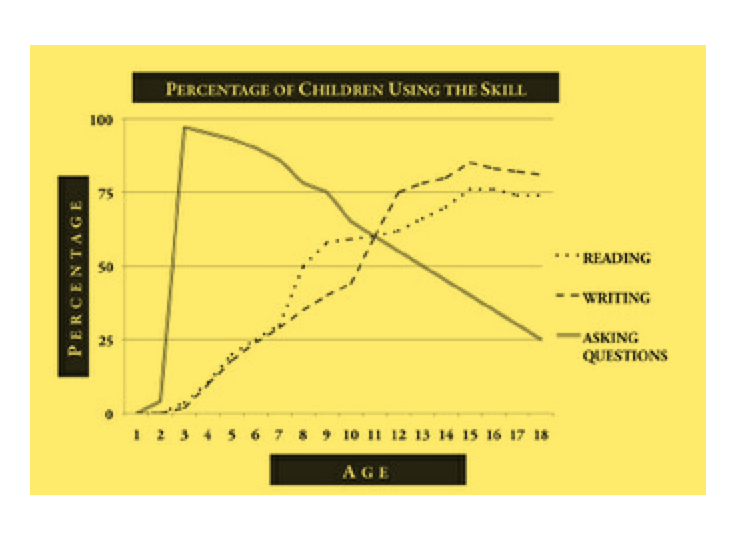
I am reading a book by Warren Berger called A More Beautiful Question.  In it he shares a study from the Right Question Institute tracking kids use of questions over time that identified a trend of students using questions less as reading and writing skills increased.  The use of questions peaks at around the age of 3, and by the age of 18 it is only used 1/3 as often as reading or writing.

From 2009 A Nation's Report Card.
From 2009 A Nation’s Report Card.

For parents, you are probably not surprised because you have lived through the WHY stage of three year olds and the grunting teenager.

This fascinates me, because I see this in adults as I work with leaders in their development and those that have gone through a career transition.  Too often EGO gets in the way of building the relationships needed to be successful in their next role.  One sign of EGO is the need to tell vs ask.  Think of that – I can read/write/Google (i.e. Figure it out) = EGO response to not knowing something.  As leaders, we battle our EGO overtaking us by leveraging the knowledge of our team to solve problems.  I believe one of the most important skills to battle EGO for adults/leaders is to learn is the ability to ask questions AND listen for the answer.  We do that by mastering the use of GREAT Questions over GOOD Questions.  Here are some examples:

GOOD Question:  Have you considered x and y as solutions?   GREAT Question:  What other solutions did you explore?

GOOD Question:  Why did this happen?   GREAT Question:  What has to happen next to make this problem go away?

GOOD Question:  How was your weekend?    GREAT Question:  What one word would you use to describe your weekend?  (What is the story behind that word?)

GOOD Question:  What do you want to share with the group before we start our meeting?       GREAT Question:  What is one personal best and one professional best you have to share with us?

My basic rule is to always start questions with What or How – that does not always make you perfect, but it makes you closer to perfect.  It is also important to be ready with – tell me a little more about that? or Tell me a little bit more about what options you considered?  Then listen.  The metric for you is to have a ratio of questions to statements of 5 to 1.

Hopefully you have already answered the question What if we asked more questions? 🙂

3 Questions that help create a culture that SUPPORTS performance

3 Questions that help create a culture that SUPPORTS performance

As a coach and consultant, performance conversations tend to start with emotions and adjectives.  One of the challenges in gaining clarity is to have a conversation that gets down to the root cause, and it also means talking to both the frustrated leader and the individual. Here are the questions I ask:

  1. Do they/you know what is expected of you at work?  What are they?
  2. Do they/you have the tools and resources to do your job well?  (see question 3 for how to deep dive on the specifics)
  3. If Yes to both 1 and 2, do you feel you/they GWC the role.  (G = Get It,  W = Want It, C = Capacity to do it)  *GWC is from a strategic planning tool I use called EOS


I don’t look at creating a performance focused culture, because my experience has shown me that leaders take this path by starting with accountability and expecting work to get done.  I have learned through Denison, a partner company I use for surveys, and my own experience that it is important to focus on creating a culture that supports performance.  It aligns with my own belief that individuals own their performance and development, and the organization owns support.

When we start with defining the target together and supporting the work to get there (frequent one on ones, asking what they need, following through, repeating often), more often than not it ends in a trusting relationship where the important things can get talked about.  Leaders, this is your work in SUPPORTING performance through the culture you create.

When people ask you what they can do to help, tell them.  Beware of asking for the extremes – no help (because you are frustrated, angry at someone, or your EGO is on overdrive) or having them do everything.  Sales is a great example because of the frequent ups and downs in a challenging market.  When you are missing sales numbers – role playing, prioritizing your leads, reviewing your pipeline are all great support activities.  Maybe even asking some people to make some calls for you or leverage relationships they have in some of your maybe companies.

Support is a two way street, it has to be offered and it has to be accepted.  The times we get in life when it has to be forced are the tough times.  Just ask an adult child who has arranged assisted living or nursing home care for a parent.  If the point is reached where a leader feels they need to force assistance in getting work done (what individuals often call micro-managing) it is probably time for you to leave.

I know it is never that easy, but it is that simple.  If that outcome is not what you want, then start back at the beginning and make a commitment to change your half of the conversation.


Read Seth

Read Seth

Entrepreneurial spirit.

A popular way to explain what you want in a person.  I recall a conversation with an HR VP at a Fortune 500 company explaining why they need more people with an entrepreneurial spirit.  I recalled the scene from A Few Good Men where Jack Nicholson’s character responded after being badgered about telling the truth with “You can’t handle the truth!”  I had a quick image of Jack Nicholson delivering the line “You can’t handle the entrepreneurial spirit!”

To truly support the entrepreneurial spirit people have to have the power to make decisions, to fail, and to get the support to fix them.  It is a common method for Seth Godin, which is why I read him everyday.  I like and respect the voices of Drucker, Collins, and Covey in the space of personal and business growth, but Seth does it in less words and it always resonates with me.

My advice – Read Seth.  Here is a sample.

My second piece of advice – Add a Seth moment to your team meetings for people to share a 30 second clip of something that resonated with them over the past week/month of his posts.