Trust and Leadership: A FREE learning activity for your leaders this summer

Trust and Leadership: A FREE learning activity for your leaders this summer

Almost 8 years ago I was trying to decide on a name for my new company. After several thousand hours working with leaders, it hit me that if I were going to tell leaders two things that they should focus on everyday it would be this: Always be building TRUST with the people around you and leverage that to get the TRUTH on the table. TrU in the name of my company is a daily reminder of what I believe and how I want to impact the leaders I work with.

Fast forward – When Harvard Business Review offered a free download of a new article, The Neuroscience of Trust: Management behaviors that foster employee engagement by Paul J. Zak, I immediately got it and read it. I posted about it, and this week I sent purchased copies to all of my EOS® partner companies and asked them to do a leadership study around it this summer. I want to share it with you because I believe everyone should understand how the brain works and how they can influence the FEELINGS that get generated by the brain each day. The feeling that I care about most because I believe in people-centered leadership is TRUST.

Here is the FREE study guide, and I believe it is $8 well spent to get a copy of the article.  If you want me to help facilitate the learning at your company this summer I have special rate for my trUTips readers to do that – just drop me a note and mention you are on my trUTips mailing list. My guarantee is that if you don’t find the article helpful let me know and I will refund your $8 – personally.

The power of PAUSE: Two tips for practicing it today

The power of PAUSE: Two tips for practicing it today

The summary of our coaching work told a powerful, yet simple, story. “Scott, the biggest impact our time had was to take a deep breath when things got heated and keep my emotions more level so the conversation could continue towards a mutually agreed upon solution.”  Breath = Pause. What situations do you get in where your emotion takes over and the pause button is needed for you to effectively manage your contribution to the conversation?

  • Parenting?
  • Home improvement project with your spouse?
  • Summer canoe trip where you are NOT in the back steering?
  • Riding a tandem bicycle where you ARE in the back and not steering?

The brain is actually wired to react first and think secondly; it is called the amygdala, which is at the base of the brain and controls the fight/flight response. It is supposed to kick in to keep you alive. When humans lived in caves and were outnumbered by animals big enough to eat them, it was critical for survival. Since we have moved into dwellings with locks and walls and work in offices, it is not as critical, but it is still there.

Seth Godin calls the amygdala the lizard brain, and says this in his book Linchpin:

The lizard brain is here to keep you alive, the rest of your brain merely makes you a happy, successful, connected member of society.

People-centered leaders still speak up and disagree, and the reason for having meetings with agendas and frequent one-on-ones with their people is to create space where disagreements can happen and be managed.

Here are two tips for practicing the pause:

  1. Bring water to the meeting and drink when you get irritated or feel the need to offer a quick rebuttle to a comment.
  2. Commit to using the comment “Tell me a little more about that?” at least once in your next meeting.

Where can you practice the pause today? When you practice the pause, how effective are you at restarting the conversation and channeling that emotion into a better solution to the issue you are addressing? When you fail at the pause, how quickly do you apologize and restart?

Listen . . Lead. Repeat often!

People-Centered Leaders – Read this article!

People-Centered Leaders – Read this article!

I have come to believe that there are two key sources of learning for leaders that will have the greatest impact on their performance: Harvard Business Review and TED Talks. There are certainly many places to learn, but the two of these provide quality, depth, and breadth that will ground you in key fundamentals of being a good person and stretch you in productive ways.

Here is a summary of an HBR article that grounded me in some timeless truths – The Neuroscience of Trust: Management behaviors that foster employee engagement by Paul Zak.

Key points:

  • Leaders know low engagement hurts the bottom line of their business (Gallup and others proved that) but don’t know how to fix it.
  • There are eight behaviors that stimulate the generation of oxytocin, which is a brain chemical that facilitates teamwork. (I will have to trust the author on this one – I missed that class in college. 🙂 )

Be ready to NOT be blown away by these behaviors:

  • Recognize excellence – When you see someone doing great work, tell them!
  • Induce “challenge stress” – Provide people with challenging assignments and/or invite them to help you solve a significant problem.
  • Give people discretion on how to do their work – Focus on defining the outcome of the project and give people space to get there (for my EOS® clients, this is when I ask “What does success look like for this rock?”)
  • Enable job crafting – Allow people to volunteer for work, or add an accountability to their job that the organization needs if they have a passion for it; also allow them to delegate work they don’t like and depend on the team to do it.
  • Share information broadly – Have a defined weekly, monthly, quarterly, annual rhythm of meetings where you talk to and listen to people beyond your immediate team.  Protect that time like it is sacred, and especially don’t allow the customer to cause you to cancel it.
  • Intentionally build relationships – See my Team Member Fact Sheet post . . . .
  • Facilitate whole person growth – See my Development Plan post . . .
  • Show vulnerability – See my Vulnerability post . . .

I appreciate the article because it provides the why behind all of the actions I promote as part of being a People-Centered Leader. The last chapter in my book is devoted to actions that hit most of these directly. I also recognize that teaching leaders the why – in this case, the science – behind trust-building leadership creates a higher level of commitment to the right behaviors.

If you are looking for a summer leadership book study, start here – and if you add my book to the second half of it, I would be glad to talk about showing up one or two times to help enhance your learning. The reason I say add my book is because leaders will all immediately agree these are the right actions to take, and yet we don’t do them – that is where my book kicks in.

This points out that leadership is that simple, and yet not that easy. Leadership is a journey that is best taken with company.

Listen . . . Lead. Repeat often!

The Ultimate Team-Building Tool + 3 Tips for Using it

The Ultimate Team-Building Tool + 3 Tips for Using it

A friend recently emailed a group of us asking for icebreaker ideas. The group responded with many of the standards: 2 truths and a lie, 5 things we all have in common, and a few other ideas. All effective at getting people laughing and talking – but none can be taken back and used when the new VP walks in or you pull a project team together.

I shared my Team Member Fact Sheet™ – over the past 5 years it has become the only tool I use. My experience with adults is that too many barriers exist in the workplace (or in our cul-de-sacs for that matter) which prevent equal sharing of ‘what you need to know about me’.

Here are three ways to use the Team Member Fact Sheet™ at one of your upcoming team gatherings or EOS® Quarterly Planning Sessions:

  1. Ask everyone to fill it out and go around and share 2 to 4 facts with each other, then hand out their sheet. As the leader, send out your completed sheet first.
  2. Give everyone a blank fact sheet and ask them to meet people and take turns asking each other questions from the sheet. Spend 2 minutes per conversation, then move on. Keep it to 2 questions. Debrief by going around and introducing their current partner and sharing 1 new fact they learned.
  3. Advanced: Fill it out for your teammates. Hand a Team Member Fact Sheet™ to each person on the team. They write their name on the top and pass the sheet to the right. Each team member has 60 seconds to fill in as much information as they can about that person, then it gets passed again. Debrief by having each person share answers to 2 questions the team did not complete and 1 correction (where the team answered wrong). I give each person a different colored pen so their answers are color-coded – and watch as people look around the room to try and figure out who answered based on ink color. Laughter is generated.

Brain research tells us that getting people talking about themselves has the same impact as feeding them or handing them money. 98% of us want to be people-centered leaders, and this is a step toward doing that.

The form is free, and if you want more tips just email me. I love to watch this sheet travel!

Listen . . Lead. Repeat often!

Hidden leadership secret? Showing Up

Hidden leadership secret? Showing Up

I spent a day with a group of leaders last week, and one of our topics in management was walking around. Each person was given an assignment to go do it daily for a week and journal about it. Only a third of the class did it, but those who did had some great stories of what they heard and observed.

The rest missed an opportunity. If you believe in people-centered leadership and the basic belief that people work harder when they feel cared for/listened to (and when they care about/listen to the people around them), then showing up is what you do – always. Do any of these statements reflect your commitment to show up?

  • You show up for potlucks or any event organized by your team around food
  • You show up at wakes and funerals
  • You send hand-written notes when there is a birth, death, or marriage
  • You walk around the office routinely, with the single goal to listen to and learn what your people are thinking about
  • You tell people what you are thinking about – both celebration and sorrows
  • You show up at the fundraisers your people care deeply for
  • You show up in the lunch room/break room and talk
  • You complete evaluations on-time
  • You show up for one-on-ones, or reschedule quickly

Showing up always starts as a physical presence. When it is done well, at some point it moves to a more emotional presence. This is where agape love kicks in. What is agape love? Read about it in People-Centered Performance.

I lost my father a couple of weeks ago after 90 years of life. As I thought about what I admired about him as a father, the top on the list was he showed up. Once I was challenged by a coach that showing up was not enough. I believe he was wrong, because when we show up consistently relationships are changed. When I look around at broken friendships, failed leaders, dysfunctional teams, and lonely people – it always seemed to start when someone stopped showing up.

I hope somebody writes the same thing about me someday. What about you?

Why don’t you try management by walking around for a week or so. Be part of the 33% that get it.

When you are ready – why don’t you try parenting by walking around and marriage by walking around?

Listen . . . Lead. Repeat often!

The key to a long journey? Focus on the next town. (Thanks, Gary.)

Yesterday on my daily run with my golden-doodle, I ended up walking with a guy named Gary. We have passed each other on the trail for two years and never really spoken. Sometimes I realize it is time to walk and listen, and this was one of those moments.

As Gary told me about his journey across the 2000+ mile Appalachian Trail in 2008, I asked him this question (remember – great conversations start with a question):

“What is the trick to successfully completing the Appalachian Trail?”

Without much thought he answered,

“You just have to focus on the next town and not think about how far away Maine is.”

I thought of my EOS® (Entrepreneurial Operating System™) clients and how creating a vision for a company is critical, but establishing smaller goals and the disciplined execution of those goals is most critical.

Successful leaders learn to help their teams understand and stay focused on the next town. People-centered leaders invite their people into the process vs just sharing the goals.

Sometimes you just have to slow down and talk to the Gary’s you run into – they have a lot to share.

Listen . . . Lead. Repeat often.

What’s on people’s minds? Clicks and questions…

What’s on people’s minds? Clicks and questions…

We were moving into a new building, and created sessions with the CEO for all employees to learn about the move and ask questions. We told our CEO to go around and collect questions BEFORE answering any.

His agenda was architecture, timelines, space for growth, and decorations; their agenda was storage, kitchen areas, and noise/privacy. It was hard for him to not jump in with answers right away, but when each session ended he was excited about the time with his team and made better decisions around the change because of what he heard. The outcome was an amazingly effective move that provided the business with a momentum bump.

When we really listen…people tell us what’s on their mind. My #1 saying to new leaders is, “Mind reader is not in your job description. Focus on listening well, making leadership decisions based on what you hear, and repeat often.”

Listen . . . Lead. Repeat often!

Clicks are like questions. At my monthly business review with my marketing lead, we reviewed what you clicked on the most in the last 28 days. Here is what your clicks told me:

  1. Rock Planning Sheet – EOS template
  2. 5 Key Outcomes – Individual Development Plan Conversation
  3. Talent Management Templates

Your clicks show me a high concern for defining the bigger work you and your people are doing so it can be managed. They also show a desire to manage the longer-term development of your people. Based on many other conversations, I know most of your organizations are doing the evaluations but have never completed the formal development planning with your people.

In two weeks, I will facilitate a day of learning with a group of leaders in a leadership development program I helped create (LeaderWork). Your clicks have given me some great material to share as I help leaders work on connecting strategy to actions for their teams. That is the way good listening works.

Do any of these topics make you want to click? How are you gathering questions from your team this week? If you look at all the questions you are hearing, what new questions get generated for you?

Listen . . . Lead. Repeat often!

If you would like a different perspective on listening and leading, take a look at my JoHari Window video.

Wanted: Passionate, Hope-Filled Leaders

Wanted: Passionate, Hope-Filled Leaders

In the last three weeks, I have received two random requests for help from leadership teams. Have you ever been in a situation where you were asked to do something and you felt obligated to say yes? When a paying customer walks in, as a small business owner I am always looking for reasons to say yes. Here is my internal filter for requests, and since I use EOS (Entrepreneurial Operating System®), it is called my Core Focus™:

Passion: Maximizing individual growth and eliminating needless pain – moving to and past the tipping point of success.

Niche: Organizations with passionate, hope-filled leaders who are over-challenged and under-supported.

In my last two posts about Give and Take by Adam Grant, I shared the research around being a giver and the core skills all givers need to develop to be more effective. A second way to look at the Core Focus™ is that it helps you negotiate more effectively and be intentional about building relationships with Givers/Matchers in your life, offering a tit-for-tat by thinking through the challenge being offered. (see post to understand these)

In your role, what is your Core Focus™ and does it align with what you do well?

For your team, what is your Core Focus™ and does everyone agree with it?

In the end, I said yes to each opportunity. Each team is going to start by generating absolute clarity in their roles, creating absolute clarity around what the team needs to accomplish, and having an open discussion around the right seat for those people taking on leadership roles. Inherent in each of these discussions is the question, “What support do you need from your leader? Your teammates?” For each team, I am asking for help from the leaders involved. Without their willingness to be 70%-90% transparent about their own Core Focus™ and life priorities, this process will only set them and the team up for short-term failure.

Do you know your own Core Focus™? (read my whitepaper if you need to think that through)

Does your team have a Core Focus™?

You can do work without one, but you can’t achieve healthy growth as an individual or organization without one. That is where my passion of eliminating needless pain comes in – which is one of the main reasons I looked these two clients in the eye and said yes. It is that simple, and I know the work will not be that easy. But if they help, and I bring my best, we can figure it out.

(Note: People-centered leaders work on this with their teams and themselves often!)

If you missed it – watch Simon Sinek’s TEDTalk, How Great Leaders Inspire Action. Do you see the tie between why and Core Focus™?

3 Skills To Become a More Powerful Giver

3 Skills To Become a More Powerful Giver

Powerful Giver? As I wrote it, the word oxymoron came to mind…

In my last post, I introduced you to Give and Take by Adam Grant and his presentation of the styles of giver, matcher, and taker. To conclude that givers will find more success is not accurate, because like any strength overused, it can become a weakness and negatively impact effectiveness. Here are the three traps for the giver style:

  • Too trusting
  • Too empathetic
  • Too timid

One of my favorite parts of Adam Grant’s book was his section on the learnings that will make givers more effective, based on the outcomes they and their businesses achieve.

Here they are:

  1. Sincerity screening: Givers need to keep trusting most of the people most of the time, and become skilled at recognizing fakers and takers. I am always looking for collaborators, and once I was connected with an individual with an idea and decided to partner with him to make the idea a reality. After four meetings a pattern emerged – we left every meeting with assignments, and every time we got back together he presented his work without ever asking for my input. Finally, after about 40 hours of work, I stopped following up with him and stepped away. He was a taker. I have learned to watch closely for someone to accept the ideas of others, as a test for recognizing fakers and takers. This is a key skill for givers, and I have learned it.
  2. Generous tit for tat: Givers do so without expecting anything back, and yet the strong empathy they possess can create a forgiving nature that gets in the way of accountability conversations. In this case, creating an environment where their roles and deliverables are clear is essential. This allows empathy (forgiveness) to be present, but it is balanced by clear expectations. Having clear deliverables helps temper the desire for endless second chances. It is one reason I love the EOS® (Entrepreneurial Operating System®) as a tool for leadership teams, because expectations stay clear.
  3. Learn to negotiate (assertiveness and advocacy paradox): Both this book and Lean In by Sheryl Sandberg share research that concludes women are less effective at negotiating than men, and this contributes to salary discrepancies with male counterparts. When you equip a giver with this skill, outcomes change. I am a giver, and recently two friends mentored me on my ability to negotiate project rates with clients. The simple skill we practiced together? State my normal rate – and stop talking. Seems simple, but I found myself trying to justify it or soften it because it felt awkward. The outcome? I am more assertive, and it increased my ability to get what I am worth. I still serve, and I do it more strategically and intentionally, instead of by accident.

Are you a giver? If you are (based on the assessment), which of these skills would make you more effective as a people-centered leader?

I believe that Learning + Doing  = Growth. Give and Take is a great book because it makes my value come alive, and this is a leadership lesson that will make you a more powerful giver.

Listen . . . Lead. Repeat often!

Are you a Giver or a Taker?

Are you a Giver or a Taker?

Great conversations start with a question, so here is one:

In approaching relationships with others, are you more of a Giver or a Taker?

I look forward to asking a group this question; I imagine a room full of leaders, and my prediction is 70% would identify themselves as givers. After all the talk of servant leadership – and Jim Collins’ research shared in Good to Great that connects an organization’s success with the presence of a level 5 leader (his term for servant leader) – a majority of leaders would put their hands up because we all know what we ought to do.

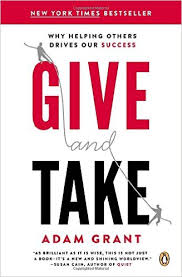
I’ve just finished Adam Grant’s book, Give and Take: Why Helping Others Drives Our Success. He shares two lists of values that he uses in his research to help identify a primary style. He considers how an individual rates the importance of each of the following:

List 1

  • Wealth (money, material possessions)
  • Power (dominance, control over others)
  • Pleasure (enjoying life)
  • Winning (doing better than others)

List 2

  • Helpfulness (working for the well-being of others)
  • Responsibility (being dependable)
  • Social justice (caring for the disadvantaged)
  • Compassion (responding to the needs of others)

As you look at these lists, does it change how you would answer this question? In the last evaluation where you received feedback, which list did it point to?

The two books that stand out for me on this topic are The Servant: A Simple Story About the True Essence of Leadership by James C. Hunter and The Go-Giver: A Little Story About a Powerful Business Idea by Bob Burg and John David Mann. While I loved both of these, the Adam Grant book I just finished stands out because of the academic approach the author takes in sharing the research behind givers and takers and, in the end, how he uses research to answer the question – Who achieves a higher level of performance and/or impact?

Of course he includes an assessment, with the option to get input from others. I scored a 66% Giver and 33% Taker on my self-assessment (Whew!). Now the hard-er part: asking others for their input. If you have seen my JoHari Window tutorial, this is the part where we ask for feedback to reveal blindspots. Look for that in another post . . .

So, are you a Giver or a Taker? Take 5 minutes to take the self-assessment.

People-centered leaders are not perfect, but they are purposeful about creating space where ‘List 2’ needs are mentioned and met.

Listen . . . Lead. Repeat often!

Final thought for EOS leaders – Look for a future post focused on the habits that are part of the EOS (Entrepreneurial Operating System) and how leaders can make certain behaviors habits.