
4 Words That Frame the Succession Conversation, 2 Tips to Reframe it

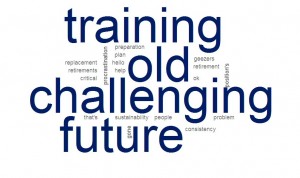
Great conversations start with a question.  A question I asked to a group recently during a keynote was What one word comes to mind when you think of succession planning?   The answers tell a pretty clear story – it is hard, it carries with it a message that we do it when we are old, and it is a future thing.

I agree with two of the issues highlighted:  It is challenging and it is future focused.
Succession_Wordsthatcometomind

The two pieces I would like to reframe for a more effective conversations are old and training.

  1. Old to Valued:  The #1 reason we do not do this – getting old is hard and minimizing people by not respecting their value will start a fight.  How many of us are at our best if we feel  we are no longer needed?  To have a different conversation, we must first reframe the conversation into key people/key roles.  People discussed in these conversation provide great value to the organization, and most would agree that the ongoing success of the organization is important.   Talking about valued people sends two messages:  You are important to our business and it is important that our business continues to be successful.  I am glad the age piece gets put on the table so it can be addressed directly.  Perception is reality, and this one will never go away as long as people are getting older and younger people are working with them and looking for opportunities.  We quiet this conversation when we make it safe to express changing life priorities and continue to focus on performance with development/support.
  2. Training to Development:  90% of development happens outside a classroom.  A message I share is most training returns nothing to the organization.  What this conversation provides for people is direction for development activities that will increase their capacity to lead in the future – both real skills/experiences for them and perceived capacity for the leaders that will be making decisions on their next move.  Capacity is the key word, and it is what your best people want.  Assignments that challenge them and show them they are valued.

A final pitch for One-on-Ones.  When we are continuing to have conversations with people and supporting them in their work it is like making deposits into a Trust account.  Each time we show people they matter and we care (by meeting with them, listening, and supporting) we build trust.  When we ask the question of someone 50+, what are your 1-2 year plans and 3-5 year plans we will need to draw on that trust to have an honest conversation.

Go build some trust, and go have some honest conversations, that lead to thoughtful actions and improved performance.

Development: Fun vs Easy, and 3 Tips For Leaders To Make It More Fun

A friend shared a great analogy with me last week comparing professional development and golf.  He had a friend that was a teaching pro in golf, and received lots of requests to ‘help my game get better’.  Ultimately he told everyone the same thing – if you want to get better you need to practice lots more, and play fewer full rounds of golf.  Person after person came for lessons, and only actually practiced when they were paying the pro for lessons.  Their games never really got better.

In the space between mediocre and great is work.   But not just work, purposeful work targeted at getting better in an area that you are interested in and passionate about.  There is nothing EASY about the path to mastery, and yet there are moves to make the work more fun.

If you lead others, here are three tips for making the work you ask from your people more fun:

  1. Leader – you first:  If people see you taking on projects where you name the intent (challenge/growth) and keep a positive attitude when it gets hard, they will have a role model.  Your attitude towards your own development will permeate your team.
  2. Ask first for participation:  Two easy questions for people:  What do you want to do more of in your role?  What do you want to do less of? – help people identify areas they want to focus and work to match that with improvements you want made.   They get more practice in an area of interest, and you make it a range session.
  3. View failure as learning:  Part of practice is hitting a bad shot.  Make a habit out of doing two things when that happens:  First, pour your energy into either helping them fix it or thanking them for reacting so quickly to fix it.  Make it a point to circle back and simply ask the questions:  What did you learn from that incident?  What steps can we take to ensure that does not happen again?

The one thing I did not hear from the pro is the option of using a slow day on the course to hit multiple balls, retake shots, or take some extra time to think through shots.  I often see the summer as a time to bring in some interns, spread the work around ,and give people time to focus on improving their games.

Practice is what you make of it, you won’t reach MASTERY without it, it will never be the classic definition of EASY, and many times you will have to work to make it Fun.

When I see MASTERY at work in a controller, a project manager, a speaker, or a COO I marvel at how easy they make it look – and I also seek out the story behind their MASTERY.   Funny connection – their story never sounds easy, but it often sounds fun.

3 Tips for Doing One-on-Ones: Skill #1 Approachability

I have developed and coached leaders for a decade now, as well as sitting in the seat as a ‘busy and stressed out executive’.  It was in the latter role that I began to see my own relationships with my people deteriorate because I was too busy and distracted by challenges I could only share with a trusted peer, my leader, or (more than likely) my spouse.  So I know One-on-Ones are hard.  I also know they are critical to leading well in any environment, but especially in a fast paced environment.

One of the key things a leader has to develop is APPROACHABILITY.   The Leadership Architect® by Lominger describes Approachability as:

Is easy to approach and talk to;  spends extra effort to put others at ease; can be warm, pleasant, and gracious; is sensitive to and patient with the interpersonal anxieties of others;  builds rapport well;  is a good listener;  is an early knower, getting informal and incomplete information in time to do something about it.

First, I get to sit with leaders as an outside expert there to support them.  Rarely do I meet with someone that does not fit this – when they are relaxed, maybe having a glass of wine or a coffee, and they are across from someone focused 100% on what they need (my role as a coach).  So let’s start with a few reasons why others don’t see you as Approachable.  Here are some excuses I have heard from some highly paid/skilled professionals as to why they don’t approach you for One-on-One time.

  • She seems so busy, I hate to bother her.  Even when her door is open or she is darting from meeting to meeting she seems deep in thought.  She is a kind person, but I can’t bring myself to interrupt her.
  • It feels weak for me to ask for time.  We have had so many layoffs in the last decade, that I somehow feel like if I ask for time I might fall into the ‘needy/hard to manage’ group that ends up being the first on the list that gets generated as soon as we see a soft sales forecast.  I need the direction and feedback, but end up talking myself out of asking almost every time.  The last time I scheduled a One-on-One I thought about it for almost a year before I asked.
  • I don’t see him doing that with his leader or the board.  If he does not see the value in it why would he do it with me?
  • She mentioned scheduling something once, but that is the last time we heard about it.  Our filter with her on work she asks us to do is jump on it when she mentions it the second time, so until we hear it a second time we don’t think she is serious.
  • To do it means getting past his assistant, who scares me.  One time Jill asked for some time and after the grilling she got from Shannon ‘The Pit Bull’, Jill never went back.  Jill still tears up when she tells the story.  Nobody messes with The Pit Bull.

Here are three moves you can make to be seen as SKILLED in the area of approachability.

  1. You own scheduling the first 6 meetings.  This gets them past the Pit Bull in your life, shows them you are serious, and takes the burden off of them.
  2. Always lace your script with questions.  Start with – What significant things have happened for you in the past week? Then work in:  What are your three priorities this week?, What celebrations have you had since we last met?”  and What support will you need over the coming weeks?  Being skilled at approachability means you get informal and incomplete information in time to do something about it – – – and the only way you get that is to ask questions and listen for what keeps being mentioned by one person or is a theme across your team.
  3. Never miss without rescheduling, and never extend the committed time.  The reality is you are busy, and if you say 30 minutes stick to it.  At least part of your team needs to learn to be brief and focused with the time, and you are not helping it by sitting there for an hour every time.   If they need more time schedule it right there, but end with “How can I support you between now and our next One-on-One?”.

This is the beginning of a series around One-on-Ones.  I welcome your thoughts and comments on what has worked.  I answer all comments on my blog or emails, so send me a note.

Much of leadership is about great conversations.  When we have them, good things happen.  Step 1 is being more approachable.


Listen Well

I follow several thought leaders and information sources, and there are only a couple I read >90% of the time.  Seth Godin is one.

His post today was very simple:  Two ways to listen

You can listen to what people say, sure.

But you will be far more effective if you listen to what people do.

I have been working with a career transition program called Shifting Gears, that helps mid/late career professionals make successful career transitions.  Many come because they have been out of work for >6 months.   One of the most important part of the program is captured by changing Seth’s words around a little.  I would say:

Others can listen to what you say, sure.

But the relationships you build will be defined by your actions.

Others are listening, and instead of worrying about how you are perceived, focus on how you live into the words you speak.

I remember one conversation in Shifting Gears that happened as our day began, and the individual was angry, frustrated, and seeing all the barriers (plus making a few up) between themselves and work.  Two hours later, they had moved past the barriers, and were optimistic and doing the work of finding work.  In listening to their actions, it became clear that they were developing  the capacity to get knocked down, and to get back up.  I saw them do this multiple times, and each time they came to apologize to me for being so stuck and negative – – I shared with them what I saw.

“Being stuck is part of any journey, and telling me about it is fine.  My job is to just listen sometimes.  What I respect and admire is that you made the choice not to stay there.  Keep doing that and you will be fine, and the world will get a gift when you are back working.”

Seth is right, and we will be far more effective as spouses, parents, professionals, friends, and leaders if we use that lens on ourselves before we use it on others.

Listen well.


Training is up . . . is ROI?

I remember every detail of the conversation.  The executive was talking to me about an investment in his people as the economy just started to recover in 2010.  He said he had put $2500 in the budget for training for each of his people.  When I asked him what kind of training he was thinking he said “He did not care, it was up to them.”  I asked him what kind of conversations they had around the development of their people, and if some sort of written development plan was part of it.  He said No.  Was this a wise investment?

Spending on training went up 50% in 2013, which is a great thing.  Investing in your people is always a good thing because, at the very least, it shows them you care.  As you spend more just remember two things:

  • 90% of learning happens outside the classroom
  • 70% of people go to training without a reason for being there

(see trU Tips #3 – Improving Your Training ROI)

In my opinion, the ROI of your training spend is dependent on these two numbers.  For the first one, when I do not see a written development plan my experience tells me that most of your people are getting training randomly and waiting for training $ to appear.    Secondly, without a written development plan and one-on-one follow-up with their leader, people see training  as something they show-up to, but very little gets transferred back to the job.  The data supports this, and in the era of flatter organizations, I would be surprised if the transfer of learning to work improved.

Quick tips . . .

First tip:  When someone on your team goes to training take a 3×5 card and have them write one learning objective on one side and you write one on the other – then after the training set a date to review these goals within a week of them returning to work.

Second tip:  Have someone do a single page summary around what they learned, how the team might benefit from what they learned, and one thing they will be doing to apply what they learned – then share it at your next team meeting.

I did several employee surveys in 2013, and in each of them the lack of training and development was highlighted by people.   It is good to see the money being spent, and if you want a higher return for your investment just the two tips above will make a big difference.  Each will also lead to a great conversation.

I still believe that Honest Conversations, leading to Thoughtful Actions, and ultimately Improved Performance is at the core of culture and talent management.  Commit to it, and the returns will surely follow.

People Habits before People Skills – Johari Window

I remember the moment I became passionate about one-on-ones.  I was in day 2 supporting a nationally known author/consultant in the area of conflict management/robust conversations.  Our challenge:  We were 16 months into a curriculum rollout/organizational change and the success was present, but only in pockets.  As we went from group to group getting feedback on successes and failures, a question came to my mind, so I asked it.  “Bill, in your assumptions of organizations and relationships between leaders and their teams, do you assume that leaders are meeting one-on-one with their teams regularly?”   His answer “Yes.”  It hit me, we can equip leaders all day long to have these wonderful fierce, crucial, or honest conversations, and yet if they are not creating controlled space that is safe and focused (like a one-on-one conversation) it will be difficult to practice and change habits.  More importantly Failure rate > Success rate – and failure in the area of building relationships (ie. leadership) is expensive at many levels.

That is also the time I realized I would start a crusade around habits that mean the most to people (ie. engagement!) and that busy leaders, if they are willing to practice them will get the biggest ROT (return on time).

Here are some videos I have put together for leaders to think differently about this time using the Johari Window as a lens for not only how they listen, but how they create safety for their people by sharing first.

Leadership and the Johari Window – Part 1

Leadership and the Johari Window – Part 2

 What is to come?  A script for how this could be a 15 minute time of learning in one of your team meetings and a key note/workshop around one on ones where this could be used.  Subscribe to my trU Tips and you will get the templates.

I believe our learning model for most organizations has changed, instead of going off to class, practicing, and then coming back to receive practice/support to help us get better – we now are in positions where we have to learn as we do and it is important in that model to get support and feedback real-time.  Since 99.9% of companies have <500 people, this model works great as long as leaders are present on a somewhat routine basis and the time is productive for both leader and individual.

My goal is to equip leaders and key supporters (HR leaders) to help their people create the habits that feed a frenzy of honest conversations, that lead to thoughtful actions, and result in trUPerformance.

Tough Conversations

Is there someone in your work life that is causing you pain?

There are some great books out on having difficult conversations.  My two favorites:  Fierce Conversations by Susan Scott and Crucial Conversations by the Vital Smarts team.  When I script leadership development activities, this is the #2 learning must for any new/current leader.  It is that important and it gets easier, but it is never that easy.

If I were a leader every time I looked around the room and realized more than half my team is new in the last 12 months, I would make a group learning assignment to read/reread one of these books as a team.  It could also be a gift for a new team member, and if you do that remember my gift giving advice!

Let me add another voice to this topic, a TED talk by Ash Beckham.  It is not specific enough to outline the skills of having honest conversations with people, but it certainly speaks to the heart of the topic.  I found myself laughing as she shared her own transformation to having more honest conversations.  Her voice is not academic – instead it is very real and that makes her advice/story relevant and helpful.

She started by controlling her own narrative first.  It would be a great follow-up to a book study group because many of the themes of the above books are captured in her talk.

A big part of having tough conversations is showing up often enough – in a focused manner – with your people to have all the other conversations that constitute a relationship. Habits around One-on-Ones and team meetings are critical to making this skill even more relevant and EASIER.

What makes tough conversations tougher is when, as leaders, those are the only time we show up to connect with our people.

Lots of Reasons, No Excuses

The conversation around performance is always a tricky one.  When I walk into a new working relationship with a CEO/Leader, I often hear the word accountability as a desired outcome.  When I explore it I hear stories that illustrate a leadership style that starts with ‘hands off/you own it” and generally ends up with “Letting them know my frustration / taking on the task myself”.  When this is the story, I can guarantee a leader that those they lead are not owning the results because the leader is not giving them the appropriate space and support to do the right thing.

Here is one shift a leader can make to start down the path of being a better supporter/coach and ultimately increasing the accountability they see with their team.

No Excuses . . . . 

The definition of an excuse when it is used as a verb –  attempt to lessen the blame attaching to (a fault or offense); seek to defend or justify.  If you are managing an english major or someone with Google skills, they might point out that as a noun the definition is a reason or explanation put forward to defend or justify a fault or offense.  In either case, excuses are put forth because a person feels the need to defend their action.  Excuses start us down the path of establishing guilt, penalty, or innocence vs blame.  It could track back to the culture established by the previous leader – which is an excuse in itself!

Lots of Reasons . . . 

Continue reading →

Leadership – The biggest choice you will have to make

As a leader, at some point you must decide what you believe leadership is.

I uttered these words in trU Tips 28, and I can’t stop reading them.  Most of us lead in places where there are no competency models, corporate training departments, coaching pools, or learning and development budgets.  We might not have an exact idea of how to answer this question, and yet it is a question that starts a journey and refocuses a journey.  Once you answer it, these next few questions help you chart a path to personal growth AND significance.

  • Where do you lead in your life today?
  • How would you prioritize these leadership roles?
  • How would you rate your performance in each role?
  • How are you getting better at ________ leadership role?

Continue reading →

Leaders and One On Ones – Know your voice

I was timing at a swim meet this past weekend for kids between 8 and 13.  What do you think my primary role was?  Timing?  Actually – no.  My primary role was encouragement and support.  Making sure they were in the right order for the next race and telling them what they did well during that race.  It was easy, because my natural voice is to encourage.  I have known that for a while, and in order to be more effective at using that voice I have had to work on knowing when that voice is NOT the one that is needed at that moment.

Do you know your natural voice when faced with someone that is depending on you for some level of support so they can do their best?  This is one very important piece of leadership.

One important message I share in any leadership training I do is that part of the leadership job description is NOT mind reader.  There are several ways to help leaders get more skilled at this, but the easiest is to ask questions and listen well.

We can make our jobs as leaders easier in the One on One by doing two things:

  1. Asking some scripted questions so we can gauge how the other person is feeling.
  2. Use the question How can I support you? coupled with multiple choice answers of Coach me / Direct me / Not sure.


I continue to publish templates for people to use in establishing healthy and productive conversations with their people that result in thoughtful actions and lead to higher performance.  Here is the page of templates, and here is the newest version of the one on one form that incorporates the two tips I shared above.

By the end of my swim meet I had recorded times for every child who swam in my lane, experienced lots of smiles, and everyone started and finished the race they were supposed to be in.  My natural voice came in handy, but so did my directive voice (go!).

As a leader, learn your voice and help your people tell you when it needs to change.