Will you be my mentor? 4 Steps to make this effective.

Will you be my mentor? 4 Steps to make this effective.

I was talking to a group of graduate students and the question was asked, “What advice would you give to someone about finding a mentor?”

I asked the follow-up question, “How many of you have ever had a mentor?” 

Less than half of the hands went up. So I started at the beginning because, from my experience in working with learners of all ages, I knew most of them (even the ones with their hands up) were missing some key knowledge they needed to create a great mentoring experience.

Mentoring is a personal growth and development strategy where a mentor supports the mentee by sharing resources, expertise, values, skills, perspectives, attitudes, and proficiencies.


The short version –

Mentoring is finding someone smarter than you and learning from them so you get smarter faster.


As I work with leaders of high growth companies, I encourage them to find people who have faced the same challenges they have faced and learn from them. I do this because as a consultant and coach, I need them to own their development and find people to help accelerate their development.

I believe that in growth transitions (double-digit growth or moving into a new leadership role), there is tremendous opportunity for growth and tremendous risk. Having a support team around you in those transitions that is focused on your development is critical. I am confident in what I can do as a coach or consultant, and I also know I cannot do it all. Encouraging mentors is my way of asking for help without eroding their confidence in me as a consultant and coach.

Here are the 4 Steps for creating a positive and productive mentoring experience:

  1. Identify what you are trying to learn or what problem you need help solving.
  2. Do some research: Who do you know that has the knowledge or experience that you are seeking?
  3. Determine who is the best fit and how long you think it will take to meet your objectives.
  4. Make the ask by reaching out (or being introduced); be ready to provide this information:
    • What input/expertise are you looking for?
    • Why are you asking them?
    • What is the time commitment? (guide is 1-2 hours a month for 3-6 months or until objectives are met)

Recently, I reached out to a friend who is about 10 years ahead of me in consulting. I am reaching a point where I need to run my business differently to continue the growth I have experienced in 2016. I followed these steps, we had two sessions, and I left with a pretty big assignment: analyze my time and use it to create filter on my work in 2017. In this way, I can focus on the most important things, find help for some things, and say no to other things.

My commitment was to follow up with her by the end of the year with my progress. In my experience of mentoring dozens of people, this follow-up is the #1 missed step. Remember, at the heart of every mentor is a desire to help. Follow-up lets them know how they helped and demonstrates our ability to follow-through on commitments. It is also a fundamental belief/value of my business:

Learning + Doing = Growth


Whether you are a leader charged with developing your team, an HR leader supporting questions around development, or an individual that is committed to mastery in what they do, mentoring is probably the most powerful and accessible tool to help achieve your outcomes.

Here is a document I share with coaching clients to help them build powerful and positive mentoring relationships.

Lead well . . .
My 7 Favorite Books for a Leadership Book Study

My 7 Favorite Books for a Leadership Book Study

Book study groups are an easy way to get leaders at all levels of your organization connecting and learning together.

One of my core beliefs is Learning + Doing = Growth, so I’ve also offered some tips on how to put this learning into action.

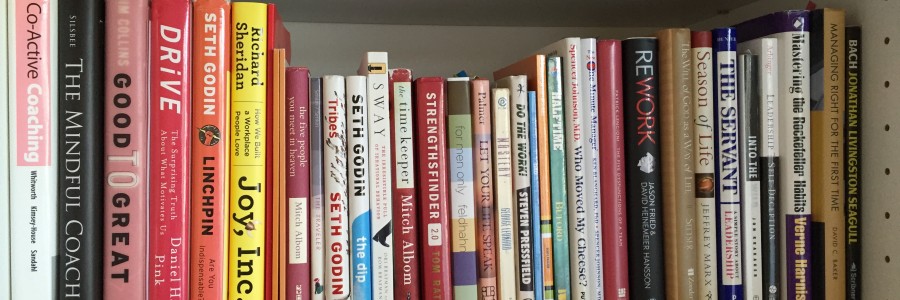
Here are my top 7 book recommendations, plus book study tips.

The ONE question leaders should answer hourly

The ONE question leaders should answer hourly

In the next week, I’ll be publishing a list of 5 books I recommend for leadership book clubs. A new addition is my favorite book this year: Triggers by Marshall Goldsmith. Here is why.

I believe that great conversations start with a question. Marshall Goldsmith asks some great questions in his book Triggers.

Some of the best:

  1. What is the most memorable change you have made in your adult life?
  2. Did I do my best to set clear goals?
  3. Did I do my best to make progress toward my goals?
  4. Did I do my best to find meaning in my work?
  5. Did I do my best to be happy?
  6. Did I do my best to build positive relationships?
  7. Did I do my best to be fully engaged?
  8. Am I willing, at this time, to make the investment required to make a positive difference on this topic? (called AIWATT for the rest of this post)

There are many reasons I love this book, and the main one is the author’s sharing of powerful questions that he has accumulated in his career as an executive coach. This post will focus on the significance of question #8, and how you can use it as a leader.

In a recent EOS quarterly, a leader shared a learning – “When we set goals, we need to make sure we set them so we can be excited about them and use that energy to complete them.” That is a powerful learning, and something that every leader needs to be thinking about when they accept a To Do or a Rock (quarterly goal). The AIWATT question is the action to ensure this happens.

Remember my 5 Tips for Managing Your Career and Performance? The first tip is Own It, and it is my way of saying what Goldsmith does by posing this question to us. If you answer No to AIWATT, then some other conversations need to happen.

This brings me to a second belief I have – Leadership is about honest conversations that lead to thoughtful actions and improved performance. One of the powerful outcomes for me from Triggers is that, as a coach, I need to always be focusing on creating space that allows honesty to happen, because that is the hard part. In my experience, thoughtful action is the easier part.

Two myths that leaders need to remember:

  • We need to love 100% of our work. There is an eastern adage: Before enlightenment, chop wood and carry water.  After enlightenment, chop wood and carry water. Here is an example: I don’t like confronting people I don’t know. However, as president of an all-volunteer athletic booster organization, one of my roles is to call volunteers who have made commitments and are not doing the work. It is my job and the team depends on my doing it – so I do it because I have to, and make sure I overbalance it with other tasks I enjoy doing.
  • We have to do 100% of our work. Delegating pieces of our work to others who have more talent/passion for that work is fine. Just don’t always pass on the hard conversations, and tell them why you are asking for their help – because they are better at it/more passionate about it.

Let me propose two actions:

  1. For EOS leaders: Teach the AIWATT philosophy. As you go through the To Do list, ask people to answer the AIWATT question with the caveat that if the answer is No they acknowledge who they will ask for help – or that I will Own It (and use those words). *Note: Make a note for anyone answering the latter, and follow-up with them one-on-one to do some micro-supporting.
  2. For individuals: Put an AIWATT on two post-it notes and stick one to your computer screen and one to your phone for a week. Ask yourself that question continuously during meetings, when you answer emails, and when you do any morning/evening quiet time. After a week, do 5 minutes of personal reflection with the question, “How did AIWATT impact my leadership this week? Of myself? Of others?” If this reveals something for you that you need to bounce off someone, just call me and we can do a 15-minute coaching session: 616-405-1018.

I believe . . . great conversations start with a question.


Leadership is . . . having honest conversations that lead to thoughtful actions and improved performance.


Lead well . . .

3 Tips for Getting Your People to Own Their Development

3 Tips for Getting Your People to Own Their Development

It is a choice . . . to buy into the fear and the system or to chart your own path and create value as you do.  It’s your job to figure out how to chart the path, because charting the path is the point.  ~ Seth Godin, Linchpin: Are You Indespensible?


The most important part of my development plan template is the last page.  It is where the individual signs it and commits to scheduling the next update meeting with their leader. That is ownership and I ask people to sign it before I end our session.

The key to getting to this point is to only start the process if the individual is ready and willing to own the process and excited about doing the work. This is not about tricking a person or trying to get into their head and guess their motivations, it is simply about providing them an opportunity to show they are ready and willing to own it.  Here are 3 ways I use to test that:

  1. Ask them to read a book before we start (the two I like are Linchpin by Seth Godin and Do The Work by Steven Pressfield).  The books are important, but more important is their capacity to create time to learn for themselves and demonstrate they can follow-thru. This demonstrates ownership.
  2. Gather 360 performance feedback and present it back to them.  Do they listen and graciously accept the gift of feedback and work through it to the point where they start making changes based on it or do they make excuses why it is not accurate? This demonstrates the ability to own their own strengths and weaknesses.
  3. Ask them to email me to setup a meeting and/or invite them to a learning event. Showing up sounds like a low threshold to demonstrate ownership – but you would be surprised how effective this is.

Seem simple? It actually is, because any one of these give you an idea that they are ready.  The ability to fill out the development plan and spend time quarterly to reflect and update it will be the ultimate test.

Remember, not showing ownership does not mean someone is a bad person or an underperformer, it just means at this point in their life they don’t have the capacity to own it.  I remember one time I took on a stretch assignment of design and delivery of some learning for a group of senior leaders at a Fortune 100 company where I worked.  It was challenging, stressful, and happened during the third trimester of our fourth child. I realized that it was too much when I saw myself spending too much time working and no time feeling the baby move and helping with the other 3 kids so my wife could rest a little. I finally asked for help and handed off the duties because it was too much at that time in my life.  I could support the work, I just did not have the capacity to lead it.

Mastery is a journey, and it is a choice. Help people understand the choice, invite them to own it, and then provide an opportunity to show ownership.


Hope as a leadership strategy: 4 keys and 2 questions to help build one

Hope as a leadership strategy: 4 keys and 2 questions to help build one

There is power in Hope, and yet it is something that does not come from the world as much as it used to. It is still something that comes from within us, and it is the hidden and critical piece of our ability to perform at our best.

Here are a few examples I have experienced:

  • Hope in a major personal transition

I experienced an unexpected job loss, and in the days that followed I learned about the difference between a good day and a bad day. On a good day, my personal outlook was captured in this formula: Hope > Fear + Anger + Hunger + Frustration + Loneliness + _______ + ________. I learned that in times of overwhelming change, our foundational outlook and strength (I called it YOUR ROCK in a keynote earlier this year) will be tested and defined. This is where our faith and social capital (friendships) will be tested.

  • Hope in developing your best people

When doing development plans for people, the best place to start is with something that will demonstrate their ability to get feedback and use it; 360° evaluations do that. I think of an organization that did this simple task with three high potentials (future leaders), in which two of them accepted the feedback and had a hope-ful discussion about how they could use it. The third was not ready, and spent most of her time on the threat and fear it created, not able to move past it.

  • Hope in leading

People expect leaders to be human in some ways, but not when it comes to managing stress and being hope-ful in the most difficult situations. Part of my work as a coach is providing a safe place to be honest and allow frustrations and fear to come out. When I coach, it is important to allow what has to come out to come out, and then ask the question – “What would be the one thing you want to focus on today in our time together?” It is a simple invitation to a hope-based problem solving session. Leaders need to learn how to balance reality and hope, and this gets modeled and practiced in every coaching session.

I read some wisdom recently from a hope expert, Dr. Anthony Scioli, who wrote a book based on his research – The Power of Hope.  He identified the four cornerstones of hope:

  1. Attachment – a feeling of connection and trust
  2. Mastery – a sense of empowerment and purpose
  3. Survival – the ability to manage our fears and generate multiple options
  4. Spirituality – faith in a religion or a set of life-defining values

Notice any common themes between my words and Dr. Scioli’s? It is no coincidence that the name of the process I use for career/development plans is simply called Journey to Mastery.

What are you doing as a leader to build and rebuild a hope-filled outlook for yourself? What are you doing as a leader to build and rebuild a hope-filled outlook for your team?

A client asked me to lead a sensitive conversation for them in the midst of some major change, and added, “You have such a great ability to make it safe to share difficult things and help us find solutions.” I thanked her, and thought back to my internal compass for selecting the clients that I work best with – passionate, hope-filled leaders that are over-challenged and under-supported.

What does your hope formula look like today?  Hope > ______ or Hope < ________?

What can you do to change the latter and maintain/build the former?  (Hint: See cornerstones above)

That is the foundation of a hope-filled leadership strategy.

Career Plans – Your Best People Should Have One; Here is How

I was leading a succession planning process with a group of nursing managers. The goal of the process was to identify future supervisors and managers from the current staff and create a process to develop them, monitoring their progress so they would be ready for a leadership role in 1 to 5 years.

Part way through the process, an epiphany happened for one of the managers. After talking about identifying people who were hungry for learning and taking on more responsibility, she said “I just realized that my most skilled nurses, the ones who have been around the longest, are not the people that will be leaders for me in a few years. They just want to do their job.”

The fact is, everyone should have a career plan – even if it is to stay in place and help solve bigger problems. But if you have limited time as a leader, your first focus has to be on the people who want more and are capable of doing more. Is this fair?  Based on the trUPerformance lens I use, I would say yes. A career plan takes guidance from you as a leader and extra effort/ownership from an individual, so asking that of someone is only fair if they are willing and have the capacity to do it. It is built on a foundation of trust and truth.

These three questions are the foundation of truth for this conversation:

  1. Do you want more responsibility?
  2. Are you willing to take on the work?
  3. Do I believe you have the capacity to grow into the larger role?

The ability to answer these questions with the truth, and face-to-face, requires trust.

I have personally been through at least a half dozen processes, from multiple day assessments to formal outplacement services. When it is all said and done, here are the key pieces of information that any individual needs to document:

  1. Strengths (not just Talents, but what the individual has proven they do well)
  2. Weaknesses
  3. Achievements
  4. Short-term goals (6-12 months)
  5. Long-term goals (1-5 years)
  6. Current job responsibilities/accountabilities
  7. Development areas (1-3) to focus on and action plans

The process to do this is outlined in my whitepaper, Own It! 5 Tips for Managing Your Career and Performance.  The trick for you as a leader? Being confident enough to put some extra work into identifying and engaging your best people in the conversation, and the skill to lead the conversation while delegating most of the work. Here is a link to the form to get you started.

If you need help getting started, it is just one click away – scott@thetrugroup.com.  This is a great time of year to have this conversation – it will feed into a few New Year’s Resolutions that will make your business more successful and help you tackle some of the problems that are making your job harder.

4 Books to Improve Leadership Conversations

4 Books to Improve Leadership Conversations

It is very common for leaders to have difficulty connecting with their people. But effective people-centered leadership relies upon effective conversations.

There are resources that can help; here are my top 4 book recommendations to help improve these leadership conversations, specifically the one-to-one, for you or someone you know.

I also have a library of free resources and templates to help get you started.

Johari Window and Leadership Development – 4 Ways to Increase Self Awareness

Every time I share the Johari Window with a group of leaders, I am amazed at the impact it has on their view of the conversations they have with their team.

Then I think of the group of 24 leaders that I took through a four-day leadership development program last summer; at the end, 13 of those leaders committed to focus on asking more powerful questions. I need to stop being surprised because the leaders I meet want to be people-centered leaders, they just don’t know how.

I believe most leaders want to be people-centered leaders, and when given the tools and some feedback (to indicate their effectiveness in doing it) they opt to become more effective listeners. The Johari Window is a great lens for leaders to think about their interactions and for people to see what their leaders are trying to accomplish. At the core of an honest conversation is clarity around both the actions we are taking and the intentions of those actions, which is fertile ground for feedback and developing our self-awareness and ability to lead.

Here are the 4 tips I have added to help leaders see the key activities that develop their self-awareness:

  1. Experience – The best way to learn about leadership and work on how you balance telling, asking, and listening is to do it. If you are intentional about it, you will learn a lot about yourself, and your team will help you get better.
  2. Personality Inventories – These provide a great lens into your BLIND SPOTS and help you formalize how you talk about your own strengths and weaknesses. I focus on transition points, so I use the Birkman Method assessment because of the language it presents around needs and stress behaviors. This provides great feedback for things the leader can share (revealing the HIDDEN) and things they did not see (BLIND SPOT).
  3. 360 Feedback – Sometimes this is just asking people some key questions routinely or finding an outside resource to do a survey of key people. The whole intent is to bring things into the open, by confirming something the leader already thought was in the OPEN area, or revealing a BLIND SPOT.
  4. Coaching – This is the most common way for executive leaders to create an individualized development plan and work on the personal change necessary to make it happen. Coaches provide perspective, access to additional resources/learning, and ask the questions that allow for self-reflection, personal growth, and focused action.

Here is a handout that includes 4 additional introspective tips for moving things into the OPEN area.

Use the Johari Window as a lens to help you ask more powerful questions of yourself and your team. That is what is at the core of people-centered leadership.

If you want a deeper dive, here are two short videos (video 1 / video 2) that introduce the topic and give you tangible advice on what you can do now to be a more people-centered leader.

3 Questions to Shift Perspective on Performance Gaps

3 Questions to Shift Perspective on Performance Gaps

Too often we see performance gaps as things that should be hidden or apologized for. Our narrative around these events contains adjectives like poor or disappointing, which only makes us want to escape them more. Then you start trying to hide what you see as the truth, which too often results in a series of moves where your ego shows up too much or too little to others. It does not take a Psychology major to spot someone who is not comfortable in their work – we just have to listen to the story they are telling.

Then you find a person or place where gaps are accepted, and more energy is put into talking about them, learning from them, and working together to close them in your business and your personal life. At the Inc 5000 conference last week, I interacted with 5 start-up leaders, and while each story contained big challenges that worried them, it also contained things like pride, resourcefulness, teamwork, hope, and perseverance. They were not trying to cover anything; they were just sharing.

It never ceases to amaze me what energy comes from choosing a more hope-filled narrative. If you are a leader, you can shape this with the questions you ask.

Three I love are:

  • What is energizing you right now?
  • What is frustrating you right now?
  • What are you learning today?

People need a place to vent. We also need to create equal amounts of space to dream and reflect so we can learn and plan. We can use words like failure, and when they are used with words like learning and growth our story is fundamentally changed. People-centered leaders create this space and invite people in – and those that value that involvement #ownit.

To learn more about my philosophy on Performance Gaps – take a look at my new whitepaper.


Micro-manager or Micro-supporter? One tip for starting the change.

Are you a micro-manager or micro-supporter?

A leader recently admitted that she did not stay close enough to a new leader and let them make decisions that were harmful to the business.  Her thought was that she needed to direct the next person more in the beginning. Expensive lesson, and one that will make her a more effective leader.

Micro-managers . . .

  • Direct the work even if the person has (or should have) the capacity to do it.
  • Sometimes say (and always think) “If I want it done right, I need do it myself.”
  • Consistently lose the people who want to lead and keep the people who want to be told what to do.
  • Are either over-involved or not involved – they have no self-control for meddling.

Micro-supporters . . .

  • Ask for the details of the plan because they either, a) Are building confidence in someone’s decision or, b) Want to see the details so they know how they can help.
  • Frequently meet with their people to brainstorm, problem solve, and delegate.
  • Know when to say “I need to take this,” and don’t do it often.
  • More often say – “Let’s work close on this one because it will be good learning for you and me, and it is important enough that two brains should be working on it.”
  • Have teams of loyal, hard-working, energized people that know they have a great leader and don’t want to leave.

If you are not sure which one you are, just look at your teams and the significance of the problems that get solved when you are not there.

The good news is, you can change.  Pick someone who gets their job, wants their job, and has the capacity to do it and do more.  Tell them what your intent is (support vs do their job) and ask for help.  Then start practicing.

If you don’t get what it looks like, read the New One-Minute Manager by Ken Blanchard.  Then start practicing.