
Leader = Linking Pin:  3 skills for leaders & 3 tips to make it a team value

Leader = Linking Pin: 3 skills for leaders & 3 tips to make it a team value

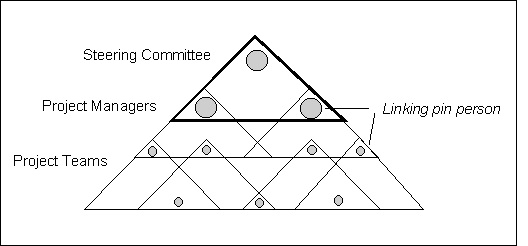
Leadership is . . . ensuring that every significant decision gets communicated to your team so they always know what, why, and who.  It is your job, as the leader, to make sure you serve as the linking pin for your leadership team and for your own team.  Rensis Likert came up with the concept several decades ago, and here is what it looks like:linking-pinThe theory is that any team you join puts you in a position to ensure that connections are made to other teams.  Linking pins hold things together, and coordinate critical work, even under extreme stress.

3 skills all Linking Pins possess (or develop):

  1. Ownership = See this role as a duty and are excited about the work and the responsibility.
  2. Make time = Create time in meetings to report, gather questions, debate, and leave with actions designed to keep other teams in sync.
  3. Take notes = Remember things and make sure they never get lost.  NEVER!

When miscommunication happens Linking Pins take it personally.  Then they fix it.

3 things teams can do to make Linking Pin a team value (EOS users: this is why you do things):

  1. Meet weekly.  Always!  (And layer meetings so info gets moved up and down through Linking Pins.)
  2. Keep all critical info in shared documents/spaces.  (Nobody has to look or ask for critical info – it is accessible and easy to find.)
  3. Have communication norms.  (Return calls/emails in 2 hours, texts in 30 minutes.)
  4. Share calendars.  (Make it easy to create time to share and make critical decisions.)

Are you a linking pin?  Do you ask your team to be linking pins?

Powerful Questions

Powerful Questions

Great conversations start with a question.  This is one of my core beliefs.

I spent four days this past month delivering a customized leadership development program to twenty-five leaders – in their final checkout one-third of the leaders shared a commitment to asking more powerful questions.  As leaders, they realized they had limits to what they could accomplish without help.  After being challenged to get their teams more aligned and engaged in the goals for their group, it became clear that asking questions is a critical first step.  It was great to see them own it.

The difference between a question and a powerful question is in what it produces.  Powerful questions produce thinking, feeling, and ultimately sharing that makes the conversation meaningful and helpful to both people who are engaged in it.  Powerful questions reframe our perspective on an event so we see it in a more significant way.  Here are some examples:

  • Question: How was your day?  Powerful question:  What was the best part of your day?
  • Question:  What are you working on right now?   Powerful question:  What are your top 2 priorities to complete this week?
  • Question:  How would you like to spend our time today?    Powerful question:  What 2 things do you want to make sure we cover today?
  • Question:  What did you think of the book?   Powerful question:  What is one thing you plan to do differently based on what you read?
  • Question:  What went wrong?   Powerful question:  What was your role in the outcome?

To achieve mastery at asking powerful questions, it is important to create scripts that help ensure they get asked in the time you devote to your people.  Let’s face it, we get weary sometimes and when we do our conversations become shorter and shallower.  We miss opportunities to really listen as leaders, so scripting helps create more moments where powerful questions get asked.  Here are four that I put into my one-on-one template:

  1. Recent successes and failures (to celebrate)?
  2. What is energizing you right now?
  3. What is frustrating you right now?
  4. What do you want to make sure we cover in our time today?

What meeting do you have in the next 24 hours that needs some powerful questions to be asked?

Remember – Great conversations start with a question . . . . think of how much greater it could be if it started with a powerful question.

If you want to explore some other ways to work questions into your conversations with your people many of my templates have questions included. Here is the link to some free talent management templates.

Mike Ellis, CEO of Spindance | Michigan 50 to Watch Company

We worked with Scott to help us create a strategic plan and develop the capacity of our leadership team to execute on our plan while preserving the culture of our organization around our core values.  He is a skilled facilitator that kept us moving while still allowing time for the important and sometimes difficult conversations that have to happen in an effective planning process .  Scott brought a valuable perspective because of his extensive experience working with a variety of high growth organizations.  If your goal is healthy growth, I recommend Scott as a partner.

Mike Harris / Mat Nguyen, Founders of Worksighted | Inc. 5000 Award (7x), Michigan 50 to Watch Company

We have been on EOS® for over a year now, and it has been a game changer for us.  When we made the internal decision that we wanted to implement EOS® in the spring of 2014, we knew that going through the process on our own would be difficult and having an Implementer would drastically increase our odds of success.  We reached out to Scott and he accepted to help us go through the entire implementation process as well as facilitate our full adoption of EOS® on an on-going basis throughout the past year.  Scott has been a key partner to Worksighted for 4 years now and has helped our team with coaching and leadership development.  His knowledge of EOS® and his passion for working with growing, entrepreneurial companies, has been a great combination and a perfect fit for us.  Scott’s facilitation has made the process fun, engaging, and honest.  He is 100% responsible for our ability to rapidly implement EOS® and embrace it company-wide.

Pat LeBlanc, CEO of EBW Electronics Inc. | Michigan Small Business Person of the Year 2015, Inc. 5000 Award (3x), Michigan 50 to Watch Company

I have done many strategic plans in my career, and the EOS® process is the best I have experienced because it helped our leadership team develop the Traction to effectively execute on our plans.  As a facilitator, Scott’s leadership of our planning session was off the charts effective.  A unique benefit of working with Scott is that he teaches while he facilitates, and I actually learned to be a more effective leader/facilitate more by watching him work.

trUTips

trUTips

trUTips are published 9-10 times per year. Do you want to receive trUTips automatically? Sign up here.

Worried about getting on a spam list? Read The trU Group privacy policy. For daily or weekly thoughts, please subscribe to our blog or follow us on Twitter.

  • trUTips #41—20 Powerful Questions™ People-Centered Leaders Ask

    Asking people questions has the same effect as giving them food and money. People-centered leaders ask powerful questions, here are 20 questions that will help you master the 5 moments that are critical to getting the best performance from you and your team. Entrepreneurial Operating System™ Leaders – please read! Read trUTips #41.

  • trUTips #40—The Cornerstone of Engagement – Empathy: 2 Tips to Show It

    What is the importance of showing empathy as a leader? As a coach, I can speak to the impact of not showing it, and it is people coming to work thinking “My leader does not care about me as a person.” Do you really think they are bringing their best if that is how they feel about the relationship with their leader? Here is a lesson an emerging leader taught me and 2 tips for practicing(and building) empathy as a leader. Read trUTips #40.

  • trUTips #39—3 Tips for Creating a Safe Culture for Truth to be Shared

    How can I create an environment and culture in which my people feel safe sharing and dialoguing in an open and honest manner? People-centered leaders recognize the need for safety, and it show up as trust that alllows the truth to be spoken, sometimes in very difficult situations.  Here are 4 tips to see if it is present and 3 tips to creating it. Read trUTips #39.

  • trUTips #38—3 Tips for Successfully Delegating

    Delegating is critical for leaders, and it is not easy to do for many reasons.  Here are the 3 barriers to delegating and how to overcome them with action. Hidden truth – it is almost impossible to make this shift for a leader without help. It has become the top development areas for my coaching practice.  Read trUTips #38.

  • trUTips #37—7 Books for a Leadership Book Study Group

    Here are my 7 favorite books for a leadership book study group. All these topics are relevant for leaders, and as a bonus I include tips for make the study be about my core value – Learning + Doing  = Growth.  Read trUTips #37.

  • trUTips #36—FREE articles to help you grow as a leader

    Don’t Avoid Gaps, Lead Through Them

    Demystifying Strategic Planning: How to Create One and Effectively Lead Through The Gap

    Own It! 5 Tips for Managing Your Career and Performance

  • trUTips #35—How do I increase accountability in my organization?

    In seven years of working with leaders and leadership teams, no one has ever started a conversation this way. Here are four ways the conversation starts and actions leaders can take tomorrow to increase accountability.  Read trUTips #35.

  • trUTips #34—Your People Want A Career Plan: How to do it

    The often overlooked key to retention?  Helping your people clearly see a career path for themselves AND understand the work they need to be doing to prepare for it.  Here are tips for leader to guide the process to ensure it is clear and owned by the individual.  Read trUTips #34.

  • trUTips #33—Right People in the Right Seats: How to do it

    Organizations cannot grow effectively if they do not have the right people in the right seats. Getting to that point is hard work, and the most important work that a CEO/Leadership Team can do to start the process of healthy growth for their organization. Here are some tips about how to work through the process of Right People in the Right Seats.  Read trUTips #33.

  • trUTips #32—8 Great Leadership Books for a Summer Vacation

    It is important to reset as a leader, and summer vacation is a time to do that.  Part of resetting for me is reading, and based on your attention span and time, here are 8 books I recommend.  I also created a special page to get some expanded descriptions of each book and an easy link if you want to order them.  Read trUTips #32.

  • trUTips #31—trUMoments™:  Someone needs something from you

    It is easy to get lost in concepts like Servant Leader.  New leaders are especially challenged because the important part of their job is the do, and too often they are buried with books and catchy phrases like “Right people/right seats” or “It’s your ship!”  My goal of truMoments™  is to focus on recognizing when you are in a place that is important and doing something significant.  Someone needs something from you is one of those trUMoments™  that happens all the time, and more important than listening for it is to create time to hear it so you can respond effectively.  Here are some tips and questions to do that.  Read trUTips #31.

  • trUTips #30—What Kind of Leader Do I Want to Be?  Introducing trUMoments™

    Leadership has been called a job, a skill, a calling, and many other words that elevate it to a place in our minds where we often get lost in the theory of what it takes to be a leader.  I call leadership a choice, and share some thoughts on what key moments leaders need to learn to be present for.  These are trUMoments™.  Read trUTips #30.

  • trUTips #29—Tools to Develop as a Leader: Listening and the Johari Window

It is critical to have One-on-One conversations with your people.  When we do have these conversations how do we make the most of that time together so we listen well and they feel comfortable and hear what they need to hear?  The Johari Window is a tool that can help leaders see their time with others differently and learn tips to build great relationships using that time.  This includes two videos and an exercise to use the videos to learn with your teams.  Read trUTips #29.

  • trUTips #28—A Case For Face to Face Leadership – The One-on-One

Why should I take the time to do one-on-ones with my team?  It is a great question, and by answering it a conversation emerges that will change you.  At the core of this question is an equally important question – What kind of leader do I want to be?  This trUTips makes a case for the one-on-one and why it is the most important time a leader has with his/her team.  Read trUTips #28.

  • trUTips #27—Mentoring

Too often people go searching for learning in a classroom or a book, when the more effective answer is ‘find a mentor’.  Here is some advice for both individuals and leaders about how to make mentoring work for them.  Read trUTips #27.

  • trUTips #26—5 Steps to Make Personal Change Stick

After making a key note on time management this summer, I had some conversations that made me realize people had lots of questions about how to define the changes they want and make those changes.  Here are 5 Steps for making those changes.  Read trUTips #26  Here is a link to the key note presentation if you are interested.

  • trUTips #25—Time. Have enough?

Talent management is about great conversations. I find myself this summer having 3 different conversations that all have a common theme. How should I be spending my time? Here are three tips for being more effective with your time. Read trUTips #25

  • trUTips #24—Problems finding the right people?  Here are some tips that will help

Are you struggling to find the right talent?  There is a talent shortage and it will probably get worse as the economy recovers.  Finding the right people when your business needs them requires a more proactive approach.  Here are tips to help you find the right people regardless of the economy .  Read trUTips  #24

  • trUTips #23—You tired?

Talent management is about great conversations.  Sometimes the things we see and feel need to first be understood.  Then we need to find a compelling reason to change.  Learn how to deal with leader burn-out or a tired team.  Learn how coaching can help.  Learn how to have the right conversations to direct your efforts as a leader to raise the energy and engagement of your team.  Read trUTips  #23

  • trUTips #22—Making One-on-Ones Cherished and Invaluable

Talent management is about great conversations.  The One-on-One should be the most valuable time for you as a leader and the most cherished time for your people to get what they need to be their best.  Here are simple tips to make cherished and invaluable a reality.  Read trUTips  #22

  • trUTips #21—Building A Leadership Development Program From Scratch

When we think of leadership development, we often think of world class organizations like the Center for Creative Leadership or some executive MBA from a top school like Harvard, Northwestern, or Michigan.  There is a way to do great leadership development no matter what size your organization.  It will cost one very valuable thing – your time. Read trUTips  #21

  • trUTips #20—Book Review:  Great On The Job / Interview with Author Jodi Glickman

There are lots of things we do not know.  How do we handle those situations where we are asked something but do not know the answer?  This situation and several others are addressed in this great book for people who are starting a new role or career and want to be successful.  The central theme in this book is creating forward momentum with all of your communication.  This book should be a key resource for all talent management professionals, leaders who are mentoring high potentials, or anyone looking to move their career forward.  I am also giving away some free books. Read trUTips  #20

  • trUTips #19—Succession Planning:  What It Is and How To Do It

There are many reasons not to do succession planning, which is why only 35% of organizations have one for their CEO.  The reasons are also similar behind the fact that only 45% of Americans have a will when they die.  Here is some practical advice about how you can do succession planning and what some logical first steps might look like.  I also included a document with some questions any leader should answer before starting the process.  Read trUTips  #19 Any leader should first answer these questions before they start succession planning.

  • trUTips #18—Choosing the Right Assessment For Developing Your Teams and People (ie: Talent Management)

Assessments can have great value for organizations.  Birkman Method, DiSC, Myers Briggs – there are lots of choices.  However, the complaints and frustrations I hear from organizations are always the same.  Here are some key questions that leaders can use to make the right choice for their people and their ROI.  Included is a table where I compare 9 assessment tools that I have used in my own career.  Whether it is leadership development, career development, or some other area of talent management – this will help you make a great buy.  Read trUTips  #18

  • trUTips #17—A Talent Management Calendar:  Here is a talent management map for a leader and how how the pieces fit.

Leadership takes time, and there is always too much to do.  Talent management activities like one-on-ones, performance conversations, and development discussions often get sacrificed because other things are more urgent.  There is lots of research that says if basic needs are met it will have a positive impact on the business.  Here is a map to those activities that will have the biggest impact on the business.  Read trUTips  #17

  • trUTips #16—One on Ones: Making the most of limited time with your people PLUS a template to help

Are you a leader with limited time that wants to make sure people are getting what they need to be successful AND you are hearing about things before they become issues? (and helping your people learn to solve most of their key problems. . . )  The bonus here is I provide a template to help you get started.  Read trUTips #16

  • trUTips #15—Development Plans: Why they are critical and How to do them

I was shocked when a group of HR leaders told me 80% of their executive teams had at least one person on it without a development plan.  This is one of the most critical pieces of talent management and probably the least used based on my research.  Here is the WHY they are important and HOW to do them.  I include links to some templates that anyone can use to start and complete these conversations with their people.  I also introduce an on-line version of the Talent Scorecard so  leaders can do a self check on how healthy their habits are around talent management.
Read trUTips #15

  • trUTips #14—Resilience

Hope > fear + anger + despair + frustration + worry + hunger + mistrust + ___________ (fill in the blank)
In a slow recovery, growing the resilience of your organization is more important than cash.  This trUTips is about what leaders can do to grow the resilience in their organization.
Read trUTips #14 and watch the video extra.

  • trUTips #13—Making Evaluations More Effective

Frustrated with your evaluation?  Maybe it is the time it takes or the value it creates.  Looking to start or restart a process at your organization.  It does not have to be complicate, but it has to be a conversation.  Learn some simple tips that will make it much easier and more impactful.
Read trUTip #13

  • trUTips #12—Followership

Lots of focus is put on leadership?  What about the people they lead?  With constantly shifting jobs and leaders, becoming a great follower is a critical skill.  The funny thing about followership, when it is done really well it looks a lot like leadership.
Read trUTips #12 and watch the video extra.

  • trUTips #11—Talent Scorecard

How well are you managing the talent in your organization? Here is a tool for a CEO, board member, or leader at any level to do a quick assessment of how an individual or organization is performing.Read trUTips #11 and watch the video extra.

  • trUTips #10—The Virtual Leader as the New Servant Leader

Do we need leaders when teams can get work done virtually? Yes and No.
Read trUTips #10.

  • trUTips #9—Why There Has to be an “I” in Team

There is no “I” in team. Popular slogan, but it is wrong. Bringing individual stars together to form a team is a challenge. Here is some practical advice on how to do it.
Read trUTips #9 and watch the video extra.

  • trUTips #8—What to Do With Your B-Players?

Those steady performers, priceless and frustrating at the same time. Here are three strategies to increase the engagement and productivity of this group.
Read trUTips #8 and watch the video extra.

  • trUTips #7—Dealing With Low Performers

Some call them C-players, but whatever you call them they drain your personal energy and hurt the performance of your team and business. Here are some tips for dealing with people that are not performing well on your team.
Read trUTips #7 and watch the video extra.

  • trUTips #6—Leadership Lessons from Greg Mortenson

He wrote a book called “Three Cups of Tea” to stress the importance of education in ending much of the violence we see in the world. In the process, he had some great things to say about leadership. Here are some tips that will help you handle your next merger, promotion, or key change project.
Read trUTips #6.

  • trUTips #5—Leadership Can Be Lonely

Leadership is, ultimately, about making decisions and keeping a team moving toward a goal. In the end, the leader has full responsibility for failure, and most of the time gets some credit for the success of the team. But it can be a lonely role. Here are strategies to keep your health and sanity as a leader.
Read trUTips #5.

  • trUTips #4—What Motivates People and How a Leader Can Help

When people are not performing or are not clear on what their job is, it is easy to stand back and blame them. Leaders need to step back, remember what motivates people, and do a couple of things to get them refocused. Executing these habits regularly will keep most people on track.
Read trUTips #4.

  • trUTips #3—Want to Increase Your Training ROI?

Focus on the why. Often times, 70% of people that go to training do not know why they are there when they walk in. That is a big problem, but an easy one to fix. Here are some simple tips to increase the return on your training investment.
Read trUTips #3.

  • trUTips #2—Connecting Your Best People With Your Biggest Problem

What motivates your high performers and high-potential employees? It is not money. Learn more about what they need and how their needs can help your business. You want these people engaged!Read trUTips #2.

  • trUTips #1—How the Recession Has Impacted Your People…and How to Fix It

The recent downturn has left your people shaken, and your best people are now more ready to move than they were four years ago. Here are some strategies to make sure they stay to help your business grow in the future.
Read trUTips #1.

Learning Resources

Learning Resources

If a selection has an * I recommend it as a gift to a new leader and/or team member. Before you give a gift, please read this gift-giving advice.

Managing More Effectively
*One Minute Manager
by Ken Blanchard
*Managing Right for the First Time
by David C. Baker
Personal Development—Answering the question: Where am I at my best?
Strengthsfinder 2.0
by Tom Rath

*Strengths Based Leadership
by Tom Rath and Barry Conchie
Linchpin
by Seth Godin
Let Your Life Speak
by Parker Palmer
One Minute Manager Meets the Monkey
by Ken Blanchard
Self Leadership and the One Minute Manager
by Ken Blanchard

*HBR Article: Managing Oneself by Peter Drucker

TED Talk: The Power of Introverts by Susan Cain

Books to Shift Your Perspective
Leadership:
The Servant
by James C. Hunter
Empathy:
The Five Love Languages
by Gary Chapman
Empathy:
For Men Only
by Shaunti and Jeff Feldhahn
Empathy:
For Women Only
by Shaunti and Jeff Feldhahn
Empathy:
StrengthsFinder 2.0
by Tom Rath
Personal Ownership:
QBQ
by John G. Miller
Personal Ownership:
Mindset
by Carol S. Dweck
Personal Ownership:
*Jonathan Livingston Seagull
by Richard Bach (really short)
Personal Ownership:
*The Dip
by Seth Godin
What Matters:
Season of Life
by Jeffrey Marx
What Matters:
The Five People You Meet In Heaven
by Mitch Albom
What Matters:
Tuesdays with Morrie
by Mitch Albom
What Matters:
*The Traveler
by Daren Simkin (really short)
Self Confidence:
*Taming Your Gremlin
by Rick Carson
Community and Learning:
Tribes
by Seth Godin
Leadership and Self-Deception:
Getting out of the Box
by Arbinger Institute

Delegation: HBR Article: Who’s Got the Monkey?

Leadership—What motivates people?
First Break All the Rules
by Marcus Buckingham and Curt Coffman
How Full Is Your Bucket
by Tom Rath and Don Clifton
*Drive
by Daniel Pink
Sway
by Ori and Ram Brafman
Building Business Acumen
What the CEO Wants You to Know
by Ram Charan

HBR Article: Cash Management Practices in Small Companies

Strategic Planning / Thinking
Rework
by Jason Fried and David Heinemeir Hanson
The Rockefeller Habits
by Verne Harnish
Good to Great
by Jim Collins
Good to Great and the Social Sectors
by Jim Collins

HBR Article: Can You Say What Your Strategy Is? By David Collis and Michael Rukstad

Managing Yourself—Through start-up and/or career transitions
*The Dip
by Seth Godin
Do the Work!
by Steven Pressfield
Let Your Life Speak
by Parker Palmer
LinchPin
by Seth Godin
*Mastery
by George Leonard

Dale Carnegie Leadership Training (being taught in most major metropolitan areas)Effective Communication and Presentation Skills
#1: Go join your local Toastmasters organization AND make a 12 month commitment#2: Dale Carnegie Course: Effective Communications & Human Relations/Skills For Success (12 weeks)#3: Have someone video tape every presentation you give for next 6 months and spend 30 minutes critiquing yourself each time.
*if this sounds too painful, see top 2 options above…

Coaching—Developing a voice and a method.
Co-Active Coaching
by Laura Whitworth, et al
The Mindful Coach
by Doug Silsbee
*The One Minute Manager
by Ken Blanchard
(for church leaders specifically)
All Things New—A Fable of Renewal
by Rodger Price
Managing Conflict
*Fierce Conversations
by Susan Scott
Crucial Conversations
by Kenny Patterson, et al
Job Transitions
New Grads:
Great on the Job
by Jodi Glickman
Leaders:
The First 90 Days
by Michael Watkins
Managing Change
Who Moved My Cheese
by Spencer Johnson
Influencer
by Kerry Patterson, et al
Basic Management Skills
*Managing Right For The First Time
by David C. Baker
Death By Meeting
by Patrick Lencioni
The Leadership Dojo
by Richard Strozzi-Heckler